1
Set the scene
Start with context
Fill the frame
2–3 ft for close-ups; keep ladders, cords and workers fully in view.
Arc flash protection is a chain of controls: de-energize first when feasible, keep panels covered and labeled, keep the working clearance in front of electrical equipment empty, and match arc-rated PPE to the incident energy on the label when energized work is unavoidable. Most of the chain is invisible in a photo — but the failures that precede an incident often aren't: an open panel with the dead-front off, a worker in a cotton shirt where an arc-rated suit belongs, boxes stacked in the clearance zone. OSHA Scan reads a photo of your electrical room or panel work and flags those visible gaps, referencing the OSHA standard each may relate to. It is an AI-assisted first pass, not an arc flash study or an energized work authorization.
Free · No account needed to scan · Results in seconds
An arc flash releases temperatures hotter than the surface of the sun in a fraction of a second — and the events that trigger one usually look mundane the moment before: a dead-front cover removed for a quick check, a metal tool slipping between phases, a panel worked energized because the shutdown paperwork felt slower than the job. OSHA cites electrical safe-work violations under 29 CFR 1910.333 and Subpart S constantly, and the underlying failures repeat: work that should have been de-energized, PPE that wasn't rated for the exposure, and equipment nobody could safely approach because the clearance space had become storage.
A photo catches a useful slice of that: open panels, missing covers, ordinary clothing where arc-rated gear belongs, conductive ladders staged next to energized equipment, and the classic clearance-zone clutter. Scanning your electrical rooms on a schedule keeps those visible basics honest, and the checklist below covers the parts of the program — studies, labels, permits, glove testing — that no camera can verify.
OSHA does not have a dedicated arc flash standard, but it cites electrical safe-work violations under 29 CFR 1910.333 (safe work practices) and 1910.335 (safeguards for personal protection) when energized work is performed without adequate protection. The practical framework most employers follow is NFPA 70E, which provides the incident-energy analysis or arc flash PPE category method for determining required protection. OSHA has incorporated NFPA 70E compliance into enforcement guidance, meaning a well-documented NFPA 70E program is the most defensible evidence of compliance with OSHA's general duty clause and electrical subpart when arc flash incidents occur.
The documentation requirements are specific: an arc flash hazard analysis must be performed by a qualified person, equipment must be labeled with the incident energy level and required PPE category, and any work inside the arc flash boundary requires a written energized electrical work permit signed by a designated management authority. Several state-plan states — including California, Washington, and Michigan — have issued interpretations or guidance that go beyond federal OSHA on electrical safe-work practices. General contractors and facility owners also carry OSHA exposure when electrical subcontractors work on their sites without verified arc-rated PPE — the multi-employer citation policy applies.
What the AI checks in a photo of an electrical room, panel, or energized work in progress.
Panels with the dead-front or covers removed, exposed breakers and conductors, and missing knockout fillers visible in the frame.
Workers at open panels in ordinary clothing — no arc-rated shirt or suit, no face shield, no insulating gloves visible where the work appears energized.
Boxes, carts, and stored material inside the space in front of electrical equipment that OSHA requires to stay clear for safe access and escape.
Metal ladders leaned beside energized equipment and uncontrolled metal tools or parts in the immediate work zone.
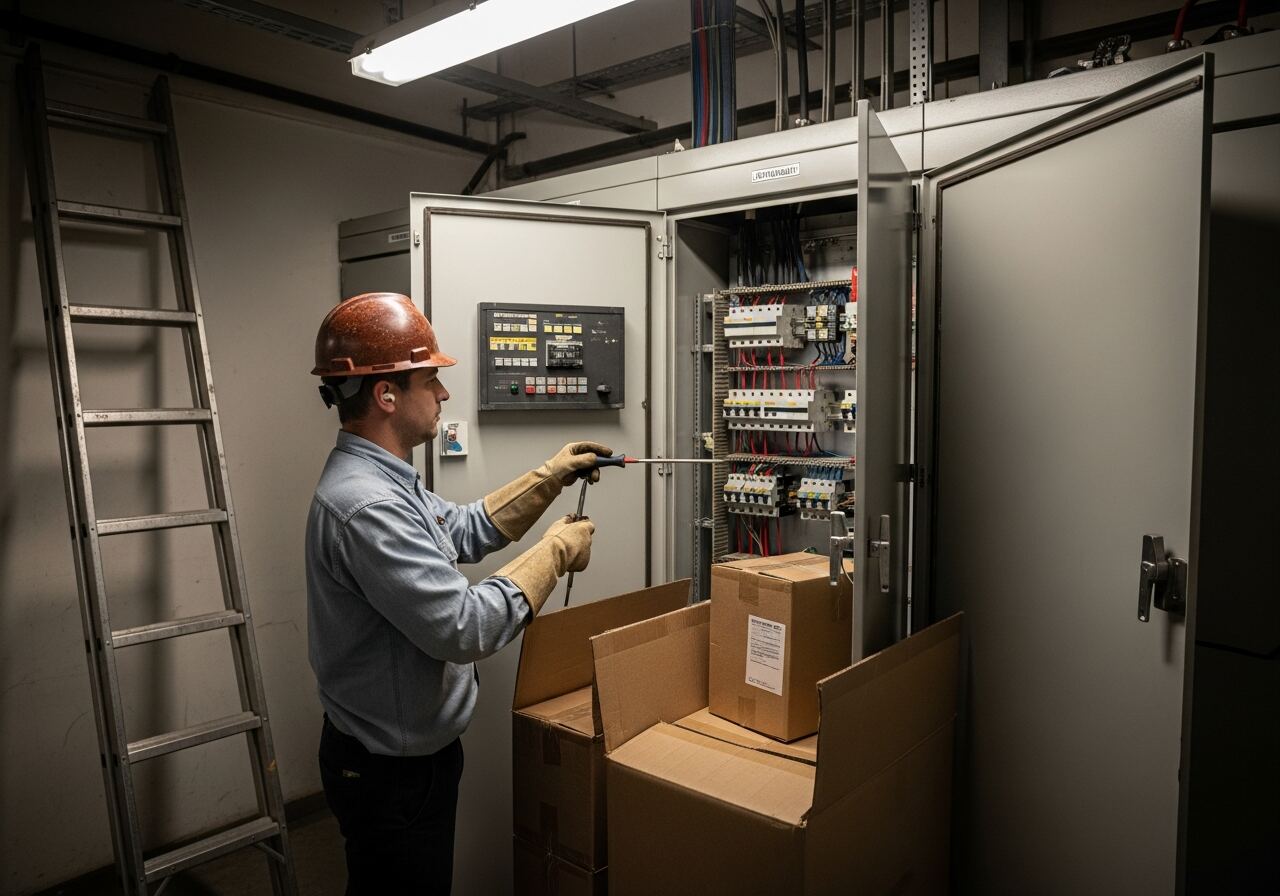
Scan a photo like the one above and this is the report you get — score, findings, OSHA references, and fixes. It is an illustrative example, clearly marked — not live scan data.
Compliance score
55
Lower means more potential hazards found
5 potential hazards found
1Worker at an open energized-appearing panel in ordinary clothing — no arc-rated face shield or apparel visible
HighPossibly related to electrical safe work practices and PPE selection (29 CFR 1910.333, 1910.335)
Observed condition: If this panel is energized, an arc event at this distance would hit an unprotected face and cotton clothing — the difference between a scare and a fatal burn is the rated gear that isn't in the picture.
Corrective action: Stop energized work until it's justified in writing; de-energize and lock out if feasible, otherwise match arc-rated PPE and a face shield to the incident energy on the equipment label.
Medium confidenceNot fully clear from the photo — verify on site.
2Cardboard boxes stacked inside the working clearance in front of the open panel
MediumPossibly related to working space about electric equipment (29 CFR 1910.303(g))
Observed condition: Storage in the clearance zone slows escape during a fault, blocks emergency access to the disconnect, and adds fuel directly in front of the equipment most likely to ignite it.
Corrective action: Clear the required working space in front of the panel entirely and mark the floor so the clearance stays storage-free.
High confidence
Upload a photo like the one above and get a compliance score and hazard count in seconds. No account needed to scan — create a free account to unlock the full report.
Use the real site or facility name. If you save the scan after signup, it becomes the report name.
Three angles, one deeper scan
Only the wide shot is required — every extra angle gives the AI more places to look.
Required: Set the scene — one wide shot lets the AI sweep the whole area at once
Stand at the entry point and capture corner to corner: floors, ladders, scaffolds, and everyone at work
Drop a job-site photo or walkthrough video
Click to upload, drag & drop, or snap a photo on site. Photos scan free in about 15 seconds — no signup, no card. Video walkthroughs (up to 3 min) run on a free account.
Small habits, sharper scans
Set the scene
Start with context
Fill the frame
2–3 ft for close-ups; keep ladders, cords and workers fully in view.
Capture clearly
Make the frame usable
Light it right
Keep the sun or lights behind you — glare and shadows hide hazards.
Tap to focus
Tap the hazard on screen and hold still one second — blur can't be flagged.
Choose the useful view
Give the AI room to understand
Go landscape
Turn your phone sideways — a wider frame catches more of the scene.
Only upload photos you have permission to use, and avoid images showing personal, customer, or confidential information. Demo photos and results are held privately for up to 48 hours so you can save them to a free account; unclaimed photos are deleted automatically. Results are an AI-assisted preliminary review, not an official OSHA determination.
New: Video walkthrough scans
Record up to 3 minutes of your site — the AI extracts frames and flags every hazard with exact timestamps. Free account required.
Get the best results
Wide shot first
Stand at the entrance and photograph the entire work area so AI sees the full context
Hazard areas
Photograph elevated surfaces, equipment, electrical panels, and anywhere workers are active
Close-ups last
Move in close on anything damaged, missing, or that looks risky — the AI catches more detail
From the incident-energy study to the housekeeping in front of the panel. The first four are free — create a free account to unlock the rest and scan your own electrical areas.
Free checklist — 12 points
Enter your email to unlock the full checklist
We'll also send you a printable PDF copy — no account required.
One email with the checklist, one follow-up. Unsubscribe anytime.
OSHA Scan reads a single photo. That makes it fast and easy for anyone on site — but it also means it has real limits. Here's an honest look at both.
A scan is a fast first look, not the final word. Before treating this kind of area as safe, a competent person should still confirm:
OSHA's electrical safe work practices (29 CFR 1910.331–335) require de-energizing exposed live parts before work unless infeasible, and protecting workers with rated PPE, insulated tools, and safe approach practices when energized work is justified. OSHA doesn't prescribe the engineering details — employers typically use NFPA 70E's incident-energy analysis, boundaries, and PPE categories as the recognized method for meeting those obligations.
Only when de-energizing is infeasible or would create a greater hazard — troubleshooting that requires voltage is the classic example. That decision needs documentation, an energized work permit in most programs, a qualified worker, and PPE matched to the equipment's incident energy. 'The shutdown was inconvenient' does not qualify, and it's the justification OSHA rejects most often after an incident.
It can flag the visible precursors: open or uncovered equipment, missing arc-rated PPE on someone working at a panel, storage crowding the working clearance, and conductive ladders staged nearby. It cannot know whether a circuit is energized, what the incident energy is, or whether a permit exists — those need your qualified person. Use the scan as a fast first pass between formal electrical audits.
Reviewed by OSHA Scan Editorial
Last updated August 29, 2026
This content is produced by the OSHA Scan Editorial team and reviewed with AI assistance. It is general safety information, not legal or compliance advice. OSHA Scan is an independent tool and is not affiliated with, endorsed by, or certified by OSHA or the U.S. Department of Labor.
More ways to see what an AI OSHA scan can do for your site.
The overview hub — how the scanner works and every job, site, and hazard it covers.
The broader electrical scan — cords, GFCIs, panels, and wiring in any photo.
The de-energize-first discipline that makes most arc flash PPE unnecessary.
A walkthrough of how a routine panel task becomes an arc flash event.
See a complete labelled example of everything a scan returns.
Start with 5 included AI site scans plus a one-time 10-scan signup bonus — no credit card. Build JHA-ready reports and catch changing conditions sooner.
Start your free trial