
1
Set the scene
Start with context
Fill the frame
2–3 ft for close-ups; keep ladders, cords and workers fully in view.
For penalties assessable in 2026, OSHA's maximums are $16,550 per serious or other-than-serious violation, $165,514 per willful or repeated violation, and $16,550 per day for failure to abate past the deadline (amounts as of January 2026; they are adjusted periodically — check osha.gov/penalties for current figures). Citations multiply per violation and per instance, so one bad walkthrough can stack quickly. The cheapest penalty is the one that never happens: the checklist below targets the most-cited standards, and a free AI photo scan flags visible violations before an inspector does.
Free · No account needed to scan · Results in seconds
The maximums are only the ceiling. OSHA sets an actual penalty from the violation's gravity — how severe the harm could be and how likely it is — then adjusts for employer size, good faith, and history. Small employers can see significant reductions; a documented safety program and clean record pull the number down further. History cuts the other way: a substantially similar violation within five years can be classified as repeated, which moves the ceiling from $16,550 to $165,514 per violation. That is where multi-site employers get hurt — a condition cited at one location becomes a repeat exposure at every other location that never fixed the same thing.
The pattern behind most citations is mundane: the same handful of standards top OSHA's most-cited list every year — fall protection, hazard communication, ladders, scaffolding, lockout/tagout, respiratory protection, powered industrial trucks, machine guarding. Nearly all of them are visible violations: a missing guardrail, an unlabeled drum, a worker off tie-off. That is exactly what a photo scan is for — catching the citable condition on Tuesday instead of during the inspection on Thursday, with a time-stamped record that you look for and fix these things.
OSHA adjusts proposed penalties from the violation's gravity score using four factors: the severity of potential injury, the likelihood that an injury would occur, the employer's size (with reductions available for employers with 250 or fewer employees), the employer's compliance history, and demonstrated good faith. The gravity-based penalty before adjustments can be up to $16,550 for a serious violation and $16,550 per day for a failure-to-abate after a citation is issued. Willful violations — where the employer knew about a hazard and made a deliberate choice not to correct it — carry a minimum of $11,524 and maximum of $165,514 per violation. A fatality following a willful violation can also trigger criminal referral.
The repeat-violation classification is where multi-location employers face the greatest financial exposure. OSHA defines a repeat violation as a substantially similar violation cited within the previous five years at any of the employer's worksites — not just the same location. For companies with operations across multiple states, a citation in one state can make an identical condition in another state a repeat violation. State-plan states set their own maximum penalties but must be 'at least as effective' as federal OSHA; several — including California, Washington, and Oregon — have higher per-violation maximums than the federal standard. Documenting a proactive inspection and correction program is the primary evidence OSHA accepts for good-faith reductions.
What the AI looks for in a photo, mapped to the standards that top OSHA's citation list year after year.
Unprotected edges, missing guardrails, uncovered holes, and workers without visible fall arrest — 1926.501 has been the most-cited standard for over a decade.
Unlabeled and unreadable chemical containers — the label half of HazCom, a perennial top-three citation.
Missing hard hats and eye protection, plus ladder misuse — overreaching, wrong ladder, damaged rails — all visible in a single frame.
Every scan is a time-stamped record of self-inspection and correction — the good-faith evidence OSHA weighs when setting penalties.
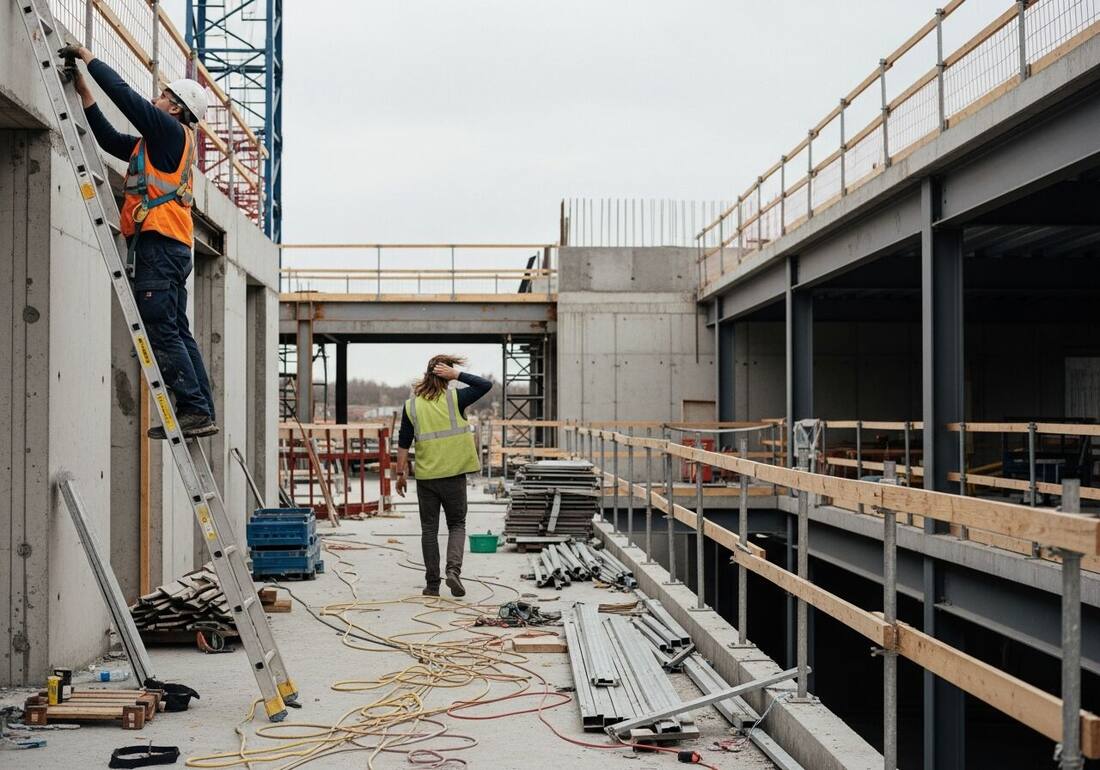
Scan a photo like the one above and this is the report you get — score, findings, OSHA references, and fixes. It is an illustrative example, clearly marked — not live scan data.
Compliance score
34
Lower means more potential hazards found
6 potential hazards found
1Worker on the upper section of a leaning ladder, overreaching to work one-handed
CriticalPossibly related to ladder use requirements (29 CFR 1926.1053(b))
Observed condition: Overreaching from a ladder shifts the center of gravity outside the rails — the classic setup for the falls that make ladders a fixture on the most-cited list.
Corrective action: Stop the work, reposition the ladder so the task stays between the rails, maintain three-point contact, and verify the ladder is secured and properly angled.
High confidence
2Worker in the walkway below overhead work with no hard hat
HighPossibly related to head protection (29 CFR 1926.100)
Observed condition: Anyone passing under overhead work is exposed to dropped tools and material; head protection citations are among the easiest for an inspector to document from the ground.
Corrective action: Require hard hats in the area, post it, and control access under active overhead work.
High confidence
3Extension cords and metal stock strewn across the pedestrian walkway
MediumPossibly related to housekeeping and passageways (29 CFR 1926.25)
Observed condition: Cluttered passageways are low-dollar citations that add up per instance — and the trip-and-fall injuries behind them are anything but low-dollar.
Corrective action: Clear the walkway, re-route cords along edges or overhead, and stage material in the laydown area instead of the path.
High confidence
Upload a photo like the one above and get a compliance score and hazard count in seconds. No account needed to scan — create a free account to unlock the full report.
Use the real site or facility name. If you save the scan after signup, it becomes the report name.
Three angles, one deeper scan
Only the wide shot is required — every extra angle gives the AI more places to look.
Required: Set the scene — one wide shot lets the AI sweep the whole area at once
Stand at the entry point and capture corner to corner: floors, ladders, scaffolds, and everyone at work
Drop a job-site photo or walkthrough video
Click to upload, drag & drop, or snap a photo on site. Photos scan free in about 15 seconds — no signup, no card. Video walkthroughs (up to 3 min) run on a free account.
Small habits, sharper scans
Set the scene
Start with context
Fill the frame
2–3 ft for close-ups; keep ladders, cords and workers fully in view.
Capture clearly
Make the frame usable
Light it right
Keep the sun or lights behind you — glare and shadows hide hazards.
Tap to focus
Tap the hazard on screen and hold still one second — blur can't be flagged.
Choose the useful view
Give the AI room to understand
Go landscape
Turn your phone sideways — a wider frame catches more of the scene.
Only upload photos you have permission to use, and avoid images showing personal, customer, or confidential information. Demo photos and results are held privately for up to 48 hours so you can save them to a free account; unclaimed photos are deleted automatically. Results are an AI-assisted preliminary review, not an official OSHA determination.
New: Video walkthrough scans
Record up to 3 minutes of your site — the AI extracts frames and flags every hazard with exact timestamps. Free account required.
Get the best results
Wide shot first
Stand at the entrance and photograph the entire work area so AI sees the full context
Hazard areas
Photograph elevated surfaces, equipment, electrical panels, and anywhere workers are active
Close-ups last
Move in close on anything damaged, missing, or that looks risky — the AI catches more detail
Built from the standards OSHA cites most. The first four are free — create a free account to unlock the rest and scan your own site for the same violations.
Unprotected edges and holes
Guardrails on open sides six feet up, covers secured and labeled over floor holes — fall protection (1926.501) tops the citation list every year.
Fall arrest actually anchored
Harnesses tied off to rated anchorage, not draped over a shoulder or clipped to guardrail mesh; a worn-but-unanchored harness is still a citable exposure.
Chemical labels complete and legible
Every container carries a readable label with a product identifier; unlabeled secondary containers are the HazCom citation inspectors find fastest.
SDS access verified
Workers can pull a safety data sheet for any chemical during their shift without barriers — the other half of the perennial HazCom citation.
OSHA Scan reads a single photo. That makes it fast and easy for anyone on site — but it also means it has real limits. Here's an honest look at both.
A scan is a fast first look, not the final word. Before treating this kind of area as safe, a competent person should still confirm:
For penalties assessable in 2026: up to $16,550 per serious or other-than-serious violation, up to $165,514 per willful or repeated violation, and up to $16,550 per day for failure to abate beyond the deadline. These are the levels in effect as of January 2026 (unchanged from 2025); OSHA adjusts amounts periodically for inflation, so verify current figures at osha.gov/penalties. Actual assessed penalties are frequently lower after adjustments for gravity, employer size, good faith, and history.
The same standards dominate the most-cited list year after year: fall protection (1926.501) at the top for over a decade, with hazard communication, ladders, scaffolding, lockout/tagout, respiratory protection, powered industrial trucks, fall protection training, eye and face protection, and machine guarding rounding out the familiar top ten. Most are visible conditions — which is why photo-based self-inspection catches so many of them.
Yes. You can request an informal conference with the OSHA area director, and you have 15 working days from receiving the citation to file a written notice of contest, which sends the case to the independent review commission. Many employers resolve citations at the informal conference with penalty reductions or amended abatement dates. For a specific citation, involve counsel — this page is general information, not legal advice.
It can influence them. OSHA's penalty structure includes adjustments for good faith — evidence of an effective safety program, like documented self-inspections with corrected findings. The bigger effect is upstream: sites that inspect and fix on a schedule simply have fewer citable conditions on the day an inspector arrives.
Reviewed by OSHA Scan Editorial
Last updated August 29, 2026
This content is produced by the OSHA Scan Editorial team and reviewed with AI assistance. It is general safety information, not legal or compliance advice. OSHA Scan is an independent tool and is not affiliated with, endorsed by, or certified by OSHA or the U.S. Department of Labor.
Free PDF checklist
33 critical checks across 7 categories — the same visible gaps the AI scanner looks for. Sent to your inbox as a free PDF.
More ways to see what an AI OSHA scan can do for your site.
The overview hub — how the scanner works and every job, site, and hazard it covers.
Pick a violation type and count — see your maximum 2026 exposure in dollars.
The full self-inspection walkthrough that catches violations before they're citations.
A deep dive on the standard OSHA cites more than any other.
The written programs and records that count as good faith when penalties are set.
See a complete labelled example of everything a scan returns.
Start with 5 included AI site scans plus a one-time 10-scan signup bonus — no credit card. Build JHA-ready reports and catch changing conditions sooner.
Start your free trial