
1
Set the scene
Start with context
Fill the frame
2–3 ft for close-ups; keep ladders, cords and workers fully in view.
A crane and rigging inspection verifies that the lift is planned and the gear can take it: slings and hardware undamaged, the load rigged and balanced correctly, the swing path clear, and no one positioned under a suspended load. OSHA Scan adds a fast first pass — photograph the lift area and the AI flags visible problems like workers standing beneath a load, visibly frayed or cut slings, and missing tag lines, referencing the OSHA standard each issue may relate to. It is an AI-assisted preliminary review of what is visible in the photo, not a formal compliance determination or a substitute for a qualified rigger.
Free · No account needed to scan · Results in seconds
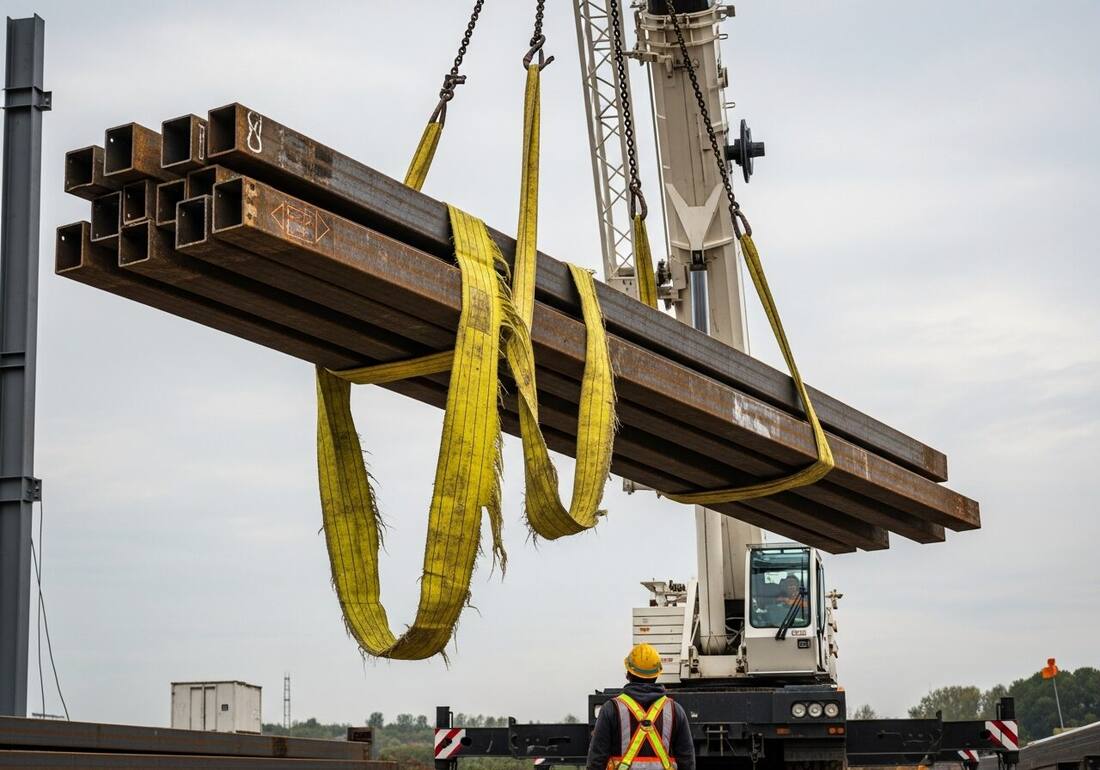
Most serious lifting incidents are visible before the pick: a sling with cut or frayed webbing that stayed in the basket one job too long, a load with no tag line to control the swing, or a crew member cutting under the load path to save thirty seconds. A rigging checklist covers all of it — but on a moving site, the pre-lift check competes with the schedule, and the schedule usually wins.
A photo scan lowers the bar: snap the lift area before the pick and get an immediate second opinion on what is visible — sling condition, load position, people in the fall zone — plus the checklist items a qualified rigger still needs to verify by hand, like rated capacities, hitch selection, and hook latch function. It turns the pre-lift walkaround into a ten-second habit instead of a skipped form.
OSHA's cranes and derricks standard (29 CFR 1926.1400) significantly overhauled crane safety requirements when it took effect in 2010, introducing operator qualification and certification requirements, annual equipment inspections by a qualified person, and assembly and disassembly director requirements. The operator certification requirement remains one of the standard's most-cited provisions — employers must verify that each operator is qualified for the specific crane type and capacity they are operating, not just hold a general crane certification. OSHA also requires a written lift plan for certain lifts (critical lifts and lifts in close proximity to power lines), and documented inspection records for each piece of crane equipment.
Rigging inspection requirements under 1926.1413 and 1926.1416 require qualified riggers to inspect slings, shackles, hooks, and lifting equipment before each shift and before each lift for hooks on the load block. The standard of 'qualified rigger' — a person who by possession of a recognized degree, certificate, or professional standing, or by extensive knowledge, training, and experience, has successfully demonstrated the ability to solve problems relating to rigging — is evaluated by the inspector based on the person's ability to identify damaged rigging and make competent remove-from-service decisions. OSHA has issued significant citations under the crane standard following crane collapses and struck-by fatalities, and these incidents consistently reveal documentation failures alongside physical ones.
Visible lift-setup and gear-condition issues the AI checks in a photo of the pick.
Workers standing or walking beneath a suspended load, or inside the swing path where a shifting load could strike them.
Frayed, cut, or abraded synthetic slings, kinked wire rope, and webbing with exposed core yarns apparent in the photo.
Loads that appear tilted or poorly seated in the slings, point loading on edges without softeners, and missing tag lines.
Cluttered landing zones, unbarricaded swing radii, and material staged where the load must travel over people or equipment.
Scan a photo like the one above and this is the report you get — score, findings, OSHA references, and fixes. It is an illustrative example, clearly marked — not live scan data.
Compliance score
32
Lower means more potential hazards found
5 potential hazards found
1Worker positioned directly beneath the suspended load
CriticalPossibly related to fall zone requirements for hoisted loads (29 CFR 1926.1425)
Observed condition: If a sling, hitch, or hook fails, anyone under the load has no time to react — struck-by incidents during lifts are among the most severe on any site.
Corrective action: Stop the lift, move all personnel out of the fall zone, and barricade the area under the load path before continuing.
High confidence
2Synthetic lifting slings with visibly frayed, stringy webbing
HighPossibly related to rigging equipment inspection (29 CFR 1926.251)
Observed condition: Frayed webbing and exposed yarns mean the sling has lost an unknown share of its rated capacity and can fail without warning under load.
Corrective action: Land the load, remove the damaged slings from service and tag them, and re-rig with slings that pass a hands-on inspection.
High confidence
Upload a photo like the one above and get a compliance score and hazard count in seconds. No account needed to scan — create a free account to unlock the full report.
Use the real site or facility name. If you save the scan after signup, it becomes the report name.
Three angles, one deeper scan
Only the wide shot is required — every extra angle gives the AI more places to look.
Required: Set the scene — one wide shot lets the AI sweep the whole area at once
Stand at the entry point and capture corner to corner: floors, ladders, scaffolds, and everyone at work
Drop a job-site photo or walkthrough video
Click to upload, drag & drop, or snap a photo on site. Photos scan free in about 15 seconds — no signup, no card. Video walkthroughs (up to 3 min) run on a free account.
Small habits, sharper scans
Set the scene
Start with context
Fill the frame
2–3 ft for close-ups; keep ladders, cords and workers fully in view.
Capture clearly
Make the frame usable
Light it right
Keep the sun or lights behind you — glare and shadows hide hazards.
Tap to focus
Tap the hazard on screen and hold still one second — blur can't be flagged.
Choose the useful view
Give the AI room to understand
Go landscape
Turn your phone sideways — a wider frame catches more of the scene.
Only upload photos you have permission to use, and avoid images showing personal, customer, or confidential information. Demo photos and results are held privately for up to 48 hours so you can save them to a free account; unclaimed photos are deleted automatically. Results are an AI-assisted preliminary review, not an official OSHA determination.
New: Video walkthrough scans
Record up to 3 minutes of your site — the AI extracts frames and flags every hazard with exact timestamps. Free account required.
Get the best results
Wide shot first
Stand at the entrance and photograph the entire work area so AI sees the full context
Hazard areas
Photograph elevated surfaces, equipment, electrical panels, and anywhere workers are active
Close-ups last
Move in close on anything damaged, missing, or that looks risky — the AI catches more detail
Run these points before every pick. The first four are free — create a free account to unlock the full checklist and scan your own lift setups.
Free checklist — 12 points
Enter your email to unlock the full checklist
We'll also send you a printable PDF copy — no account required.
One email with the checklist, one follow-up. Unsubscribe anytime.
OSHA Scan reads a single photo. That makes it fast and easy for anyone on site — but it also means it has real limits. Here's an honest look at both.
A scan is a fast first look, not the final word. Before treating this kind of area as safe, a competent person should still confirm:
The core items are: sling and hardware condition, rated capacities against a known load weight, correct hitch and sling angles, a clear fall zone, tag line control, barricaded swing radius, stable crane setup, power line clearance, a designated signal person, and a prepared landing zone. A photo scan covers the visible setup items instantly; capacity math and hands-on gear checks still need a qualified rigger.
It checks what is visible: people under the load, obviously damaged slings, missing tag lines, tilted or edge-loaded rigging, and clutter in the lift area. It cannot read capacity tags at distance, verify load weight, or feel a cracked hook — so treat the scan as a fast first pass before the pick, not a replacement for the qualified rigger's inspection.
Cranes and derricks in construction live in 29 CFR 1926 Subpart CC (1926.1400 series — 1926.1425 covers keeping workers out of the fall zone), and rigging equipment for material handling is 29 CFR 1926.251. OSHA Scan references the standard each visible finding may relate to — the scan itself is a preliminary AI review, not an official determination.
Reviewed by OSHA Scan Editorial
Last updated August 29, 2026
This content is produced by the OSHA Scan Editorial team and reviewed with AI assistance. It is general safety information, not legal or compliance advice. OSHA Scan is an independent tool and is not affiliated with, endorsed by, or certified by OSHA or the U.S. Department of Labor.
More ways to see what an AI OSHA scan can do for your site.
The overview hub — how the scanner works and every job, site, and hazard it covers.
A deep dive on uncontrolled load swing and how to prevent it.
The struck-by hazards every overhead lift feeds into.
Scan the whole site, not just the lift.
The exclusion zones and line-of-fire rules around every lift.
See a complete labelled example of everything a scan returns.
Start with 5 included AI site scans plus a one-time 10-scan signup bonus — no credit card. Build JHA-ready reports and catch changing conditions sooner.
Start your free trial