
Contractor chemical management — who owns HazCom when multiple crews share a site
When a general contractor and several subs work one property, OSHA's hazard communication standard treats it as a multi-employer situation: each employer must inform the others about the hazardous chemicals its workers bring, share access to those safety data sheets and labels, and describe the precautions that go with them. Nobody gets to assume 'the other crew handles it.' The host employer needs a picture of every chemical on site; each contractor stays responsible for its own products, labeling, and training. OSHA Scan has no contractor upload portal — but each crew can scan its own products into its own organization in minutes, and a printed room or trailer QR poster gives everyone on site the same no-login view of what's stored there. Grab the free checklist below to run the exchange properly before mobilization.
Free · No account needed to scan · Results in seconds
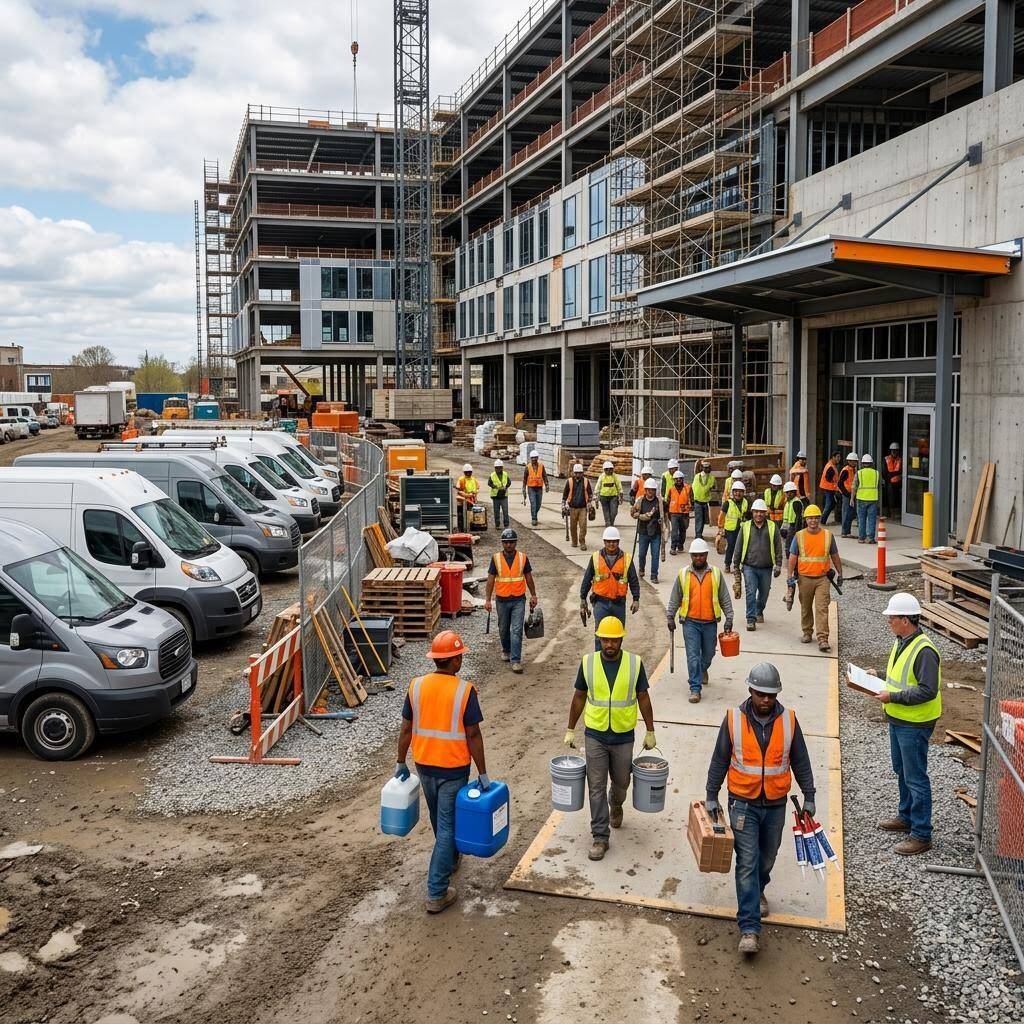
Four crews, one property, and a chemical picture nobody owns
A single job site can host an electrician staging solvents and contact cleaners, a painter with primers and thinners, a flooring crew running adhesives and reducers, and a cleaning company with concentrated disinfectants — each employer bringing its own chemicals, its own labels, and its own SDSs. OSHA's multi-employer HazCom duty is blunt about this: employers who use hazardous chemicals in a shared workplace must exchange information about those chemicals, provide access to each other's SDSs, describe the labeling systems in use, and explain the protective measures needed. The trouble is that on most sites, the chemical picture is owned by no one. The GC assumes the subs handle their own products; the subs assume the GC tracks the site; and the day a spill or an inspector arrives, nobody can produce a complete list.
The fix starts before anyone mobilizes. A pre-mobilization chemical list from each contractor tells the host what's coming, so incompatible products aren't stored side by side and emergency responders know what's on the property. OSHA Scan doesn't offer a contractor upload portal where subs feed into the GC's account — that feature doesn't exist, and we won't pretend it does. What works is honest and fast: each crew scans its own products into its own organization, building an SDS library its own workers can reach from any phone, and a printed room or trailer QR poster gives every person on site — regardless of employer — the same no-login view of the chemicals stored in that space. The checklist below walks the full exchange so the shared-site duty is met, not assumed.
Multi-employer citations in construction: how OSHA reads a shared chemical site
Construction sites are the archetypal multi-employer workplace, and OSHA's multi-employer citation policy shapes how hazard communication gets enforced when crews share a property. A compliance officer can issue citations under several roles: the employer whose workers are exposed, the employer who created the hazard, the employer responsible for correcting it, and — often the general contractor — the controlling employer with general supervisory authority over the site. In practice, that means an unlabeled drum or an unreachable SDS in a shared trailer can generate exposure and controlling-employer scrutiny at once, because the chemical belongs to one crew but endangers everyone working nearby.
Construction's HazCom standard applies the same GHS framework as general industry and expressly contemplates chemicals from different employers used in shared spaces. The information exchange isn't optional courtesy; it's the mechanism that keeps a painter's crew from being blindsided by a flooring adhesive's vapors, or a cleaning crew from mixing incompatible concentrates near another sub's oxidizers. The employers who avoid citations treat the exchange as a mobilization step: pre-mobilization chemical lists collected before work starts, a designated owner for the combined picture, and a shared access point every worker can use regardless of who signs their check. Keeping each crew's inventory current through label scans and posting a trailer QR view is a lightweight way to make that exchange real and demonstrable, without pretending any one tool erases each employer's own HazCom duty.
What a shared-site scan surfaces about the chemical picture
OSHA Scan reviews the visible conditions in a photo of a shared storage area or trailer — the concrete facts a multi-employer chemical exchange has to account for.
Mixed-employer storage
Flags containers of clearly different product types staged together — the tell of multiple crews sharing one trailer or room without a coordinated storage plan.
Unidentified staged products
Highlights containers with missing or unreadable labels that no crew has claimed — the orphaned products a shared site accumulates when ownership is fuzzy.
Shared access point
Notes whether an SDS access point is visible for the shared space — where a printed room or trailer QR poster would give every employer's workers the same view.
Incompatible-storage red flags
Surfaces visible arrangements — oxidizers near flammables, containers without containment — that arise when crews stack products without knowing what the others brought.
Demo: the library entry a scanned label comes back with
An illustrative example for this trade — product identity, signal word, GHS pictograms, and hazard statements, filed and searchable.
Solvent-based construction adhesive
Example manufacturer
The adhesive a subcontractor carries onto a shared site is exactly the chemical the GC needs on the inventory with an SDS before crews overlap.
- H225 — Highly flammable liquid and vapour
- H336 — May cause drowsiness or dizziness
Now scan your own label — free
Photograph any chemical product on your shelf. The AI transcribes the label in seconds — no account needed to try it.
- The multi-employer chemical-information exchange OSHA expects between host and contractors
- A pre-mobilization chemical-list approach so nobody arrives with a surprise product
- Honest notes: no contractor portal, but each crew scans its own products and shares a room QR view
Free · No account needed to scan · Results in seconds
The contractor chemical management checklist
How host and contractor employers run the multi-employer HazCom exchange on a shared site. The first four are free — leave your email to unlock the rest and set up the exchange before mobilization.
Free checklist — 12 points
Enter your email to unlock the full checklist
We'll also send you a printable PDF copy — no account required.
One email with the checklist, one follow-up. Unsubscribe anytime.
What the AI can and can't detect
OSHA Scan reads a single photo. That makes it fast and easy for anyone on site — but it also means it has real limits. Here's an honest look at both.
What it can catch from a photo
- Mixed-employer product types staged together in a shared space
- Unlabeled or unclaimed containers on the site
- Whether a shared SDS access point is visible for the space
- Visible incompatible-storage arrangements between crews' products
What a photo can't tell it
- Whether the multi-employer information exchange actually happened
- Which contractor owns which staged container
- Whether each crew trained its own workers on shared-site hazards
- Whether a pre-mobilization chemical list was collected
Always confirmed by a person on site
A scan is a fast first look, not the final word. Before treating this kind of area as safe, a competent person should still confirm:
- Every contractor provided a pre-mobilization chemical list to the host
- SDS access was exchanged both ways for shared-space chemicals
- Each crew keeps responsibility for its own inventory, labeling, and training
- The combined chemical picture is documented and updated as crews rotate
People also ask
Who is responsible for HazCom when contractors bring chemicals to a site?
Responsibility is shared, not transferred. Under OSHA's multi-employer HazCom provisions, each employer remains responsible for its own workers' training, labeling, and SDSs, and every employer using hazardous chemicals in the shared workplace must inform the others about those chemicals, provide SDS access, and describe the precautions and labeling systems involved. The host or general contractor coordinates the exchange and typically owns the combined site picture, but a sub can't hand off its HazCom duty to the GC, and vice versa.
What is a pre-mobilization chemical list and why does it matter?
It's a list each contractor provides before arriving on site, naming the hazardous chemicals it plans to bring, by product and manufacturer. It matters because it lets the host plan storage so incompatible products aren't staged together, ensures emergency responders know what's on the property, and gives every crew advance notice of hazards they'll work near. Collecting it up front is far easier than reconstructing a chemical picture after products are already scattered across the job.
Does OSHA Scan have a contractor upload portal for the general contractor's account?
No — there is no portal where subcontractors feed chemicals into the GC's organization, and we won't imply otherwise. The honest workflow is different and still fast: each crew scans its own products into its own OSHA Scan organization in minutes, building an SDS library its workers reach from any phone. For the shared exchange, a printed room or trailer QR poster gives every person on site — no matter their employer — the same no-login view of the chemicals stored in that space.
How do workers from different crews reach the SDS for another crew's chemical?
That's exactly what the shared access point solves. If several employers store products in one trailer or room, a worker who's exposed to a neighbor crew's chemical still needs to reach its SDS. A printed QR poster for that space lists every chemical stored there — signal word, pictograms, hazards, precautions, and the attached SDS PDFs — and any worker can scan it on a phone with no login. That satisfies the 'readily accessible during the shift' expectation across employer lines.
Does the general contractor have to track every subcontractor's chemicals?
The GC generally needs to know what hazardous chemicals are on the property and coordinate the information exchange, but it isn't required to absorb each sub's labeling and training obligations. Think of it as owning the combined picture, not doing everyone's HazCom for them. A practical split: subs keep their own scanned inventories current, the GC collects pre-mobilization lists and maintains the shared access point, and the exchange is documented so the shared-site duty is demonstrable.
Reviewed by OSHA Scan Editorial
Last updated August 29, 2026
This content is produced by the OSHA Scan Editorial team and reviewed with AI assistance. It is general safety information, not legal or compliance advice. OSHA Scan is an independent tool and is not affiliated with, endorsed by, or certified by OSHA or the U.S. Department of Labor.
Keep exploring
More ways to see what an AI OSHA scan can do for your site.
The AI OSHA inspection tool
The overview hub — how the scanner works and every job, site, and hazard it covers.
SDS scanner
Each crew scans its own products to build the inventory the shared exchange draws on.
SDS management for construction
How construction crews keep SDSs organized and reachable across changing job sites.
OSHA compliance checklist
The broader administrative checklist multi-employer HazCom fits inside.
Chemical inventory list
Building the per-crew inventory that feeds the combined site chemical picture.
OSHA — 1910.1200 Hazard Communication
The standard's text, including the multi-employer information-exchange duty in paragraph (e).
Official resource — osha.govA full sample report
See a complete labelled example of everything a scan returns.
Ready to secure your job sites?
Start with 5 included AI site scans plus a one-time 10-scan signup bonus — no credit card. Build JHA-ready reports and catch changing conditions sooner.
Start your free trial