
1
Set the scene
Start with context
Fill the frame
2–3 ft for close-ups; keep ladders, cords and workers fully in view.
An HVAC job hazard analysis (JHA — the same document OSHA also calls a JSA) breaks an HVAC task into steps and names the hazard and control for each one: rooftop unit access, LOTO before electrical work, refrigerant handling, attic and mechanical-room confined spaces, rigging a unit into place, and brazing or other hot work. OSHA Scan does not write the whole JHA for you — it reads a photo of the actual task and drafts the visible hazards, each tied to the OSHA standard it may relate to, with a reason and a suggested fix. Photograph the rooftop, the open air handler, or the mechanical room and the AI returns a scored draft in seconds. It is a free first look — a second set of eyes for the competent person, never a replacement.
Free · No account needed to scan · Results in seconds
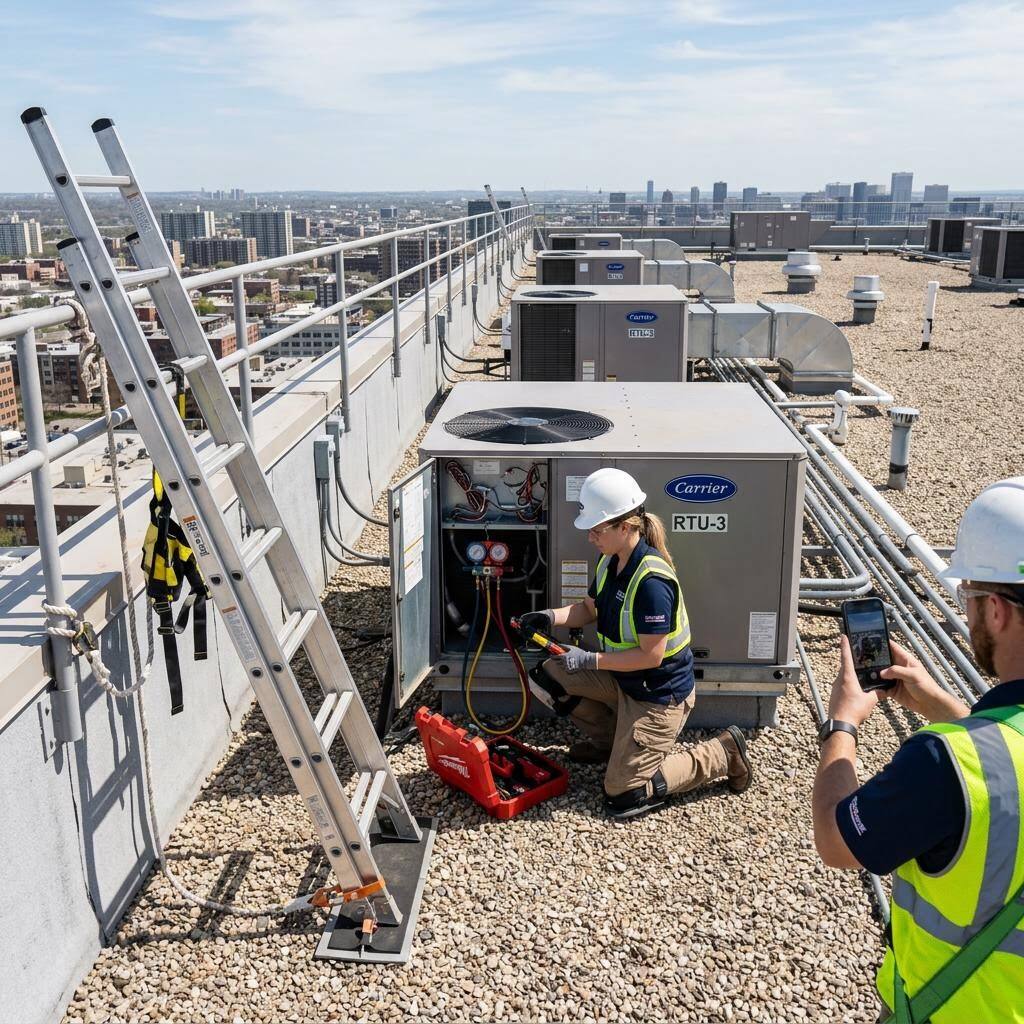
HVAC work is not one hazard — it is a chain of very different tasks, and a job hazard analysis is supposed to follow that chain step by step. Getting to a rooftop packaged unit is a fall-and-ladder problem. Opening the disconnect on a condenser is a lockout/tagout and electrical problem. Recovering refrigerant in a tight mechanical room is a confined-space and asphyxiation problem. Setting a new air handler is a rigging problem. Brazing a line set is a hot-work problem. A single template JHA that lists 'wear gloves, watch your step' for all of that protects nobody, because it never describes the task in front of the crew.
OSHA Scan does not try to author the whole analysis from a dropdown. It reads a photo of one task and drafts the hazards the camera can actually see: the technician near an unguarded roof edge, the ladder set at the wrong angle to the hatch, the open panel with no lock on the disconnect, the tools crowding the walkway on the roof. Each drafted finding names the OSHA standard it may relate to, why it matters, and a control to consider — the hazard-and-control columns of the JHA, grounded in this job instead of a library.
The competent person still owns the analysis. They break the task into its steps, verify every drafted finding on the spot, and add everything a photo cannot show — whether the circuit is truly de-energized, the atmosphere in a mechanical room, the weight and rigging plan for a unit. Each scan saves as a dated, scored report, findings become corrective actions with owners, a re-scan after the fix documents the correction, and the whole thing exports to PDF or Excel for the JHA form your program already files.
There is no OSHA standard that says 'HVAC contractors must complete a job hazard analysis.' JHA (which OSHA treats as identical to a JSA) is a strongly recommended practice described in OSHA Publication 3071 — and OSHA even publishes a free JHA template you can download and use. The one hazard-assessment requirement that does carry the force of a standard is narrower: 29 CFR 1910.132(d) requires the employer to assess the workplace for hazards that need PPE and to certify that assessment in writing. That PPE hazard assessment is a real, citable requirement; a formal task JHA, while excellent practice, is not itself mandated.
That distinction matters for how you use this page. The value of an HVAC JHA is not that a rule forces it — it is that HVAC tasks span fall protection, electrical, LOTO, confined space, and rigging, and a step-by-step analysis is the cleanest way to catch the control each step needs before the crew is committed. OSHA Scan speeds the hazard-identification part of that work; it does not turn a recommended practice into a compliance verdict, and it does not replace the written PPE assessment your program owes under 1910.132(d).
Which OSHA standards apply to an HVAC task depends on the setting, and the difference is not cosmetic. Service and maintenance work in an existing building is usually general industry (29 CFR 1910): rooftop fall protection reads to 1910.28, and permit-required confined spaces read to 1910.146. Installation and construction work on a project site is usually construction (29 CFR 1926): fall protection reads to 1926.501, ladders to 1926.1053, aerial and scissor lifts to 1926.453, and construction confined spaces to 1926 Subpart AA (1926.1200 series) rather than 1910.146.
A JHA that names the wrong citation is not automatically wrong about the hazard — the fall risk on a roof edge is the same either way — but it signals that the document was copied rather than thought through. The scan phrases every reference as a possible relationship for the competent person to confirm against the actual setting, and the manual-verification list flags exactly this: decide whether the task is general industry or construction before you settle the citations.
A photo is a strong first pass for the visible half of an HVAC JHA: fall exposure on a roof, ladder setup, an open panel, housekeeping in the walk path, a missing lock on a disconnect. It is useless for the invisible half. It cannot confirm a circuit is de-energized after LOTO, measure the oxygen or refrigerant concentration in a mechanical room or attic, feel the stored pressure in a charged line, verify a rigging plan for the weight of a unit, or tell whether a hot-work permit and fire watch are in place off-frame.
So use the scan for what it is and no more: photograph the setup for each task, get the drafted visible-hazard list, verify each finding at the spot, and add the atmospheric, electrical, pressure, and rigging judgments that only a qualified person can make. Try the loop on a photo of your own rooftop unit or mechanical room below — it is free and takes about a minute.
Run through these steps before crews start — each one covers a visible gap the AI can help you catch.
Name the distinct tasks in the job in sequence — roof access, lockout/tagout, opening the unit, refrigerant recovery, rigging the swap, brazing, start-up — then break each task into its own ordered steps. Finer steps expose hazards that a one-line task description hides.
For getting to and working on a rooftop unit, confirm the fall-protection method on the work path (guardrail, warning line, or personal fall arrest to a rated anchor) and the ladder angle and securement at the hatch. Fall exposure may relate to 29 CFR 1910.28 or 1926.501; ladders to 1926.1053.
Make lockout/tagout the written first step before any hands enter a condenser or air handler — de-energizing may relate to 29 CFR 1910.147, and only a meter confirms zero energy. For refrigerant recovery in a tight mechanical room, decide whether the space is permit-required (1910.146 or the 1926.1200 series) and plan ventilation.
Photograph the roof edge and unit, the open panel and disconnect, the ladder at the hatch, and the mechanical room, and upload each to OSHA Scan. The AI drafts the visible hazards it can see, notes the OSHA standard each may relate to, and suggests a control — treat every finding as a draft to verify on site. Free, no account needed.
Walk to each drafted finding and confirm it in context, add the hazards a photo cannot show (energized-circuit status, atmosphere, stored pressure, rigging loads, fire watch), turn accepted findings into assigned corrective actions, and export the dated JHA to PDF or Excel for your program's file. A JHA that is not read is not a control.
One frame of the task — rooftop unit, open air handler, mechanical room, or lift — is what comes back as drafted JHA content.
Work near unprotected roof edges on the path to a packaged unit, ladder angle and securement at the hatch, and aerial/scissor-lift setup for elevated access.
Open disconnects and panels at condensers and air handlers with no visible lock or tag, exposed live parts, and cord condition around the unit.
Cylinders stored without valve caps, work in tight mechanical rooms and attics, and the housekeeping and access conditions of an enclosed space.
Brazing near combustibles without a visible fire watch or barrier, and how a unit is staged, slung, or landed during a lift.
Scan a photo like the one above and this is the report you get — score, findings, OSHA references, and fixes. It is an illustrative example, clearly marked — not live scan data.
Compliance score
58
Lower means more potential hazards found
8 potential hazards found
1Technician working on a rooftop unit within a few feet of an unguarded roof edge
CriticalPossibly related to walking-working surface fall protection (29 CFR 1910.28) — or 29 CFR 1926.501 if the work is construction
Observed condition: A fall from a low-slope roof is the leading cause of HVAC fatalities, and a technician focused on a unit near an unprotected edge has nothing to arrest a stumble or a backward step off the parapet.
Corrective action: Establish a guardrail or a warning line set back from the edge on the work path, or put each tech in a harness clipped to a rated anchor, and write the chosen fall-protection method into that step of the JHA.
Medium confidenceNot fully clear from the photo — verify on site.
2Condenser disconnect open with no visible lock or tag while a tech works at the unit
HighPossibly related to the control of hazardous energy — lockout/tagout (29 CFR 1910.147)
Observed condition: An unlocked disconnect can be re-energized by anyone at the panel while hands are inside the unit — the whole point of LOTO is to make that impossible, and a photo cannot confirm the circuit is actually dead.
Corrective action: Apply a lock and personal tag to the disconnect, verify zero energy with a meter, and make LOTO the written first step of any electrical task in the JHA — then confirm de-energization manually on site.
Medium confidenceNot fully clear from the photo — verify on site.
3Ladder to the roof hatch set at a shallow angle and not secured at the top
HighPossibly related to portable ladder use (29 CFR 1926.1053) — or the general industry ladder rule 1910.23
Observed condition: A ladder at the wrong angle or unsecured at a hatch is the most common way HVAC techs fall during access — the failure happens at the transition on and off the roof, hands full of tools.
Corrective action: Set the ladder at roughly a 4:1 angle, extend it about 3 feet above the landing, and tie it off at the top; note the securement method in the access step of the JHA.
High confidence
4Tools, hoses, and packaging staged across the walk path on the roof
MediumPossibly related to housekeeping requirements (29 CFR 1926.25) — or the general industry equivalent 1910.22
Observed condition: On a roof, a trip is not just a fall to the deck — near an edge or a skylight it can become the fatal fall, and clutter in the path is the easiest hazard on this page to remove.
Corrective action: Stage tools and materials in a defined area clear of the walk path and away from edges and skylights, and add a keep-the-path-clear check to the JHA before the task starts.
High confidence
Upload a photo like the one above and get a compliance score and hazard count in seconds. No account needed to scan — create a free account to unlock the full report.
Use the real site or facility name. If you save the scan after signup, it becomes the report name.
Three angles, one deeper scan
Only the wide shot is required — every extra angle gives the AI more places to look.
Required: Set the scene — one wide shot lets the AI sweep the whole area at once
Stand at the entry point and capture corner to corner: floors, ladders, scaffolds, and everyone at work
Drop a job-site photo or walkthrough video
Click to upload, drag & drop, or snap a photo on site. Photos scan free in about 15 seconds — no signup, no card. Video walkthroughs (up to 3 min) run on a free account.
Small habits, sharper scans
Set the scene
Start with context
Fill the frame
2–3 ft for close-ups; keep ladders, cords and workers fully in view.
Capture clearly
Make the frame usable
Light it right
Keep the sun or lights behind you — glare and shadows hide hazards.
Tap to focus
Tap the hazard on screen and hold still one second — blur can't be flagged.
Choose the useful view
Give the AI room to understand
Go landscape
Turn your phone sideways — a wider frame catches more of the scene.
Only upload photos you have permission to use, and avoid images showing personal, customer, or confidential information. Demo photos and results are held privately for up to 48 hours so you can save them to a free account; unclaimed photos are deleted automatically. Results are an AI-assisted preliminary review, not an official OSHA determination.
New: Video walkthrough scans
Record up to 3 minutes of your site — the AI extracts frames and flags every hazard with exact timestamps. Free account required.
Get the best results
Wide shot first
Stand at the entrance and photograph the entire work area so AI sees the full context
Hazard areas
Photograph elevated surfaces, equipment, electrical panels, and anywhere workers are active
Close-ups last
Move in close on anything damaged, missing, or that looks risky — the AI catches more detail
This is the task-analysis method, not a repeat of the equipment walk-through on our HVAC safety inspection checklist page. Work each task's steps in order. The first few points are free — create a free account to unlock the full method and scan your own HVAC photos.
List the tasks in the job, in order
Roof access, LOTO, open the unit, recover refrigerant, rig the swap, braze the line set, start-up. A JHA follows the job's sequence — name each distinct task before you analyze any of it.
Break each task into its own steps
For 'access the roof': stage the ladder, tie it off, climb, transition at the hatch. Finer steps expose the hazard that a one-line task description hides.
Photograph each task's setup before work starts
Frame the roof edge and unit, the open panel and disconnect, the ladder at the hatch, the mechanical-room access. The scan drafts from the relationships in the frame, not close-ups.
Analyze the rooftop-access task for falls and ladders
Confirm the fall-protection method on the work path (guardrail, warning line, or personal fall arrest to a rated anchor) and the ladder angle and securement. Fall exposure may relate to 1910.28 or 1926.501; ladders to 1926.1053.
OSHA Scan reads a single photo. That makes it fast and easy for anyone on site — but it also means it has real limits. Here's an honest look at both.
A scan is a fast first look, not the final word. Before treating this kind of area as safe, a competent person should still confirm:
It is a step-by-step review of an HVAC task that names the hazard and the control for each step — the same document OSHA also calls a job safety analysis (JSA). Because HVAC work spans very different tasks (rooftop access, LOTO, refrigerant, confined space, rigging, brazing), a good HVAC JHA is built task by task rather than from one generic form.
No OSHA standard requires a job hazard analysis for HVAC work. The JHA is a recommended practice described in OSHA Publication 3071, and OSHA publishes a free JHA template you can use. The one related requirement with the force of a standard is the written PPE hazard assessment under 29 CFR 1910.132(d), which is separate from — and not satisfied by — a task JHA.
You photograph the task's setup — the rooftop unit and edge, the open panel and disconnect, the ladder at the hatch, the mechanical room — and the AI drafts the visible hazards, each with the OSHA standard it may relate to, why it matters, and a suggested control. That is the hazard-and-control content for that step. The competent person then adds the job's steps, verifies each finding, and adds what the camera cannot see.
The HVAC safety inspection checklist walks the equipment and space — refrigerant storage, panels, CO, drain pans — as a condition check. This page is the task-by-task hazard analysis: it follows the steps of a specific job (access, LOTO, recovery, rigging, brazing) and drafts the hazards for each step. Use the checklist to inspect the site; use the JHA to plan the task.
It depends on whether the work is general industry or construction. Common references include fall protection (1910.28 or 1926.501), portable ladders (1926.1053 or 1910.23), lockout/tagout (1910.147), permit-required confined spaces (1910.146, or the 1926.1200 series in construction), and aerial/scissor lifts (1926.453). The scan phrases each as a possible relationship for the competent person to confirm against the actual setting — never a compliance verdict.
No. It is a second set of eyes for the visible hazards, not a replacement. The scan cannot confirm a circuit is de-energized, measure an atmosphere, feel stored pressure, or judge a rigging plan, and it has no authority on your site. The competent person breaks the job into steps, verifies every drafted finding, adds the invisible hazards, and signs off.
Reviewed by OSHA Scan Editorial
Last updated August 29, 2026
This content is produced by the OSHA Scan Editorial team and reviewed with AI assistance. It is general safety information, not legal or compliance advice. OSHA Scan is an independent tool and is not affiliated with, endorsed by, or certified by OSHA or the U.S. Department of Labor.
Free PDF checklist
33 critical checks across 7 categories — the same visible gaps the AI scanner looks for. Sent to your inbox as a free PDF.
More ways to see what an AI OSHA scan can do for your site.
The overview hub — how the scanner works and every job, site, and hazard it covers.
The equipment-and-space condition check that pairs with this task analysis.
The general photo-to-JHA drafting workflow behind this page.
The JHA method in depth, for any trade.
De-energizing condensers and air handlers before electrical work.
Ladder setup and securement for rooftop and attic access.
Flag panel gaps and LOTO issues at HVAC equipment from a photo.
OSHA's free guide and template for building a job hazard analysis — the recommended practice this page speeds up.
Official resource — osha.govSee a complete labelled example of everything a scan returns.
Start with 5 included AI site scans plus a one-time 10-scan signup bonus — no credit card. Build JHA-ready reports and catch changing conditions sooner.
Start your free trial