1
Set the scene
Start with context
Fill the frame
2–3 ft for close-ups; keep ladders, cords and workers fully in view.
Catch the exposure before the panel explodes
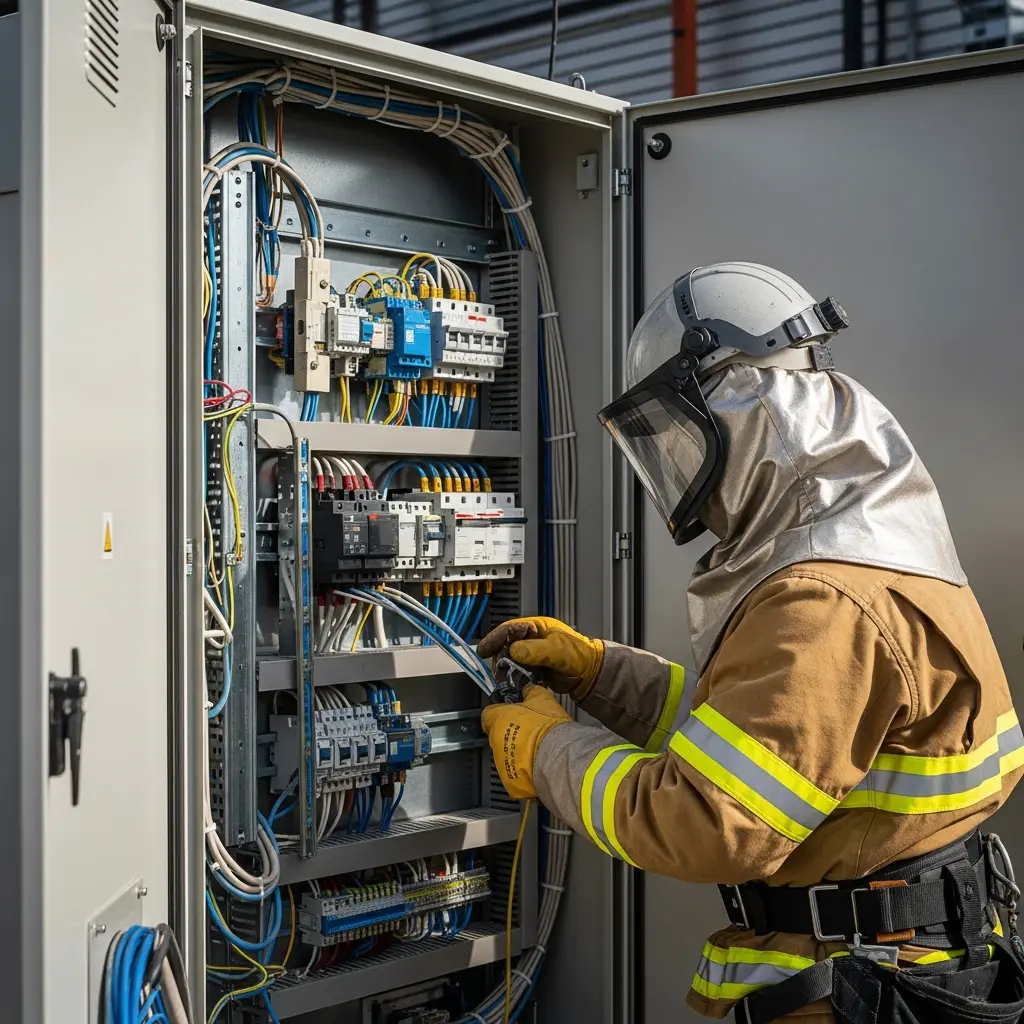
An arc flash can reach 35,000°F, vaporize copper, and hurl a pressure blast and molten metal at anyone nearby — in a fraction of a second and with no warning. The burns are catastrophic and often fatal. OSHA Scan analyzes photos of electrical work to flag open live panels, missing arc-rated PPE, and workers inside the arc-flash boundary before an incident occurs.
Free · No account needed to scan · Results in seconds
May relate to 29 CFR 1910.333
Arc flash temperature — hotter than the sun's surface
Arc flash incidents per day in the US
Typical cost of treating a single arc-flash burn
Typical time to get scan results
An arc flash is an explosive release of energy caused by a fault between energized conductors or a conductor and ground. It produces intense heat, blinding light, a pressure wave (arc blast), and a spray of molten metal and shrapnel. It is one of the most violent hazards a worker can face and can occur while operating, testing, or working near energized equipment.
On site the hazard shows up as an open live panel or switchgear with a worker in front of it, energized work performed without an established arc-flash boundary, missing or mismatched arc-rated clothing and face protection, dropped tools bridging bus bars, and no evidence of an energized-work permit or de-energization. Dust, corrosion, loose connections, and rodent damage inside gear all raise the odds of a fault.
The trap is that arc flash is instantaneous and silent until it happens. A worker can stand at a panel a thousand times with no incident — until one loose connection, dropped tool, or insulation failure triggers a blast that burns them before they can blink. That is why verifying de-energization, boundaries, and PPE from a photo before the work is so valuable.
Here is what an OSHA Scan report looks like for arc flash incident. It is an illustrative example built from this scenario's hazards — clearly marked, not live scan data.
Compliance score
47
Lower means more potential hazards found
3 potential hazards found
Arc Flash Incident
CriticalPossibly related to Selection and use of work practices (electrical) (29 CFR 1910.333)
Observed condition: An arc flash is an explosive release of energy caused by a fault between energized conductors or a conductor and ground.
Corrective action: De-energize and lock out equipment before work whenever feasible
High confidence
Arc Flash Incident: Safeguards for personnel protection
HighPossibly related to Safeguards for personnel protection (29 CFR 1910.335)
Observed condition: Requires electrical protective equipment and PPE, including arc-rated protection, and barriers or alerting techniques to protect workers from electrical and arc-flash hazards.
Corrective action: Install arc-resistant switchgear and remote racking/operation devices
Medium confidenceNot fully clear from the photo — verify on site.
Arc Flash Incident: Personal protective equipment — general requirements
MediumPossibly related to Personal protective equipment — general requirements (29 CFR 1910.132)
Observed condition: Requires hazard assessment and selection of appropriate PPE, the basis for matching arc-rated clothing to the calculated incident energy.
Corrective action: Apply arc-energy-reducing settings and current-limiting protection
High confidence
Arc flash causes severe third-degree burns, blindness, hearing loss, lung damage, and death. The arc blast can throw a worker across a room and drive shrapnel into the body.
Energized-work and PPE violations draw heavy OSHA enforcement. A serious violation runs over $16,000, willful violations exceed $160,000, and a single arc-flash burn can cost over a million dollars to treat and litigate.
An arc flash destroys equipment, can start fires, and shuts down power and production. Investigation, gear replacement, and downtime compound the human cost dramatically.
Electricians, maintenance techs, data-center and utility workers, and manufacturing crews work on or near energized gear daily, where incident-energy levels demand strict boundaries and arc-rated PPE.
OSHA Scan uses an AI vision model to assess arc-flash exposure. Upload a photo of the work and it identifies open live panels and switchgear, checks for arc-rated clothing, gloves, and face protection, flags workers inside the arc-flash boundary and missing barriers with a severity rating, and cites the OSHA standard it may relate to — before the work proceeds.
Analyze your first photo freeUpload a real job-site photo and OSHA Scan detects visible hazards in seconds — no account needed to run your first scan.
Use the real site or facility name. If you save the scan after signup, it becomes the report name.
Three angles, one deeper scan
Only the wide shot is required — every extra angle gives the AI more places to look.
Required: Set the scene — one wide shot lets the AI sweep the whole area at once
Stand at the entry point and capture corner to corner: floors, ladders, scaffolds, and everyone at work
Drop a job-site photo or walkthrough video
Click to upload, drag & drop, or snap a photo on site. Photos scan free in about 15 seconds — no signup, no card. Video walkthroughs (up to 3 min) run on a free account.
Small habits, sharper scans
Set the scene
Start with context
Fill the frame
2–3 ft for close-ups; keep ladders, cords and workers fully in view.
Capture clearly
Make the frame usable
Light it right
Keep the sun or lights behind you — glare and shadows hide hazards.
Tap to focus
Tap the hazard on screen and hold still one second — blur can't be flagged.
Choose the useful view
Give the AI room to understand
Go landscape
Turn your phone sideways — a wider frame catches more of the scene.
Only upload photos you have permission to use, and avoid images showing personal, customer, or confidential information. Demo photos and results are held privately for up to 48 hours so you can save them to a free account; unclaimed photos are deleted automatically. Results are an AI-assisted preliminary review, not an official OSHA determination.
New: Video walkthrough scans
Record up to 3 minutes of your site — the AI extracts frames and flags every hazard with exact timestamps. Free account required.
Get the best results
Wide shot first
Stand at the entrance and photograph the entire work area so AI sees the full context
Hazard areas
Photograph elevated surfaces, equipment, electrical panels, and anywhere workers are active
Close-ups last
Move in close on anything damaged, missing, or that looks risky — the AI catches more detail
An electrician opened an energized 480-volt panel to troubleshoot an intermittent fault, wearing only a standard uniform. He judged it a 'quick look' and did not establish an arc-flash boundary or don arc-rated gear.
While probing near the bus, his metal test lead slipped and bridged two phases, triggering an arc flash. The blast caused severe burns to his face, arms, and torso, and the pressure wave ruptured an eardrum.
A single photo of the open live panel run through OSHA Scan would have flagged the energized work without arc-rated PPE or an established boundary as a critical arc-flash hazard, cited 29 CFR 1910.333, and prompted the electrician to de-energize and lock out or don full arc-rated protection under an energized-work permit before proceeding.
There is no 'quick look' at a live panel. Work de-energized whenever possible, and when energized work is truly necessary, an arc-flash boundary, permit, and arc-rated PPE are mandatory — a fast photo scan confirms they are in place.
Layered controls, from most to least effective.
Reduce or eliminate the arc energy a worker can be exposed to.
Govern energized work with permits, boundaries, and analysis.
Arc-rated protection matched to the calculated incident energy.
The federal standards this hazard may relate to.
Requires de-energizing circuits before work where possible and, when energized work is justified, safe work practices and protection against arc-flash and shock hazards.
Up to $16,550 per serious violation; $165,514 for willful or repeat
Requires electrical protective equipment and PPE, including arc-rated protection, and barriers or alerting techniques to protect workers from electrical and arc-flash hazards.
Up to $16,550 per serious violation
Requires hazard assessment and selection of appropriate PPE, the basis for matching arc-rated clothing to the calculated incident energy.
Up to $16,550 per serious violation
If an incident occurs, act fast and in order.
Workers will understand how arc flash occurs, recognize energized-work hazards and boundaries, and correctly select and use arc-rated PPE and safe work practices.
Train qualified workers before energized work, refresh at least every three years, and reinforce with a pre-task briefing using real photos of proper boundaries and PPE.
Run these checks to stay ahead of citations.
10 more checklist points are waiting. Register with your email to reveal every item and download the complete OSHA compliance checklist as a printable PDF. Free, and it only takes a few seconds.
Already have an account? Sign in
An arc flash is an explosive release of energy from an electrical fault, producing temperatures up to 35,000°F, a blinding flash, a pressure blast, and molten metal. It can cause fatal burns in a fraction of a second.
The arc-flash boundary is the distance from exposed energized parts within which a person could receive a second-degree burn from an arc flash. Only qualified workers in proper arc-rated PPE may cross it.
OSHA requires de-energizing whenever feasible (29 CFR 1910.333). Energized work is allowed only when de-energizing introduces greater hazard or is infeasible, and then only with an energized-work permit, boundaries, and arc-rated PPE.
PPE must be arc-rated at or above the calculated incident energy at the work distance, including arc-rated clothing or suit, face shield or hood, voltage-rated gloves with leather protectors, and hearing protection.
An arc-flash risk assessment calculates the incident energy (cal/cm²) at the working distance, which sets the minimum arc rating of clothing and PPE. Equipment should be labeled with this information under NFPA 70E.
Yes. Non-arc-rated clothing, especially synthetics, can ignite and melt onto the skin in an arc flash, dramatically worsening burns. Only arc-rated materials that self-extinguish should be worn for the task.
A serious violation can cost over $16,000, and willful or repeat violations can exceed $165,000 per instance. Arc-flash burns also lead to major medical costs, litigation, and long recoveries.
OSHA Scan flags arc-flash exposure. It checks for open live panels, arc-rated PPE, and boundary violations, returning the location and OSHA citation.
Upload a photo of your electrical work and get instant, specific feedback on arc-flash exposure and missing PPE.
Get startedPut our expert arc-flash checklist to work before your next energized task to stay ahead of burns and citations.
Get startedSee how OSHA Scan fits your electrical operation and get recommendations for your specific equipment.
Get startedSee how other crews use OSHA Scan to confirm boundaries and PPE before working on energized gear.
Get startedReview findings, organize chemical records, and open relevant official resources for your saved locations and work context.
You make the final call. Review, edit, or dismiss any AI-flagged hazard before finalizing your inspection report.
Scan chemical labels or upload legacy MSDS sheets to create structured drafts that support your team's search for and review of current official manufacturer Safety Data Sheets.
Open official OSHA and State Plan guidance, required posters, emergency contacts, and relevant publications for saved locations and work requirements.
OSHA Scan reads a single photo. That makes it fast and easy for anyone on site — but it also means it has real limits. Here's an honest look at both.
Reviewed by OSHA Scan Editorial
Last updated August 29, 2026
This content is produced by the OSHA Scan Editorial team and reviewed with AI assistance. It is general safety information, not legal or compliance advice. OSHA Scan is an independent tool and is not affiliated with, endorsed by, or certified by OSHA or the U.S. Department of Labor.
Start with 5 included AI site scans plus a one-time 10-scan signup bonus — no credit card. Build JHA-ready reports and catch changing conditions sooner.
Start your free trial