
1
Set the scene
Start with context
Fill the frame
2–3 ft for close-ups; keep ladders, cords and workers fully in view.
You prevent falls at height by putting a physical barrier between the worker and the edge before work starts: a guardrail on every open side and hole, then personal fall arrest or a safety net where a guardrail cannot go, backed by trained crews and inspected ladders. Falls are the leading cause of construction fatalities per OSHA, and almost all of them share the same visible causes — a missing guardrail, an unclipped harness, an uncovered floor hole, a ladder used wrong. OSHA Scan lets you photograph the elevated work area and get an instant read on those visible fall hazards, the OSHA fall-protection standard each may relate to, and a suggested fix. It is an AI second set of eyes on your upload, not a replacement for the competent person who has to verify the anchor, the setup, and everything the camera cannot see.
Free · No account needed to scan · Results in seconds
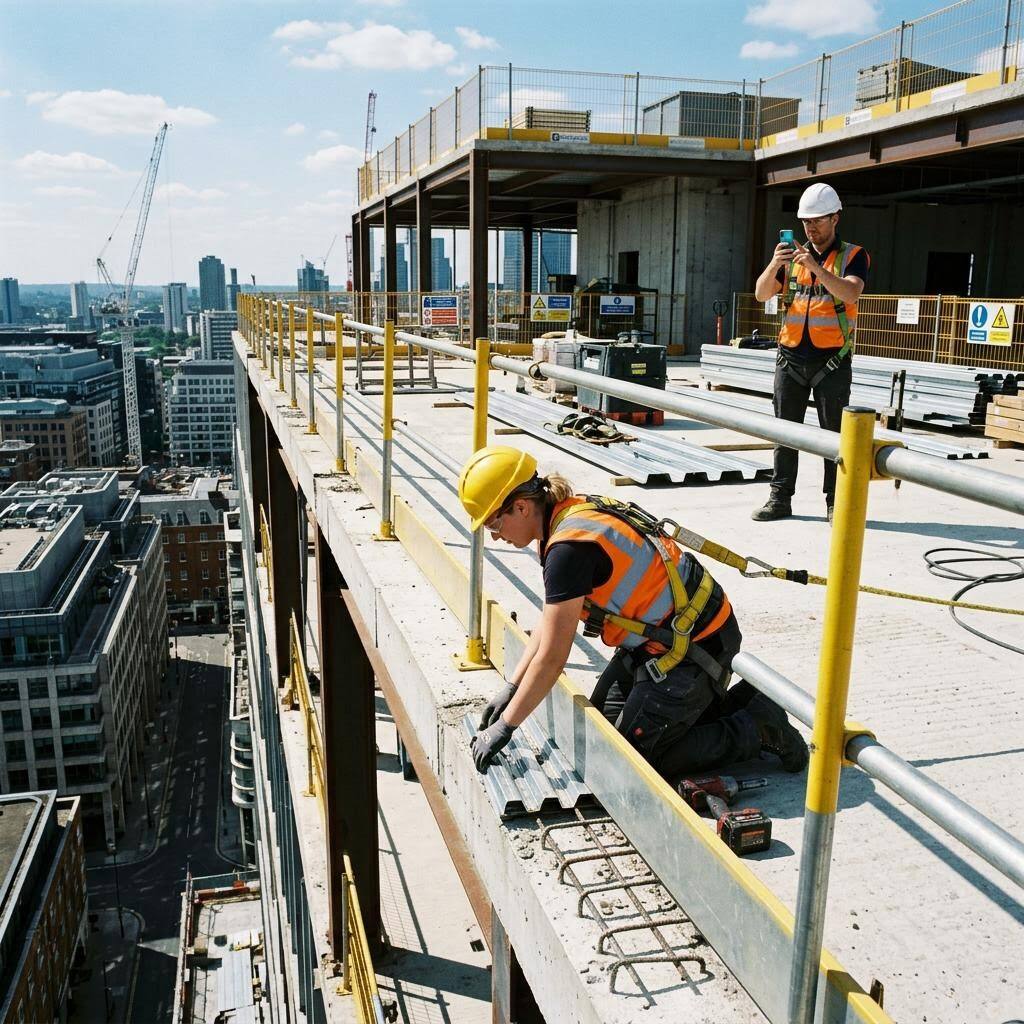
Fall prevention is not one control — it is an order of controls, and the order is what protects people. First, remove the exposure where you can: cover the hole, move the task to ground level, prefabricate at grade. Where the exposure stays, put a passive barrier in the way — a guardrail on the open side, a hole cover rated for the load, a warning line and monitor on a low-slope roof. Only when a guardrail genuinely cannot go there do you move to personal fall arrest: a full-body harness clipped to a rated anchor with a lanyard sized so the worker cannot reach the ground. Safety nets sit alongside arrest as a collective backup where individual tie-off is impractical. Passive first, because a guardrail protects everyone who walks past it without anyone remembering to clip in.
The reason falls stay the leading cause of construction fatalities is not that the controls are unknown — it is that they get skipped on the in-between tasks. The guardrail comes down for a material delivery and does not go back up. The harness is worn but the lanyard clips to a pipe instead of a rated anchor. The floor hole gets an unsecured piece of plywood instead of a marked, fastened cover. Every one of those is visible in a photo taken thirty seconds before the work.
That is where a photo check earns its place. Photograph the leading edge, the roof, the deck, or the ladder before the crew commits, and the scan reads what a guardrail-or-harness question really needs answered: is there a barrier on the open side, is the worker tied to something rated, is the hole covered and marked. It flags the visible gap, names the fall-protection standard it may relate to, and suggests the fix — then the competent person verifies the anchor rating and the fall-clearance math that no camera can measure.
In US construction, the trigger height is low: OSHA's Subpart M requires fall protection at 6 feet above a lower level (29 CFR 1926.501), with the criteria for each system — guardrail heights, arrest anchor strength, net clearances — spelled out in 1926.502, and the training that makes any of it work required by 1926.503. General industry uses a 4-foot trigger under 1926.501's counterpart at 29 CFR 1910.28. Portable ladders have their own rules under 1926.1053. None of these is optional above the trigger height, and the standard does not care which system you pick as long as it is one of the recognized ones, installed and used correctly.
The standards are also specific in ways that trip crews up. A guardrail's top rail sits about 42 inches high and has to withstand a 200-pound force; a personal fall arrest anchor has to hold 5,000 pounds per worker or be designed by a qualified person with a safety factor; a hole cover has to be secured and marked. A harness worn but clipped to an inadequate anchor is not fall protection — it is the appearance of it. This is exactly the gap a photo shows and a competent person confirms.
The fatal falls rarely happen during the planned, high-profile elevated work where everyone is watching. They cluster on the short-duration, low-visibility tasks: stepping onto a roof to check a flashing, reaching over a leading edge to guide a load, walking a deck where a hole cover was borrowed for another opening. On residential and light-commercial sites especially, the crew is small, there is no full-time safety officer, and the person setting the fall-protection standard is the same person swinging the hammer.
Skylights and floor holes are their own quiet killer. A skylight looks like a solid surface and is not; an uncovered or lightly covered floor opening reads as floor until someone steps on it. OSHA treats both as holes requiring a cover, a guardrail, or personal fall arrest — and both are easy to photograph and easy to miss in the rush. A pre-work scan of the deck or roof is a cheap way to catch the opening before a boot finds it.
A photo shows whether a barrier exists, whether a worker is clipped, whether a hole is covered. It cannot tell you whether the anchor is rated for 5,000 pounds, whether the lanyard length plus deceleration plus harness stretch clears the ground below, whether the plywood over that hole is fastened and load-rated, or whether the guardrail's top rail will hold 200 pounds. Those are measurements and verifications, not observations — and they are exactly what the competent person owns.
So use the scan for what it is: the fastest possible first pass on the visible half of fall prevention, followed by a walk. Photograph the setup, read the flagged gaps, verify each one at the edge, do the fall-clearance and anchor-rating checks by hand, and keep the dated record. Try that loop on a photo of your own elevated work area below — the scan is free and takes about a minute.
Run through these steps before crews start — each one covers a visible gap the AI can help you catch.
Before choosing equipment, look for ways to remove the hazard: cover the hole, prefabricate at ground level, or relocate the task off the edge. The safest fall protection is the exposure that no longer exists — controls only manage what you cannot eliminate.
Put a guardrail with a top rail near 42 inches and a mid rail on every open side 6 feet or more above a lower level, and cover, secure, and mark every floor hole and skylight. Passive barriers may relate to 29 CFR 1926.501 and the criteria in 1926.502.
Where the edge cannot be guarded, put each worker in a full-body harness clipped to an anchor rated for 5,000 lb per worker or engineered by a qualified person, and confirm the lanyard length clears the level below. Arrest criteria may relate to 29 CFR 1926.502(d).
Confirm ladders are free of cracked rails and missing rungs, set at a 4:1 angle, extended 3 feet above the landing, and secured — and that no one stands on the top cap. Portable ladder use may relate to 29 CFR 1926.1053.
Photograph the leading edge, roof, deck, or ladder and upload it to OSHA Scan for an AI second pass. The AI flags the visible fall hazards it can see, notes the OSHA standard each may relate to, and suggests a fix — treat the findings as a draft the competent person verifies on site. Free, no account needed.
The visible half of fall prevention — barriers, tie-off, holes, and ladders — read from one image.
Unguarded leading edges, missing or removed top and mid rails, open-sided platforms and decks, and low-slope roof edges with no barrier or warning line.
Workers at height with no harness, a harness worn but not clipped, or a lanyard tied off to piping or scaffold instead of a visibly rated anchor point.
Uncovered or unsecured floor openings, plywood covers with no fastening or marking, and skylights on roofs with no guard, screen, or cover.
Ladders at the wrong angle, not extended above the landing, standing on the top cap, or set up as the access to elevated work without securing.
Scan a photo like the one above and this is the report you get — score, findings, OSHA references, and fixes. It is an illustrative example, clearly marked — not live scan data.
Compliance score
47
Lower means more potential hazards found
6 potential hazards found
1Worker at the leading edge of an elevated deck with no guardrail on the open side
CriticalPossibly related to Duty to have fall protection (29 CFR 1926.501)
Observed condition: An unprotected edge more than 6 feet above a lower level is the single most common condition in construction fall fatalities — one misstep or lost balance with nothing in the way is a ground-level impact.
Corrective action: Install a guardrail with top rail near 42 inches and a mid rail on the open side before work continues; where a guardrail is impractical, put each worker in a harness clipped to a rated anchor. Have the competent person verify the system.
High confidence
2Full-body harness worn but lanyard clipped to a scaffold tube, not a rated anchor
HighPossibly related to fall arrest system criteria (29 CFR 1926.502(d))
Observed condition: A harness tied to a random structural member can shock-load a connection never designed for arrest forces — the worker feels protected while the anchor may fail on the first fall. Anchors must hold 5,000 lb per worker or be engineered.
Corrective action: Re-clip to a designated anchor point rated for 5,000 lb per attached worker, or one designed by a qualified person; confirm the anchor and lanyard length give adequate fall clearance to the level below.
Medium confidenceNot fully clear from the photo — verify on site.
3Floor opening covered with a loose, unmarked sheet of plywood
HighPossibly related to hole cover requirements (29 CFR 1926.501(b)(4) and 1926.502(i))
Observed condition: An unsecured cover shifts underfoot and an unmarked one invites material to be stacked on it or a worker to step across — a hole read as floor is how a routine walk becomes a fall through.
Corrective action: Secure the cover against displacement, mark it 'HOLE' or 'COVER', and confirm it is rated to support at least twice the intended load; replace ad-hoc plywood with a purpose-built cover.
Medium confidenceNot fully clear from the photo — verify on site.
Upload a photo like the one above and get a compliance score and hazard count in seconds. No account needed to scan — create a free account to unlock the full report.
Use the real site or facility name. If you save the scan after signup, it becomes the report name.
Three angles, one deeper scan
Only the wide shot is required — every extra angle gives the AI more places to look.
Required: Set the scene — one wide shot lets the AI sweep the whole area at once
Stand at the entry point and capture corner to corner: floors, ladders, scaffolds, and everyone at work
Drop a job-site photo or walkthrough video
Click to upload, drag & drop, or snap a photo on site. Photos scan free in about 15 seconds — no signup, no card. Video walkthroughs (up to 3 min) run on a free account.
Small habits, sharper scans
Set the scene
Start with context
Fill the frame
2–3 ft for close-ups; keep ladders, cords and workers fully in view.
Capture clearly
Make the frame usable
Light it right
Keep the sun or lights behind you — glare and shadows hide hazards.
Tap to focus
Tap the hazard on screen and hold still one second — blur can't be flagged.
Choose the useful view
Give the AI room to understand
Go landscape
Turn your phone sideways — a wider frame catches more of the scene.
Only upload photos you have permission to use, and avoid images showing personal, customer, or confidential information. Demo photos and results are held privately for up to 48 hours so you can save them to a free account; unclaimed photos are deleted automatically. Results are an AI-assisted preliminary review, not an official OSHA determination.
New: Video walkthrough scans
Record up to 3 minutes of your site — the AI extracts frames and flags every hazard with exact timestamps. Free account required.
Get the best results
Wide shot first
Stand at the entrance and photograph the entire work area so AI sees the full context
Hazard areas
Photograph elevated surfaces, equipment, electrical panels, and anywhere workers are active
Close-ups last
Move in close on anything damaged, missing, or that looks risky — the AI catches more detail
Walk the leading edges, roofs, decks, holes, and ladders with these points before elevated work starts. The first few are free — create a free account to unlock the full checklist and scan your own elevated-work photos.
A guardrail or barrier on every open side above the trigger height
Every open-sided surface and platform 6 feet or more above a lower level (4 feet in general industry) has a top rail near 42 inches and a mid rail, or an equivalent barrier, before anyone works near the edge.
Floor holes and openings covered, secured, and marked
Every hole a worker or material could fall through has a cover rated for at least twice the load, fastened against displacement, and marked — or a guardrail or personal fall arrest around it.
Skylights protected as the holes they are
Every skylight on a walking-working roof has a guard, a screen, or a cover, or workers near it are tied off — a skylight is never treated as a load-bearing surface.
Harnesses worn and clipped to a rated anchor
Where arrest is the chosen system, each worker wears a full-body harness clipped to an anchor rated for 5,000 lb per worker or engineered by a qualified person — never to piping, conduit, or a convenient tube.
OSHA Scan reads a single photo. That makes it fast and easy for anyone on site — but it also means it has real limits. Here's an honest look at both.
A scan is a fast first look, not the final word. Before treating this kind of area as safe, a competent person should still confirm:
Follow the order of controls: eliminate the exposure where you can, then use passive protection like guardrails and hole covers, then personal fall arrest and safety nets where a guardrail cannot go, all backed by trained workers and inspected ladders. Passive protection comes first because a guardrail protects everyone who passes it without anyone having to remember to clip in.
In construction, OSHA requires fall protection at 6 feet above a lower level under 29 CFR 1926.501, with system criteria in 1926.502 and training in 1926.503. General industry uses a 4-foot trigger under 29 CFR 1910.28. Certain work like scaffolds and steel erection has its own specific trigger heights. Above the trigger, a recognized system is required — it is not optional.
A guardrail is generally preferred because it is passive — it protects everyone near the edge without any action from the worker, and it prevents the fall rather than arresting it after it starts. Personal fall arrest with a harness is the right choice where a guardrail is impractical, but it depends on a rated anchor, correct fall clearance, and a rescue plan. Use the guardrail where you can and arrest where you must.
OSHA treats floor holes and skylights as holes requiring a cover, a guardrail, or personal fall arrest. A cover must be secured against displacement, marked, and rated to support at least twice the intended load. A skylight is never a walking surface — it needs a guard, screen, cover, or tie-off. The most common failure is a loose, unmarked sheet of plywood, which a photo scan flags easily.
Yes. 29 CFR 1926.503 requires that every worker exposed to fall hazards be trained by a competent person to recognize the hazards and correctly use the fall-protection systems in place, with retraining when conditions change. Equipment without training is not a complete control — a harness clipped to the wrong anchor is a common result of skipped training.
No. OSHA Scan is an AI second set of eyes on your uploaded photo — it flags visible fall hazards like missing guardrails, unclipped harnesses, and uncovered holes, and notes the standard each may relate to. It cannot verify an anchor rating, calculate fall clearance, or confirm a cover is fastened and load-rated. Fall-protection standards require a competent person with the authority to identify hazards and correct them, and no software has that authority on your site.
Reviewed by OSHA Scan Editorial
Last updated August 29, 2026
This content is produced by the OSHA Scan Editorial team and reviewed with AI assistance. It is general safety information, not legal or compliance advice. OSHA Scan is an independent tool and is not affiliated with, endorsed by, or certified by OSHA or the U.S. Department of Labor.
Free PDF checklist
33 critical checks across 7 categories — the same visible gaps the AI scanner looks for. Sent to your inbox as a free PDF.
More ways to see what an AI OSHA scan can do for your site.
The overview hub — how the scanner works and every job, site, and hazard it covers.
The hazard reference behind guardrails, arrest, nets, and holes.
A trade-specific JHA for roof work and its fall-protection steps.
The photo checklist for roof-edge, skylight, and access hazards.
Portable and fixed ladder practices for safe access to height.
Fall protection and guardrails on scaffold platforms.
The complete hub of every hazard type and industry the scanner covers.
OSHA's fall-protection standards, guidance, and the Subpart M requirements this page draws on.
Official resource — osha.govSee a complete labelled example of everything a scan returns.
Start with 5 included AI site scans plus a one-time 10-scan signup bonus — no credit card. Build JHA-ready reports and catch changing conditions sooner.
Start your free trial