
1
Set the scene
Start with context
Fill the frame
2–3 ft for close-ups; keep ladders, cords and workers fully in view.
There is no specific federal OSHA ergonomics standard — OSHA cites serious ergonomic hazards under the General Duty Clause (Section 5(a)(1)) and publishes industry guidelines instead. But musculoskeletal disorders remain among the most common serious workplace injuries, and the risk factors are visible: lifting with a fully bent back, loads held far from the body, overhead reaches to heavy items stored too high, repetitive twisting, and no carts or lift equipment anywhere near the manual handling. OSHA Scan reads a photo of material handling or workstation activity and flags those visible strain patterns with practical fixes. It is an AI-assisted first pass, not an ergonomic job analysis.
Free · No account needed to scan · Results in seconds
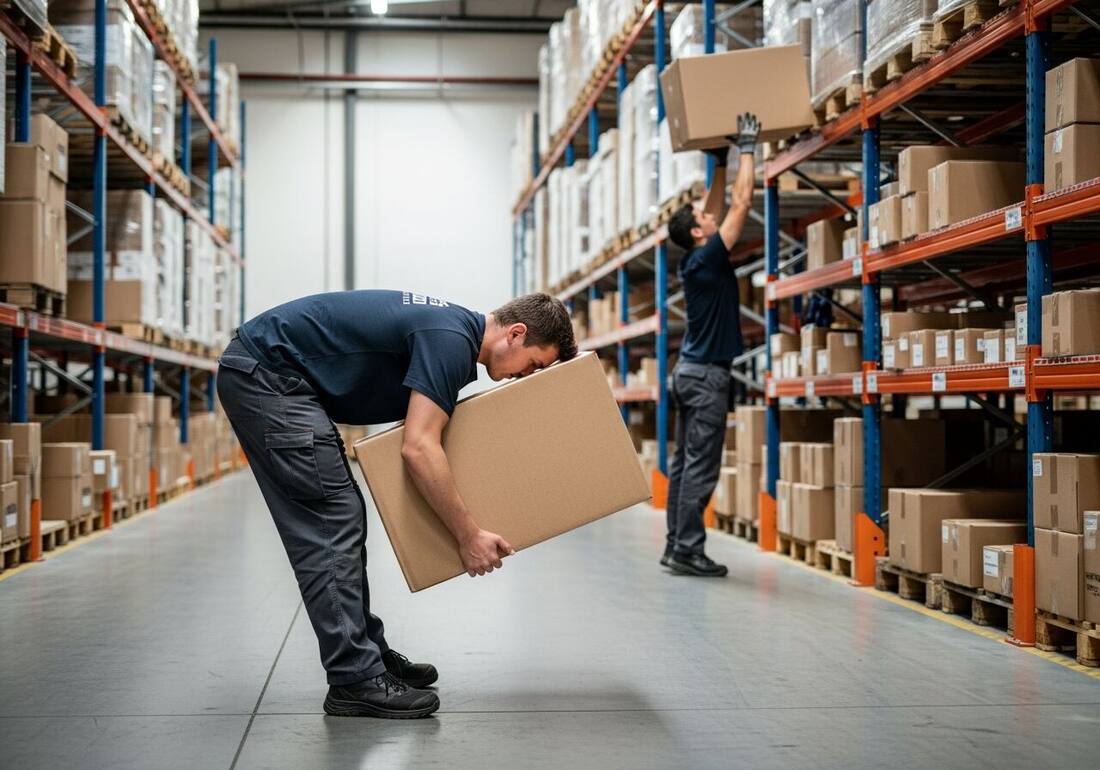
Musculoskeletal disorders — back injuries, shoulder tears, tendonitis — consistently rank among the most common serious workplace injuries, and they rarely come from a single dramatic event. They accumulate: a hundred bent-back lifts a shift, heavy items stored above shoulder height because that's where there was room, a workstation that forces the same twist every cycle. Because there's no specific federal standard, some employers assume ergonomics is unenforceable — but OSHA cites serious, recognized ergonomic hazards under the General Duty Clause, and workers' compensation costs for MSDs dwarf most citation amounts anyway.
The useful part is that the biggest risk factors photograph well. A worker mid-lift with a rounded back and the box a foot from his torso is a textbook frame. So is the tiptoe overhead pull of a heavy carton, the pallet stacked chest-high with no pallet jack in sight, and the workstation that puts the frequent-use bin at ankle height. Scanning real work as it happens catches the patterns a walkthrough misses — people pose for walkthroughs; they don't pose for the third hour of a shift. The checklist below adds the program pieces a camera can't see: job rotation, early symptom reporting, and workstation design reviews.
OSHA withdrew its comprehensive ergonomics standard in 2001, and no federal ergonomics standard exists for general industry. However, OSHA can and does cite ergonomic hazards under the general duty clause (Section 5(a)(1) of the OSH Act), which requires employers to provide a workplace free from recognized hazards likely to cause serious harm. General duty clause ergonomics citations require OSHA to demonstrate that the employer recognized the hazard (through injury rates, employee complaints, or industry knowledge), that the hazard was causing or likely to cause serious harm, and that a feasible means of abatement existed. These are significant evidentiary requirements, which is why general duty ergonomics citations are most common following investigations of high-rate musculoskeletal injury employers.
Several state-plan states have adopted their own ergonomics standards that go beyond the federal general duty clause. California's Title 8 Section 5110 (Repetitive Motion Injuries standard) requires employers with multiple employees experiencing work-related repetitive motion injuries to establish a Repetitive Motion Injury prevention program. Washington State's ergonomics rules (WAC 296-62-051) identify specific risk factors and require employers to take feasible steps to control them in jobs that exceed threshold exposure levels. These state-specific standards create different compliance obligations depending on where a facility is located — a program adequate under federal OSHA may not satisfy California or Washington requirements.
What the AI checks in a photo of lifting, carrying, or workstation activity.
Fully bent backs with straight legs, loads held far from the body, and lifts starting from floor level — the mechanics behind most back injuries.
Workers on tiptoes pulling heavy cartons from above shoulder height — heavy storage belongs between knee and shoulder.
Lifting combined with trunk rotation — moving a load by twisting instead of stepping multiplies spinal stress.
Heavy manual handling with no cart, dolly, pallet jack, or lift equipment anywhere in frame — strength substituting for equipment.
Scan a photo like the one above and this is the report you get — score, findings, OSHA references, and fixes. It is an illustrative example, clearly marked — not live scan data.
Compliance score
58
Lower means more potential hazards found
5 potential hazards found
1Worker lifting a large box from floor level with a fully rounded back, straight legs, and the load held away from his body
MediumPossibly related to recognized ergonomic hazards under the General Duty Clause (Section 5(a)(1)); see NIOSH lifting guidance
Observed condition: A rounded-back lift with the load away from the torso can multiply compressive force on the lower spine several times over — and this posture repeated across shifts is how most disabling back injuries are built.
Corrective action: Train and reinforce lifting with the load close, back neutral, and legs driving — and fix the source: stage heavy items off the floor at waist height and provide a cart or lift table for this task.
High confidence
2Worker on tiptoes reaching overhead to pull a heavy carton from a shelf above head height
MediumPossibly related to recognized ergonomic hazards (5(a)(1)) and safe material storage (29 CFR 1910.176)
Observed condition: Overhead pulls of heavy items load the shoulders at their weakest angle and put the worker under a falling load if the grip slips — two injuries in one reach.
Corrective action: Re-slot heavy items to between knee and shoulder height, keep lighter items up high, and stage a step platform or rolling ladder where overhead access is unavoidable.
High confidence
Upload a photo like the one above and get a compliance score and hazard count in seconds. No account needed to scan — create a free account to unlock the full report.
Use the real site or facility name. If you save the scan after signup, it becomes the report name.
Three angles, one deeper scan
Only the wide shot is required — every extra angle gives the AI more places to look.
Required: Set the scene — one wide shot lets the AI sweep the whole area at once
Stand at the entry point and capture corner to corner: floors, ladders, scaffolds, and everyone at work
Drop a job-site photo or walkthrough video
Click to upload, drag & drop, or snap a photo on site. Photos scan free in about 15 seconds — no signup, no card. Video walkthroughs (up to 3 min) run on a free account.
Small habits, sharper scans
Set the scene
Start with context
Fill the frame
2–3 ft for close-ups; keep ladders, cords and workers fully in view.
Capture clearly
Make the frame usable
Light it right
Keep the sun or lights behind you — glare and shadows hide hazards.
Tap to focus
Tap the hazard on screen and hold still one second — blur can't be flagged.
Choose the useful view
Give the AI room to understand
Go landscape
Turn your phone sideways — a wider frame catches more of the scene.
Only upload photos you have permission to use, and avoid images showing personal, customer, or confidential information. Demo photos and results are held privately for up to 48 hours so you can save them to a free account; unclaimed photos are deleted automatically. Results are an AI-assisted preliminary review, not an official OSHA determination.
New: Video walkthrough scans
Record up to 3 minutes of your site — the AI extracts frames and flags every hazard with exact timestamps. Free account required.
Get the best results
Wide shot first
Stand at the entrance and photograph the entire work area so AI sees the full context
Hazard areas
Photograph elevated surfaces, equipment, electrical panels, and anywhere workers are active
Close-ups last
Move in close on anything damaged, missing, or that looks risky — the AI catches more detail
From lift mechanics to storage heights and early reporting. The first four are free — create a free account to unlock the rest and scan your own material handling.
Free checklist — 12 points
Enter your email to unlock the full checklist
We'll also send you a printable PDF copy — no account required.
One email with the checklist, one follow-up. Unsubscribe anytime.
OSHA Scan reads a single photo. That makes it fast and easy for anyone on site — but it also means it has real limits. Here's an honest look at both.
A scan is a fast first look, not the final word. Before treating this kind of area as safe, a competent person should still confirm:
No — a federal ergonomics standard was issued in 2000 and repealed by Congress in 2001, and no replacement exists. OSHA instead publishes industry-specific guidelines and cites serious ergonomic hazards under the General Duty Clause, which requires a hazard that is recognized, causing or likely to cause serious harm, and feasibly correctable. In practice the bigger driver is cost: musculoskeletal disorders are among the most expensive injury categories in workers' compensation, so the business case usually arrives before the citation does.
Force, posture, repetition, and duration — usually in combination. The classic high-risk patterns: lifting from floor level with a bent back, holding loads away from the body, twisting while lifting, reaching overhead for heavy items, high-repetition motions without recovery, and long-duration static postures. Each factor multiplies the others, which is why the standard fixes attack the setup — storage heights, staging, carts — rather than just coaching technique.
It can flag the visible risk factors: a rounded-back lift in progress, an overhead pull of a heavy carton, twisting under load, and heavy handling with no mechanical aids in sight. It cannot weigh the load, count repetitions across a shift, or assess cumulative exposure — that's what an ergonomic job analysis does. Use scans to spot the obvious patterns in real work, then target formal analysis where the patterns cluster.
Reviewed by OSHA Scan Editorial
Last updated August 29, 2026
This content is produced by the OSHA Scan Editorial team and reviewed with AI assistance. It is general safety information, not legal or compliance advice. OSHA Scan is an independent tool and is not affiliated with, endorsed by, or certified by OSHA or the U.S. Department of Labor.
More ways to see what an AI OSHA scan can do for your site.
The overview hub — how the scanner works and every job, site, and hazard it covers.
The full facility scan — racking, forklifts, exits — around your manual handling.
The mechanical alternative to manual handling, with its own visible failure modes.
The general-duty framework OSHA uses where no specific standard applies.
See a complete labelled example of everything a scan returns.
Start with 5 included AI site scans plus a one-time 10-scan signup bonus — no credit card. Build JHA-ready reports and catch changing conditions sooner.
Start your free trial