
1
Set the scene
Start with context
Fill the frame
2–3 ft for close-ups; keep ladders, cords and workers fully in view.
A roofing job hazard analysis (JHA, also called a JSA) breaks a roofing task into steps and identifies the hazards at each one — and on a roof, that list is dominated by falls: ladder access, unprotected roof edges, skylights and roof openings, steep-slope work, plus material handling and heat. OSHA Scan lets a roofer or foreman photograph the setup — the ladder against the eave, the crew near the edge, the covered skylight — and get an instant read on the visible fall-protection gaps, the OSHA standard each may relate to, and a suggested fix. It is a browser web app that analyzes the photos you upload; the first scan is free with no account. It is a second set of eyes for the competent person, not a replacement, and no photo can confirm anchor ratings or what is under a fragile skylight.
Free · No account needed to scan · Results in seconds
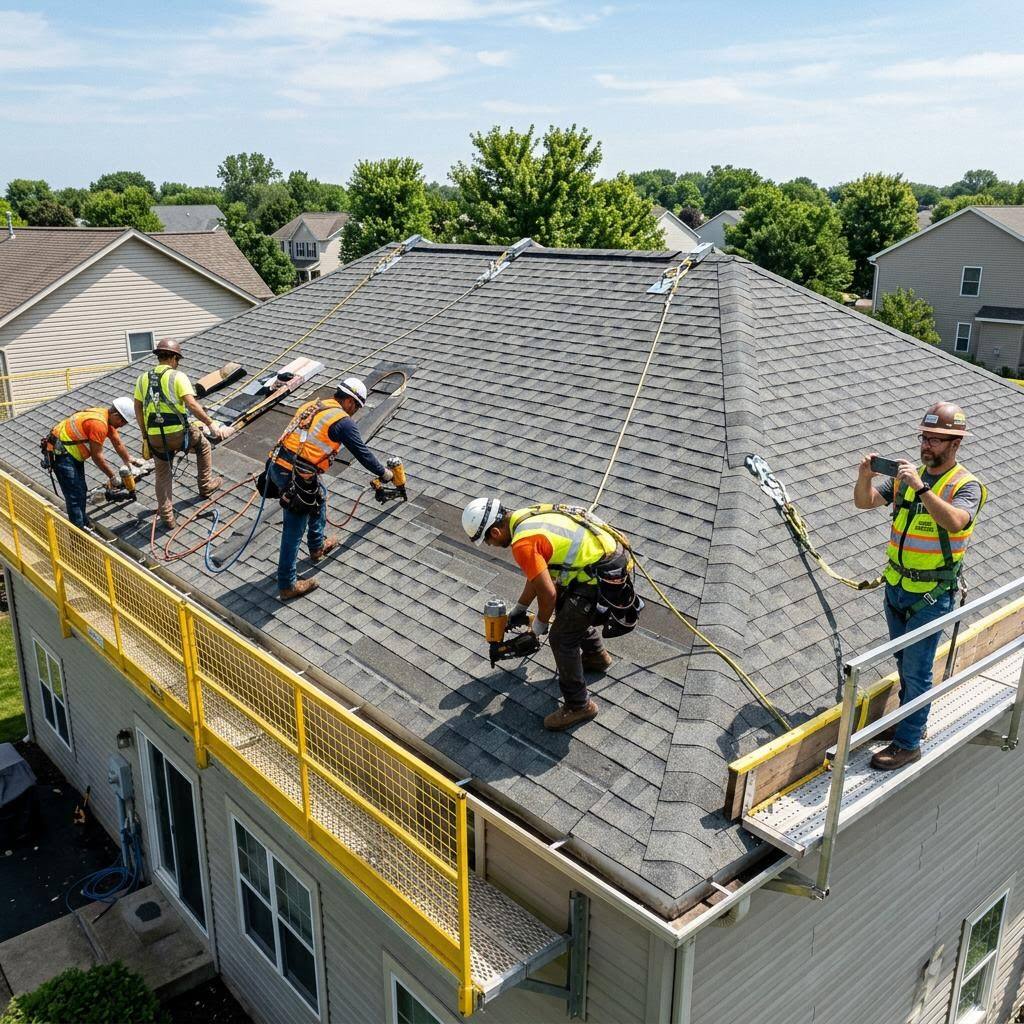
On most trades a job hazard analysis spreads across a dozen hazard families. Roofing is different: year after year, falls are the dominant way roofers are killed and seriously hurt, and nearly every line of a roofing JHA circles back to keeping a worker off the ground below. Ladder access to the roof, work at and near the eave and rake edges, holes and skylights waiting mid-deck, steep-slope footing, and the material handling that pulls a worker's balance toward an edge — that is the core of the analysis, and it is why a roofing JHA lives or dies on its fall-protection controls.
OSHA Scan reads the setup from a photo the foreman can take in the time it takes to climb down. The scan looks at the ladder against the eave, the crew's position relative to the edge, whether a skylight is covered and marked, and the general slope and staging, and it drafts each visible gap: the ladder that does not extend three feet above the landing, the edge with no guardrail or visible harness line, the skylight covered with a flimsy panel nobody labeled. Each finding names the fall-protection standard it may relate to — 29 CFR 1926.501 for the duty to provide protection, 1926.502 for how the systems must be built, 1926.1053 for the ladder — and suggests a fix.
The point is not to replace the walk. It is to give the competent person a standard-referenced starting list before the crew is committed to the roof, so the pre-task huddle argues about real conditions instead of a generic template. Verify each finding on the roof, add what the camera cannot see — anchor ratings, deck condition under a skylight, the wind that is not in the frame — and keep the dated report as the record that the analysis actually happened.
A roofing JHA has to reconcile four related fall-protection rules, and they answer different questions. 29 CFR 1926.501 is the duty clause — it says that above six feet on a construction surface, workers must be protected from falling, and it is the standard most roofing JHAs are really about. 1926.502 is the criteria: if you use a guardrail, a personal fall arrest system, or a safety net, this is how strong and how configured it has to be, which is why a harness clipped to an un-rated anchor is not compliance, it is a photo of a harness. 1926.1053 governs the ladder that gets the crew up there, and 1926.503 requires that the people using all of this were trained to recognize the hazards. A JHA that names only the duty clause and skips the criteria is the kind of document that looks finished and protects no one.
Steep-slope roofing carries its own history. OSHA once allowed a slide-guard-and-monitor approach for residential roofing under a directive, but that interim policy was rescinded, and residential roofers are now expected to meet the conventional fall-protection requirements of 1926.501 unless an employer can document that those methods are infeasible or create a greater hazard and then follow a written fall-protection plan built to 1926.502(k). That is exactly the kind of judgment a photo cannot make for you — the scan can flag that a crew is on a steep slope with no visible protection, but whether a written plan is justified is a competent-person decision.
Falls through skylights and unguarded roof openings are a recurring source of roofing fatalities, and they are uniquely dangerous because the hazard is often invisible from above — a skylight domed just enough to look walkable, or a panel laid over a hole that reads as solid decking in a photo. OSHA treats a skylight as a hole: 1926.501(b)(4) requires that workers be protected from falling through holes and skylights, and 1926.502(i) sets the criteria for covers, including that they be secured, marked, and able to support the loads they will see. A cover that is not labeled and not fastened is not a control; it is a trap.
The scan can flag a skylight that appears uncovered, unmarked, or covered with something that does not look load-rated, and it will say so as a possibility, not a verdict — because from a single frame it cannot confirm what is under the panel or how it is fastened. That is precisely the finding to walk to and verify: lift nothing, but confirm the cover is secured, rated, and marked, or that a guardrail or fall arrest protects the opening. It is one of the highest-severity, easiest-to-miss items on any roof.
A camera on a roof captures geometry, not ratings. It can show a lifeline running to an anchor point; it cannot tell you the anchor is rated for 5,000 pounds per worker or was installed to the manufacturer's instructions. It can show a ladder at the eave; it cannot feel whether the footing is secure or measure the 4-to-1 angle precisely. It cannot sense the wind that turns a sheet of underlayment into a sail, read the heat index that is cooking the crew on a black membrane, or know that the decking under a patched area is rotten. And OSHA cites conditions, not paperwork — a flawless roofing JHA for a crew with no real fall protection helps no one.
So treat the scan as the fastest possible first pass for visible fall-protection gaps, then do the walk. Photograph the setup, read the drafted findings, verify each one on the roof, add the anchor ratings, deck condition, weather, and training that no frame can show, and keep the dated report. Try that loop on a photo of your own roof job below — the scan is free and takes about a minute.
Run through these steps before crews start — each one covers a visible gap the AI can help you catch.
List each discrete step from start to finish — for example: raise and secure the access ladder, stage material, set fall protection at the edge, work the field, handle openings, load or tear off. Finer steps make the hazard identification more complete and give each finding a place to attach.
With a smartphone, photograph the ladder at the eave, the crew's position relative to the edge, and any skylight or opening in the work path. Capture relationships between worker, edge, and access — conditions you can see but might miss writing from memory.
Upload the roof-work photo. The AI returns each visible hazard — unprotected edges, ladder-access gaps, uncovered skylights, material near edges — with the fall-protection standard it may relate to, the risk level, and a suggested corrective action. That is the drafted hazards-and-controls content for your roofing JHA.
The draft is a starting point, not a final document. The competent person walks each finding, confirms anchor ratings and cover integrity, checks deck condition and steep-slope footing, adds hazards the photo could not show — wind, heat, training — and dismisses anything that does not apply.
Finalize the JHA in OSHA Scan — turn each verified finding into a corrective action with an owner, export the report to PDF or Excel, and review it with the crew before anyone accesses the roof. A JHA that the crew has not read is not a control.
One frame of the roof setup or work in progress — this is the fall-protection core it reads from the image.
Extension and portable ladders that do not extend above the landing, poor angle or footing, and access points with no way to secure the top — the climb before the roof work even starts.
Eave and rake edges worked with no visible guardrail, warning line, or harness-and-lifeline, and crew positioned close to an open edge above six feet.
Skylights that appear uncovered or unmarked, holes covered with panels that do not look load-rated or secured, and openings a worker could step into mid-deck.
Whether a harness, lifeline, and anchor connection appear present on steep-slope work — flagged as a possibility, since a photo cannot confirm anchor ratings or connection integrity.
Scan a photo like the one above and this is the report you get — score, findings, OSHA references, and fixes. It is an illustrative example, clearly marked — not live scan data.
Compliance score
38
Lower means more potential hazards found
7 potential hazards found
1Worker at an unprotected roof edge above six feet with no visible guardrail or lifeline
CriticalPossibly related to fall protection duty on roofs (29 CFR 1926.501(b)(10)/(b)(13))
Observed condition: Falls from roof edges are the leading way roofers are killed. An open eave above six feet with a worker within reach of it and no visible guardrail, warning line, or harness-and-lifeline is the single highest-severity condition on a roof.
Corrective action: Stop edge work until conventional fall protection is in place — a compliant guardrail, a warning-line system with a monitor where allowed, or a personal fall arrest system connected to a rated anchor. Write which method applies into the JHA's edge-work step.
Medium confidenceNot fully clear from the photo — verify on site.
2Extension ladder does not appear to extend three feet above the eave landing
HighPossibly related to portable ladder requirements (29 CFR 1926.1053(b)(1))
Observed condition: A ladder that stops at or below the landing gives the worker nothing to hold while stepping onto and off the roof — the transition on and off is where ladder-access falls concentrate.
Corrective action: Reset the ladder so the side rails extend at least three feet above the landing, secure the top against displacement, and confirm the 4-to-1 setup angle. Add the ladder-extension check to the JHA's roof-access step.
Medium confidenceNot fully clear from the photo — verify on site.
3Skylight in the work area appears uncovered and unmarked
HighPossibly related to protection from falls through skylights and holes (29 CFR 1926.501(b)(4))
Observed condition: A skylight is treated as a hole. An uncovered or unmarked skylight in the traffic path is a fall-through waiting to happen, and it is easy to overlook because it reads as part of the roof from above.
Corrective action: Protect the opening with a secured, load-rated, marked cover meeting 1926.502(i), or with a guardrail or personal fall arrest. Verify on the roof that any existing cover is fastened and rated — do not assume a panel is load-bearing.
Low confidenceNot fully clear from the photo — verify on site.
4Bundles of shingles stacked near the roof edge in the work path
MediumPossibly related to construction housekeeping (29 CFR 1926.25)
Observed condition: Material staged near an edge forces workers to carry loads toward the fall zone and blocks the path they retreat along — a stumble over a bundle near the eave is how a manual-handling task becomes a fall.
Corrective action: Stage material away from edges and openings, distribute the load to avoid point-loading the deck, and keep the edge-work path clear. Add a material-staging check to the JHA before loading the roof.
High confidence
Upload a photo like the one above and get a compliance score and hazard count in seconds. No account needed to scan — create a free account to unlock the full report.
Use the real site or facility name. If you save the scan after signup, it becomes the report name.
Three angles, one deeper scan
Only the wide shot is required — every extra angle gives the AI more places to look.
Required: Set the scene — one wide shot lets the AI sweep the whole area at once
Stand at the entry point and capture corner to corner: floors, ladders, scaffolds, and everyone at work
Drop a job-site photo or walkthrough video
Click to upload, drag & drop, or snap a photo on site. Photos scan free in about 15 seconds — no signup, no card. Video walkthroughs (up to 3 min) run on a free account.
Small habits, sharper scans
Set the scene
Start with context
Fill the frame
2–3 ft for close-ups; keep ladders, cords and workers fully in view.
Capture clearly
Make the frame usable
Light it right
Keep the sun or lights behind you — glare and shadows hide hazards.
Tap to focus
Tap the hazard on screen and hold still one second — blur can't be flagged.
Choose the useful view
Give the AI room to understand
Go landscape
Turn your phone sideways — a wider frame catches more of the scene.
Only upload photos you have permission to use, and avoid images showing personal, customer, or confidential information. Demo photos and results are held privately for up to 48 hours so you can save them to a free account; unclaimed photos are deleted automatically. Results are an AI-assisted preliminary review, not an official OSHA determination.
New: Video walkthrough scans
Record up to 3 minutes of your site — the AI extracts frames and flags every hazard with exact timestamps. Free account required.
Get the best results
Wide shot first
Stand at the entrance and photograph the entire work area so AI sees the full context
Hazard areas
Photograph elevated surfaces, equipment, electrical panels, and anywhere workers are active
Close-ups last
Move in close on anything damaged, missing, or that looks risky — the AI catches more detail
How to take a roofing task from a phone photo to a verified, filed JHA. The first four steps are free — create a free account to unlock the full workflow and scan your own roof-work photos.
Break the roof task into its real steps
Access the roof, stage material, set the work at the edge, work the field, handle openings, tear off or load — write the steps in order before you analyze hazards, because the JHA hangs its findings on them.
Photograph the setup, not just the roof
Frame the ladder at the eave, the crew's position relative to the edge, and any skylight or opening in one shot — the scan drafts from relationships between worker, edge, and access, not close-ups.
Shoot at setup, before the crew is committed
A photo taken while the ladder is going up gives the analysis time to matter. Findings about a crew already spread across an unprotected roof protect nobody.
Run the scan and read the fall-protection findings first
Upload the frame and the visible hazards come back in seconds. On a roof, triage the edge, skylight, and ladder findings before anything else — that is where the fatalities are.
OSHA Scan reads a single photo. That makes it fast and easy for anyone on site — but it also means it has real limits. Here's an honest look at both.
A scan is a fast first look, not the final word. Before treating this kind of area as safe, a competent person should still confirm:
A roofing JHA breaks a roofing task into steps and identifies the hazard at each one, then names the control that will keep the worker safe. Per OSHA, a JHA is the same thing as a JSA (job safety analysis). On a roof the analysis is dominated by fall hazards — ladder access, unprotected edges, skylights and holes, and steep-slope footing — plus material handling and heat. OSHA Scan drafts the visible fall-protection findings from a photo so the competent person starts with a standard-referenced list instead of a blank form.
No — there is no general OSHA mandate requiring a JHA (or JSA) for roofing or any other task. What OSHA does require is that workers be protected from the hazards the analysis would find — the fall-protection duty under 29 CFR 1926.501 applies whether or not you wrote a JHA. The one closely related certification requirement is the PPE hazard assessment under 29 CFR 1910.132(d) in general industry. OSHA also publishes a free JHA booklet (Publication 3071) with templates, so a written analysis is well-supported best practice even though it is not itself mandated.
Four related standards do most of the work. 29 CFR 1926.501 is the duty to provide fall protection above six feet on construction surfaces. 1926.502 sets the criteria for how guardrails, personal fall arrest systems, safety nets, and hole covers must be built. 1926.1053 covers the ladder used to access the roof. And 1926.503 requires that workers were trained to recognize fall hazards. A JHA that names the duty but skips the criteria is incomplete.
No. Fall-protection standards rely on a competent person — someone able to identify hazards and with the authority to correct them — and no software has authority on your roof. OSHA Scan is a second set of eyes: it hands the competent person a standard-referenced draft of the visible fall-protection gaps in seconds so their time goes into verifying anchors, checking deck condition, judging steep-slope methods, and the hazards a camera cannot see. The verification and sign-off stay human.
A photo captures geometry, not ratings or conditions. The scan cannot confirm an anchor point is rated for 5,000 pounds per worker, cannot check whether a skylight cover is fastened and load-rated, cannot read wind or heat index, and cannot know the deck under a patch is rotten. It also cannot confirm the crew was trained. Those are exactly the items it lists for manual verification — the scan finds the visible gaps fast, and the competent person confirms the rest on the roof.
Trying it is free with no account: OSHA Scan is a browser web app, so there is nothing to install — open it on a phone or laptop, upload a roof-work photo, and see the score and hazard count. A free account unlocks the full drafted findings with OSHA references, 5 free scans, saved reports, corrective-action tracking, and PDF or Excel export. It analyzes the photos you upload on demand; it does not track GPS, monitor video, or work offline.
Reviewed by OSHA Scan Editorial
Last updated August 29, 2026
This content is produced by the OSHA Scan Editorial team and reviewed with AI assistance. It is general safety information, not legal or compliance advice. OSHA Scan is an independent tool and is not affiliated with, endorsed by, or certified by OSHA or the U.S. Department of Labor.
Free PDF checklist
33 critical checks across 7 categories — the same visible gaps the AI scanner looks for. Sent to your inbox as a free PDF.
More ways to see what an AI OSHA scan can do for your site.
The overview hub — how the scanner works and every job, site, and hazard it covers.
The full roofing checklist behind this analysis, point by point.
The JHA method this roofing page applies to one trade.
Draft the hazards-and-controls columns of any JHA from a photo.
The ladder-access half of getting a crew safely onto a roof.
Where the drafted roofing findings land in the paper form.
The complete hub of every hazard type and industry the scanner covers.
OSHA's fall-protection standards and guidance for construction — the requirements a roofing JHA is built to meet.
Official resource — osha.govSee a complete labelled example of everything a scan returns.
Start with 5 included AI site scans plus a one-time 10-scan signup bonus — no credit card. Build JHA-ready reports and catch changing conditions sooner.
Start your free trial