
1
Set the scene
Start with context
Fill the frame
2–3 ft for close-ups; keep ladders, cords and workers fully in view.
A hot work inspection checks the area around the arc, not just the welder: combustibles cleared or shielded within 35 feet, gas cylinders secured and upright, a fire extinguisher within reach, screens protecting nearby workers, and the right PPE on the person striking the arc. OSHA Scan adds a fast first pass — photograph the hot work area and the AI flags visible problems like cardboard and packaging stacked next to live sparks or an unsecured cylinder beside the bench, referencing the OSHA standard each issue may relate to. It is an AI-assisted preliminary review of what is visible in the photo, not a formal compliance determination or a hot work permit.
Free · No account needed to scan · Results in seconds
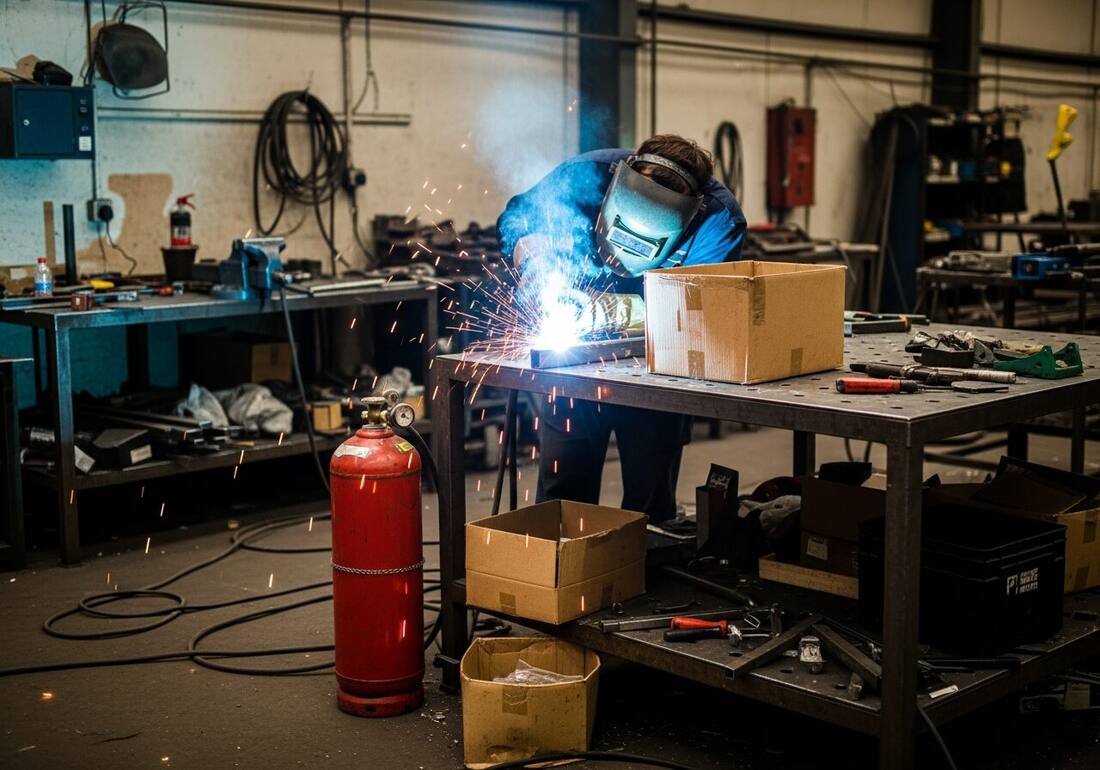
Hot work fires rarely start at the arc — they start in the things around it. A stack of cardboard that migrated onto the welding table, a cylinder wheeled over for a quick job and never chained, sparks bouncing under a bench into packing foam that smolders for an hour after everyone leaves. The 35-foot rule exists because that radius is exactly where these fires begin, and it is exactly what a busy shop stops seeing.
A photo scan lowers the bar: snap the work area before striking the arc and get an immediate second opinion on what is visible — combustibles in spark range, cylinder condition, extinguisher coverage, missing screens — plus the checklist items a person still needs to verify by hand, like permit status, gas connections, and ventilation. It turns the pre-job fire check into a ten-second habit.
OSHA's welding, cutting, and brazing standard (29 CFR 1910.252 for general industry; 29 CFR 1926.350–354 for construction) requires that hot work be authorized through a permit system when performed outside a designated welding area, and that a fire watch be maintained for at least 30 minutes after work stops. These requirements exist because hot work fires frequently smolder for hours before igniting fully — the sprinkler activations, building fires, and fatalities attributed to welding and cutting often happen long after the arc went cold. Insurance carriers track hot work losses closely and many require a documented permit program as a policy condition.
NFPA 51B (Standard for Fire Prevention During Welding, Cutting, and Other Hot Work) provides the detailed framework that OSHA references and that industrial fire insurers and property managers commonly require. The 35-foot clear zone, fire-resistance barriers where clearing is impractical, covered floor drains and openings, and specific fire-extinguisher requirements in NFPA 51B go beyond what the OSHA standard alone specifies. State-plan states including California, Washington, and Oregon have adopted hot work rules that incorporate NFPA 51B requirements by reference, making what was formerly a best-practice element an enforceable obligation in those jurisdictions.
Visible fire-prevention and setup issues the AI checks in a photo of the work area.
Cardboard, packaging, lumber, rags, and other combustible material stacked within the spark and slag radius of the work.
Compressed gas cylinders standing unsecured, left near active sparks, or stored without caps away from the job.
No extinguisher visible in the work area, blocked access to fire equipment, and hot work in corners a fire watch cannot see.
Missing welding screens where other workers or walkways face the arc, and bystanders in the flash or spark zone.
Scan a photo like the one above and this is the report you get — score, findings, OSHA references, and fixes. It is an illustrative example, clearly marked — not live scan data.
Compliance score
44
Lower means more potential hazards found
5 potential hazards found
1Combustible cardboard boxes stacked on the bench beside active welding
HighPossibly related to fire prevention during hot work (29 CFR 1910.252(a))
Observed condition: Sparks and slag travel well beyond the weld; combustibles inside that radius are the most common ignition source for hot work fires.
Corrective action: Move all combustible material at least 35 feet from the work, or shield it with fire-resistant covers before continuing.
High confidence
2Compressed gas cylinder standing free next to the spark zone
MediumPossibly related to compressed gas cylinder handling (29 CFR 1926.350)
Observed condition: An unsecured cylinder can be knocked over and shear its valve, and heat or slag near a cylinder raises the stakes of any small fire.
Corrective action: Chain the cylinder upright to a fixed support or cart, and relocate it out of the direct spark path.
Medium confidenceNot fully clear from the photo — verify on site.
Upload a photo like the one above and get a compliance score and hazard count in seconds. No account needed to scan — create a free account to unlock the full report.
Use the real site or facility name. If you save the scan after signup, it becomes the report name.
Three angles, one deeper scan
Only the wide shot is required — every extra angle gives the AI more places to look.
Required: Set the scene — one wide shot lets the AI sweep the whole area at once
Stand at the entry point and capture corner to corner: floors, ladders, scaffolds, and everyone at work
Drop a job-site photo or walkthrough video
Click to upload, drag & drop, or snap a photo on site. Photos scan free in about 15 seconds — no signup, no card. Video walkthroughs (up to 3 min) run on a free account.
Small habits, sharper scans
Set the scene
Start with context
Fill the frame
2–3 ft for close-ups; keep ladders, cords and workers fully in view.
Capture clearly
Make the frame usable
Light it right
Keep the sun or lights behind you — glare and shadows hide hazards.
Tap to focus
Tap the hazard on screen and hold still one second — blur can't be flagged.
Choose the useful view
Give the AI room to understand
Go landscape
Turn your phone sideways — a wider frame catches more of the scene.
Only upload photos you have permission to use, and avoid images showing personal, customer, or confidential information. Demo photos and results are held privately for up to 48 hours so you can save them to a free account; unclaimed photos are deleted automatically. Results are an AI-assisted preliminary review, not an official OSHA determination.
New: Video walkthrough scans
Record up to 3 minutes of your site — the AI extracts frames and flags every hazard with exact timestamps. Free account required.
Get the best results
Wide shot first
Stand at the entrance and photograph the entire work area so AI sees the full context
Hazard areas
Photograph elevated surfaces, equipment, electrical panels, and anywhere workers are active
Close-ups last
Move in close on anything damaged, missing, or that looks risky — the AI catches more detail
Run these points before striking an arc. The first four are free — create a free account to unlock the full checklist and scan your own hot work areas.
Free checklist — 12 points
Enter your email to unlock the full checklist
We'll also send you a printable PDF copy — no account required.
One email with the checklist, one follow-up. Unsubscribe anytime.
OSHA Scan reads a single photo. That makes it fast and easy for anyone on site — but it also means it has real limits. Here's an honest look at both.
A scan is a fast first look, not the final word. Before treating this kind of area as safe, a competent person should still confirm:
The core items are: combustibles cleared or shielded to 35 feet, a permit where required, an extinguisher at the job, a fire watch where more than a minor fire could develop, secured cylinders, sound hoses and leads, correct PPE and shade, screens for bystanders, adequate ventilation, protected floor openings, and a post-work check for smoldering. A photo scan covers the visible area items instantly; permits, gas connections, and shade numbers still need a person.
It checks what is visible: combustibles in spark range, unsecured cylinders, missing screens, missing extinguishers, and bystander exposure. It cannot smell a gas leak, read a permit, or verify a lens shade — so treat the scan as a fast first pass before striking the arc, not a replacement for the permit process or the fire watch.
General industry welding, cutting, and brazing live in 29 CFR 1910 Subpart Q (1910.252 covers fire prevention), and construction welding is 29 CFR 1926 Subpart J, with cylinder handling in 1926.350. OSHA Scan references the standard each visible finding may relate to — the scan itself is a preliminary AI review, not an official determination.
Reviewed by OSHA Scan Editorial
Last updated August 29, 2026
This content is produced by the OSHA Scan Editorial team and reviewed with AI assistance. It is general safety information, not legal or compliance advice. OSHA Scan is an independent tool and is not affiliated with, endorsed by, or certified by OSHA or the U.S. Department of Labor.
More ways to see what an AI OSHA scan can do for your site.
The overview hub — how the scanner works and every job, site, and hazard it covers.
The exposure hazard that ventilation checklist points target.
What happens when screens and shade numbers are skipped.
Scan any crew photo for missing protective equipment.
Extinguisher access and combustible control beyond the hot-work zone.
See a complete labelled example of everything a scan returns.
Start with 5 included AI site scans plus a one-time 10-scan signup bonus — no credit card. Build JHA-ready reports and catch changing conditions sooner.
Start your free trial