
1
Set the scene
Start with context
Fill the frame
2–3 ft for close-ups; keep ladders, cords and workers fully in view.
A school safety inspection checklist covers the occupational and facility-safety hazards that affect teachers, staff, and maintenance employees working in K-12 and higher-education buildings: blocked or propped exit doors in classrooms and corridors, laboratory chemical storage and fume hood compliance, housekeeping and trip hazards in hallways, playground equipment condition visible from a photo, and electrical safety in science and vocational classrooms. OSHA Scan lets a facilities director, safety officer, or principal photograph any area — a corridor, a science lab, a shop classroom, a cafeteria, or an exterior area — and get an instant read on visible workplace safety hazards for staff. It is an AI-assisted occupational-safety tool, not a student-safety, school-security, or fire-code inspection.
Free · No account needed to scan · Results in seconds
School employees — teachers, custodians, food-service workers, and maintenance staff — face real occupational hazards: science labs with chemicals, vocational shops with power equipment, slippery cafeteria floors, and heavy custodial carts in narrow corridors. OSHA covers these employees under its General Industry standards, and public-school employees in most states are covered by state-plan OSHA programs. A photo-based check lets a facilities manager document conditions across a large campus without a full staff walk-through every week.
The scanner focuses on the visible, OSHA-addressable hazards in school buildings: a chemistry lab storage room with incompatible chemicals sharing a shelf, a corridor exit door propped open and blocked, a cafeteria floor with standing water during lunch service, or a shop classroom with a power tool guard missing. It does not evaluate student behavioral safety, school security measures, or life-safety code compliance beyond what's visible in a photo.
Public school employees are covered by OSHA in 28 states and the District of Columbia under state-plan programs; in the remaining states, public school employees are not covered by federal OSHA but may be covered by state occupational safety and health laws. Private school employees are covered by federal OSHA in all states. This jurisdictional complexity means that the applicable standards — and the enforcement agency — depend on both the school's governance (public or private) and the state. Employers unsure of their coverage should verify with their state labor department or state-plan OSHA office.
The hazards OSHA most consistently addresses in school settings are chemical laboratory safety under 1910.1450 (Chemical Hygiene Plan requirement for any lab using hazardous chemicals), vocational shop machine guarding under 1910.212, and walking-working surfaces in food service areas. Art rooms using lead-containing glazes, solvents, or spray paints may trigger hazard communication and exposure monitoring requirements. Maintenance and custodial operations at school buildings fall under the same general industry standards as any other facility — LOTO for boiler and HVAC maintenance, confined space for mechanical rooms, and fall protection for roof access — and are often the highest-risk employee activities on a school campus.
Run through these steps before crews start — each one covers a visible gap the AI can help you catch.
Walk the egress path from classrooms to exits and confirm doors are clear of furniture and doorstops, corridors are at full width, and self-closing fire doors are not propped open. Blocked egress and fire doors may relate to 29 CFR 1910.37.
Confirm flammables are in approved cabinets, oxidizers are separated from organics, corrosives are in secondary containment, and the fume hood sash is at working height with adequate face velocity whenever chemicals are in use. These conditions may relate to 29 CFR 1910.1450 and 1910.106.
Check that blade guards are on table saws and band saws, eye shields are on bench grinders, and every guard is in place before a machine is turned on. Unguarded machinery may relate to 29 CFR 1910.212.
Verify wet-floor signs go out within seconds of any spill or mopping in cafeterias and restrooms, and that custodial chemicals are in labeled containers in locked storage with the SDS binder accessible. These conditions may relate to 29 CFR 1910.22 and 1910.1200.
Photograph the corridor, science lab, and shop area and upload to OSHA Scan for an AI second pass. The scan flags visible hazards, references the OSHA standard each may relate to, and suggests a corrective action — a preliminary review a person still verifies on site. Free, no account needed.
The occupational-safety core of a K-12 and campus inspection checklist, read from an image.
Classroom and corridor exit doors propped, blocked by furniture or deliveries, and egress paths narrowed by stored materials — a common finding in school buildings.
Incompatible chemicals co-stored in lab storage rooms, unlabeled chemical containers, and fume hoods operated with the sash fully raised.
Wet cafeteria floors without signage, raised floor tiles and thresholds in corridors, and boxes or equipment stored in hallways.
Fire extinguishers blocked or overdue for inspection, fire doors held open with wedges or doorstops, and cluttered storage near electrical panels.
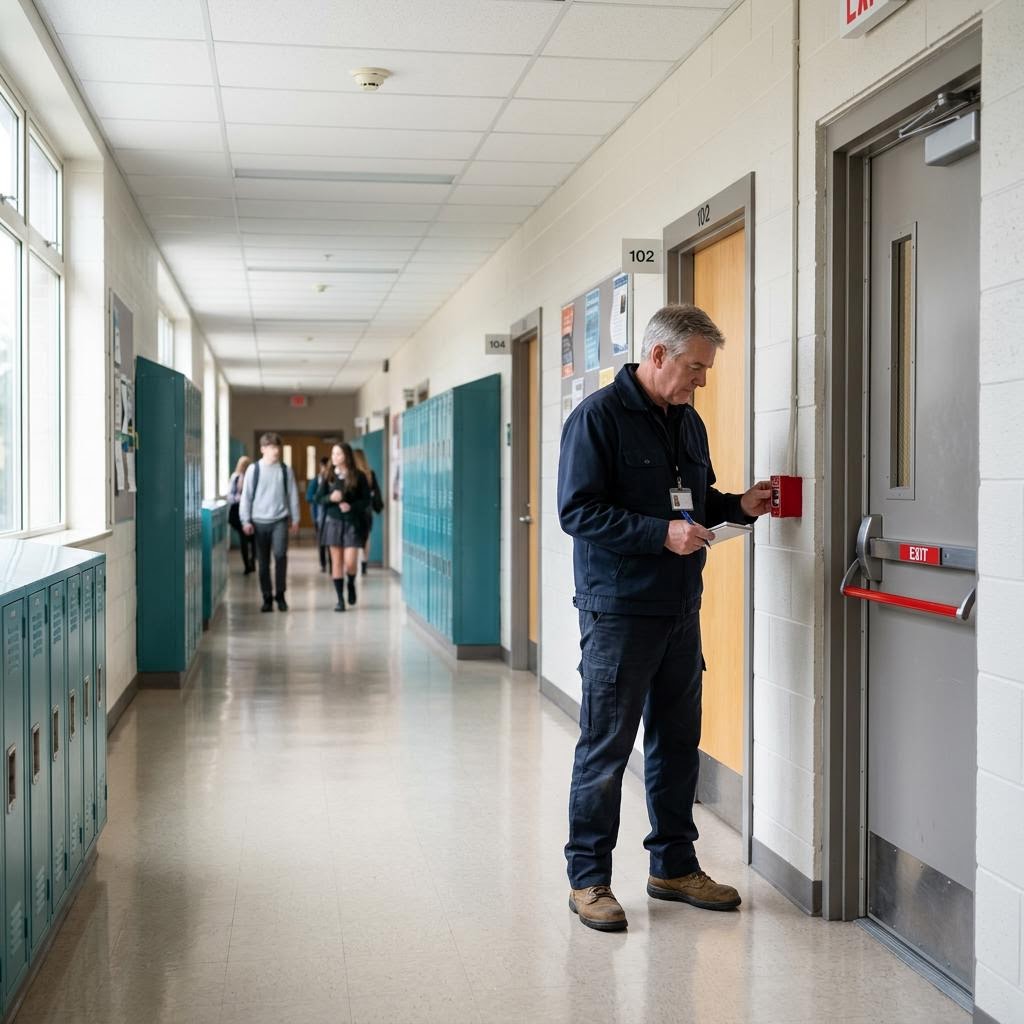
Scan a photo like the one above and this is the report you get — score, findings, OSHA references, and fixes. It is an illustrative example, clearly marked — not live scan data.
Compliance score
76
Lower means more potential hazards found
5 potential hazards found
1Paper postings accumulating on corridor walls near classroom doors
LowPossibly related to fire prevention housekeeping (29 CFR 1910.38) and NFPA 101 interior finish limits
Observed condition: Fire codes limit how much of a school corridor wall may be covered by paper displays — postings concentrated near doors add fuel exactly where occupants evacuate.
Corrective action: Keep artwork and postings within the coverage percentage allowed by the local fire code, away from exit doors, and off fire doors entirely.
Medium confidenceNot fully clear from the photo — verify on site.
2Fire alarm pull station beside the exit — verify clear access and inspection date
LowPossibly related to employee alarm systems (29 CFR 1910.165)
Observed condition: Pull stations must stay visible and reachable — carts, displays, or door swings that block them delay the first alarm in an emergency.
Corrective action: Keep a clear zone around the pull station, confirm it appears on the annual fire alarm inspection report, and verify the exit door's panic hardware latches freely.
Medium confidenceNot fully clear from the photo — verify on site.
Upload a photo like the one above and get a compliance score and hazard count in seconds. No account needed to scan — create a free account to unlock the full report.
Use the real site or facility name. If you save the scan after signup, it becomes the report name.
Three angles, one deeper scan
Only the wide shot is required — every extra angle gives the AI more places to look.
Required: Set the scene — one wide shot lets the AI sweep the whole area at once
Stand at the entry point and capture corner to corner: floors, ladders, scaffolds, and everyone at work
Drop a job-site photo or walkthrough video
Click to upload, drag & drop, or snap a photo on site. Photos scan free in about 15 seconds — no signup, no card. Video walkthroughs (up to 3 min) run on a free account.
Small habits, sharper scans
Set the scene
Start with context
Fill the frame
2–3 ft for close-ups; keep ladders, cords and workers fully in view.
Capture clearly
Make the frame usable
Light it right
Keep the sun or lights behind you — glare and shadows hide hazards.
Tap to focus
Tap the hazard on screen and hold still one second — blur can't be flagged.
Choose the useful view
Give the AI room to understand
Go landscape
Turn your phone sideways — a wider frame catches more of the scene.
Only upload photos you have permission to use, and avoid images showing personal, customer, or confidential information. Demo photos and results are held privately for up to 48 hours so you can save them to a free account; unclaimed photos are deleted automatically. Results are an AI-assisted preliminary review, not an official OSHA determination.
New: Video walkthrough scans
Record up to 3 minutes of your site — the AI extracts frames and flags every hazard with exact timestamps. Free account required.
Get the best results
Wide shot first
Stand at the entrance and photograph the entire work area so AI sees the full context
Hazard areas
Photograph elevated surfaces, equipment, electrical panels, and anywhere workers are active
Close-ups last
Move in close on anything damaged, missing, or that looks risky — the AI catches more detail
Walk classrooms, corridors, labs, and service areas with these points. The first four are free — create a free account to unlock the full checklist and scan your own campus photos.
Free checklist — 12 points
Enter your email to unlock the full checklist
We'll also send you a printable PDF copy — no account required.
One email with the checklist, one follow-up. Unsubscribe anytime.
OSHA Scan reads a single photo. That makes it fast and easy for anyone on site — but it also means it has real limits. Here's an honest look at both.
A scan is a fast first look, not the final word. Before treating this kind of area as safe, a competent person should still confirm:
In most states with OSHA state plans (covering about 29 states and territories), public school employees are covered by state occupational safety requirements. In states under federal OSHA jurisdiction, public employees are not covered by federal OSHA but many states provide comparable protections. Private school employees are covered by federal OSHA in all states.
Common OSHA-category findings in school investigations include chemical storage violations in science labs (incompatible storage, unlabeled containers), egress problems (blocked exits, propped fire doors), electrical violations (open panels, improper cords), and walking-working surface hazards (wet floors, damaged surfaces). The scan flags visible conditions in all of these categories.
No. OSHA Scan covers occupational-safety hazards visible in a photo — conditions affecting the safety of employees working in the facility. Student behavioral safety, school security systems, and emergency lockdown procedures are outside the scope of OSHA and outside the scope of this tool.
Science labs and shop classrooms benefit from a photo-based check at the start of each week. Corridors and common areas should be checked daily by custodial staff. A facilities-level inspection of all buildings should happen at least once per semester between formal fire inspections.
Yes. The report is in plain language with a specific suggested fix for each finding — no safety certification is required to run the walk-through. Findings involving chemicals, electrical systems, or structural conditions should be escalated to qualified professionals.
Reviewed by OSHA Scan Editorial
Last updated August 29, 2026
This content is produced by the OSHA Scan Editorial team and reviewed with AI assistance. It is general safety information, not legal or compliance advice. OSHA Scan is an independent tool and is not affiliated with, endorsed by, or certified by OSHA or the U.S. Department of Labor.
More ways to see what an AI OSHA scan can do for your site.
The overview hub — how the scanner works and every job, site, and hazard it covers.
Extinguishers, fire doors, and egress for any building.
Chemical labeling and SDS compliance for science labs and custodial areas.
Focused detection for exit and corridor hazards.
Ergonomics, egress, and electrical hazards in office and administrative buildings.
The full software platform behind every industry safety scan.
How AI-assisted audits compare to traditional safety audit programs.
See a complete labelled example of everything a scan returns.
Start with 5 included AI site scans plus a one-time 10-scan signup bonus — no credit card. Build JHA-ready reports and catch changing conditions sooner.
Start your free trial