
1
Set the scene
Start with context
Fill the frame
2–3 ft for close-ups; keep ladders, cords and workers fully in view.
A hotel safety inspection checklist covers the hazards that injure housekeeping staff, kitchen workers, and maintenance employees in lodging properties: wet floors in corridors and pool areas, blocked or propped fire exits, kitchen slip and burn risks, inadequate lighting in stairwells, and chemical storage in housekeeping carts and laundry rooms. OSHA Scan lets a hotel supervisor photograph any area — a guest corridor, a commercial kitchen, a pool deck, or a laundry room — and get an instant read on visible occupational-safety hazards. It is an AI-assisted first look for staff-safety compliance, not a guest-experience or fire-marshal inspection.
Free · No account needed to scan · Results in seconds
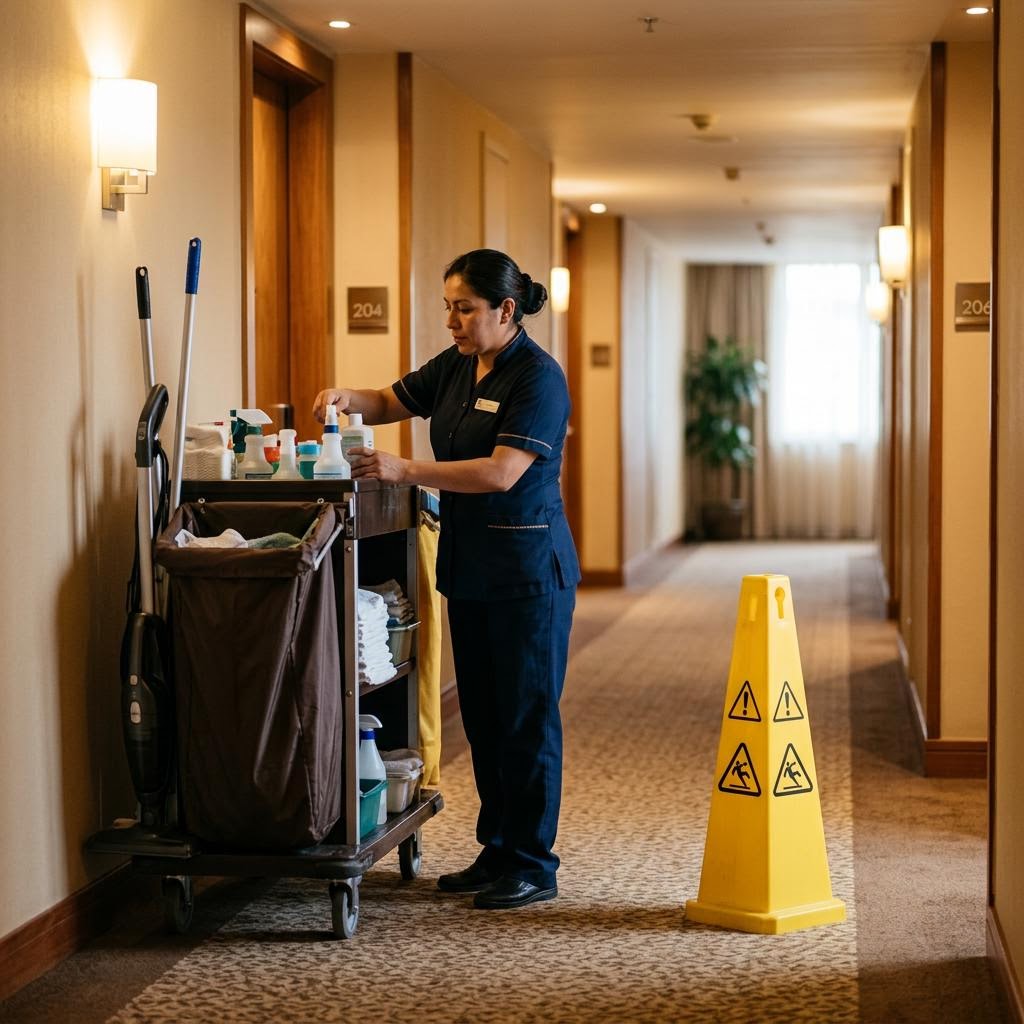
Lodging properties run around the clock with high staff turnover, which makes consistent safety checks difficult. Housekeeping workers face some of the highest injury rates in hospitality — slips on wet floors, strains from cart pushing and bed-making, and chemical exposures from concentrated cleaning products. Kitchen staff face burn and slip risks identical to restaurant workers. A fast photo-based check between shifts catches the hazards that build up when no one is looking.
The scanner reads visible conditions in any area of the property: a housekeeping cart blocking a corridor exit, a pool deck with standing water and no wet-floor sign, a laundry room with chemicals stored without labels, or a kitchen line with grease on the floor. It surfaces the OSHA standard most likely to apply and a specific suggested fix for each finding.
Hotels and lodging properties employ workers across multiple hazard environments simultaneously: housekeeping (musculoskeletal from room-cleaning tasks, chemical exposure from cleaning products), food and beverage (cuts, burns, slip and fall), maintenance (electrical, fall from height, confined space in mechanical rooms), and security (workplace violence). OSHA covers all of these occupationally under the applicable general industry standards, and hospitality has one of the higher injury rates among service industries when measured by days-away-from-work cases.
Housekeeping musculoskeletal disorders are among the highest-volume injury categories in hotel operations, driven by bed-making, bathroom cleaning, and cart pushing. Several states with high hotel concentrations — California, Hawaii, and New York — have considered or adopted hotel worker protection ordinances that address workload limits, panic buttons for solo-working housekeepers, and ergonomic program requirements. OSHA has pursued general duty clause citations against hotel employers for housekeeping ergonomic hazards. Chemical exposure from cleaning product mixing, particularly acids and bleach combined in enclosed bathroom spaces, has also produced both general duty clause citations and emergency-response incidents at hotel properties.
Run through these steps before crews start — each one covers a visible gap the AI can help you catch.
Walk lobbies, restrooms, the kitchen, and the pool deck and confirm a wet-floor sign is out within seconds of any spill, mopping, or splash, and that pool decks keep adequate slip resistance. Slips and falls on walking surfaces may relate to 29 CFR 1910.22.
Verify service exits and corridors are free of linen carts, supply deliveries, and maintenance equipment at full width, and that self-closing fire doors are not propped with wedges or doorstops. Blocked egress may relate to 29 CFR 1910.37.
Check for grease accumulation on floors and hood filters, confirm the K-class extinguisher is mounted near the line and unobstructed, and that the suppression system tag is current. Fire-protection conditions may relate to 29 CFR 1910.157.
Confirm cleaning chemicals on carts and in closets are in labeled original containers with the SDS binder accessible, and that gloves and eye protection are available for chemical-handling tasks. Labeling and PPE may relate to 29 CFR 1910.1200 and 1910.132.
Photograph the corridor, kitchen line, and pool deck and upload to OSHA Scan for an AI second pass. The scan flags visible hazards, references the OSHA standard each may relate to, and suggests a corrective action — a preliminary review a person still verifies on site. Free, no account needed.
The occupational-safety core of a lodging-facility checklist, read from an image.
Standing water on pool decks and corridor floors, wet kitchen surfaces without mats or signage, and housekeeping spills left unmarked.
Service exits blocked by linen carts or supplies, fire doors wedged open, and egress paths narrowed by housekeeping or maintenance equipment.
Grease accumulation around cooking equipment, flammable materials near heat sources, and fire extinguisher access obstructed by equipment.
Unlabeled cleaning chemicals on housekeeping carts, chemicals stored without secondary containment in laundry rooms, and SDS binders inaccessible.
Scan a photo like the one above and this is the report you get — score, findings, OSHA references, and fixes. It is an illustrative example, clearly marked — not live scan data.
Compliance score
74
Lower means more potential hazards found
5 potential hazards found
1Assorted chemical spray bottles on the open housekeeping cart shelf
MediumPossibly related to hazard communication (29 CFR 1910.1200)
Observed condition: Housekeeping chemicals staged on an open cart in a guest corridor must be labeled and secured — unlabeled or guest-accessible bottles are among the most common hotel HazCom citations.
Corrective action: Verify every bottle carries a legible secondary label with product name and hazard warning; keep chemicals on the enclosed side of the cart, out of guest reach.
Medium confidenceNot fully clear from the photo — verify on site.
2Housekeeping cart, mop and vacuum partially blocking the corridor path
MediumPossibly related to means of egress (29 CFR 1910.36)
Observed condition: A fully loaded cart with protruding mop handles narrows the guest corridor — during an alarm, guests unfamiliar with the building will be funneling past exactly this point.
Corrective action: Park the cart tight against the wall on the room side being serviced; keep handles vertical and secured; never stage the cart at corridor intersections or exits.
High confidence
Upload a photo like the one above and get a compliance score and hazard count in seconds. No account needed to scan — create a free account to unlock the full report.
Use the real site or facility name. If you save the scan after signup, it becomes the report name.
Three angles, one deeper scan
Only the wide shot is required — every extra angle gives the AI more places to look.
Required: Set the scene — one wide shot lets the AI sweep the whole area at once
Stand at the entry point and capture corner to corner: floors, ladders, scaffolds, and everyone at work
Drop a job-site photo or walkthrough video
Click to upload, drag & drop, or snap a photo on site. Photos scan free in about 15 seconds — no signup, no card. Video walkthroughs (up to 3 min) run on a free account.
Small habits, sharper scans
Set the scene
Start with context
Fill the frame
2–3 ft for close-ups; keep ladders, cords and workers fully in view.
Capture clearly
Make the frame usable
Light it right
Keep the sun or lights behind you — glare and shadows hide hazards.
Tap to focus
Tap the hazard on screen and hold still one second — blur can't be flagged.
Choose the useful view
Give the AI room to understand
Go landscape
Turn your phone sideways — a wider frame catches more of the scene.
Only upload photos you have permission to use, and avoid images showing personal, customer, or confidential information. Demo photos and results are held privately for up to 48 hours so you can save them to a free account; unclaimed photos are deleted automatically. Results are an AI-assisted preliminary review, not an official OSHA determination.
New: Video walkthrough scans
Record up to 3 minutes of your site — the AI extracts frames and flags every hazard with exact timestamps. Free account required.
Get the best results
Wide shot first
Stand at the entrance and photograph the entire work area so AI sees the full context
Hazard areas
Photograph elevated surfaces, equipment, electrical panels, and anywhere workers are active
Close-ups last
Move in close on anything damaged, missing, or that looks risky — the AI catches more detail
Walk guest corridors, the kitchen, pool, and service areas with these points. The first four are free — create a free account to unlock the full checklist and scan your own property photos.
Free checklist — 12 points
Enter your email to unlock the full checklist
We'll also send you a printable PDF copy — no account required.
One email with the checklist, one follow-up. Unsubscribe anytime.
OSHA Scan reads a single photo. That makes it fast and easy for anyone on site — but it also means it has real limits. Here's an honest look at both.
A scan is a fast first look, not the final word. Before treating this kind of area as safe, a competent person should still confirm:
It covers occupational-safety hazards for hotel staff: slips in wet areas, blocked exits, chemical storage in housekeeping, kitchen burn and fire risks, laundry room conditions, and electrical safety. OSHA Scan flags the visible versions of these from a photo and references the applicable OSHA standard. Guest-room conditions and food-hygiene grading are separate inspection processes.
Housekeeping workers and kitchen staff. Housekeeping has high rates of musculoskeletal injuries from making beds and pushing carts, and slip-and-fall injuries from wet floors. Kitchen workers face burns, cuts, and slip hazards similar to any restaurant. The scan focuses on the visible conditions that drive these injury categories.
Any shift supervisor or department lead can run it. The report uses plain language and gives a specific suggested fix for each finding, so no safety certification is required to act on the results.
High-risk areas like kitchens and pool decks benefit from a daily check. Guest corridors and service areas should be checked each shift change. This sits between the formal property-risk inspections done by insurance carriers or third-party auditors.
Yes. Hotel employees are covered by OSHA's General Industry standards — primarily walking-working surfaces (1910.22), means of egress (1910.37), hazard communication (1910.1200), and fire protection (1910.157). Hospitality is one of the industries OSHA regularly inspects following worker injury reports.
Reviewed by OSHA Scan Editorial
Last updated August 29, 2026
This content is produced by the OSHA Scan Editorial team and reviewed with AI assistance. It is general safety information, not legal or compliance advice. OSHA Scan is an independent tool and is not affiliated with, endorsed by, or certified by OSHA or the U.S. Department of Labor.
More ways to see what an AI OSHA scan can do for your site.
The overview hub — how the scanner works and every job, site, and hazard it covers.
Kitchen and food-service hazards covered in detail.
Catch wet floor and surface hazards across the property.
Chemical labeling and SDS requirements for housekeeping and laundry.
The full software platform behind every industry safety scan.
The complete hub of every hazard type and industry the scanner covers.
Extinguishers, egress, and fire doors across guest floors, kitchen, and laundry.
Build a scanned chemical library for housekeeping, laundry, pool, and kitchen.
See a complete labelled example of everything a scan returns.
Start with 5 included AI site scans plus a one-time 10-scan signup bonus — no credit card. Build JHA-ready reports and catch changing conditions sooner.
Start your free trial