
1
Set the scene
Start with context
Fill the frame
2–3 ft for close-ups; keep ladders, cords and workers fully in view.
OSHA enforces heat protection primarily through the General Duty Clause (Section 5(a)(1)) and a National Emphasis Program on outdoor and indoor heat, built around three visible basics: cool drinking water within reach, shade or a cool-down area available, and rest breaks that actually happen — plus acclimatization for new and returning workers, who account for most heat deaths. A federal heat injury and illness prevention rule has been proposed and is still moving through rulemaking, but OSHA already cites employers whose crews work heat without these basics. OSHA Scan reads a photo of a hot-weather work area and flags what's visibly missing: no shade structure, empty or absent water coolers, and crews showing strain in direct sun. It is an AI-assisted first pass, not a heat-exposure assessment.
Free · No account needed to scan · Results in seconds
Heat is one of the few workplace killers where the victims cluster so predictably: most heat fatalities happen in a worker's first days on the job, before their body has adapted to working in heat. That's why acclimatization — ramping new and returning workers up gradually — sits at the center of every credible heat program, alongside the three things a crew can see from across the site: water close enough to actually drink from all shift, shade or a cooled space to recover in, and a rest schedule that scales with the temperature. None of these cost much; all of them show up in OSHA's heat-related General Duty Clause citations when they're missing.
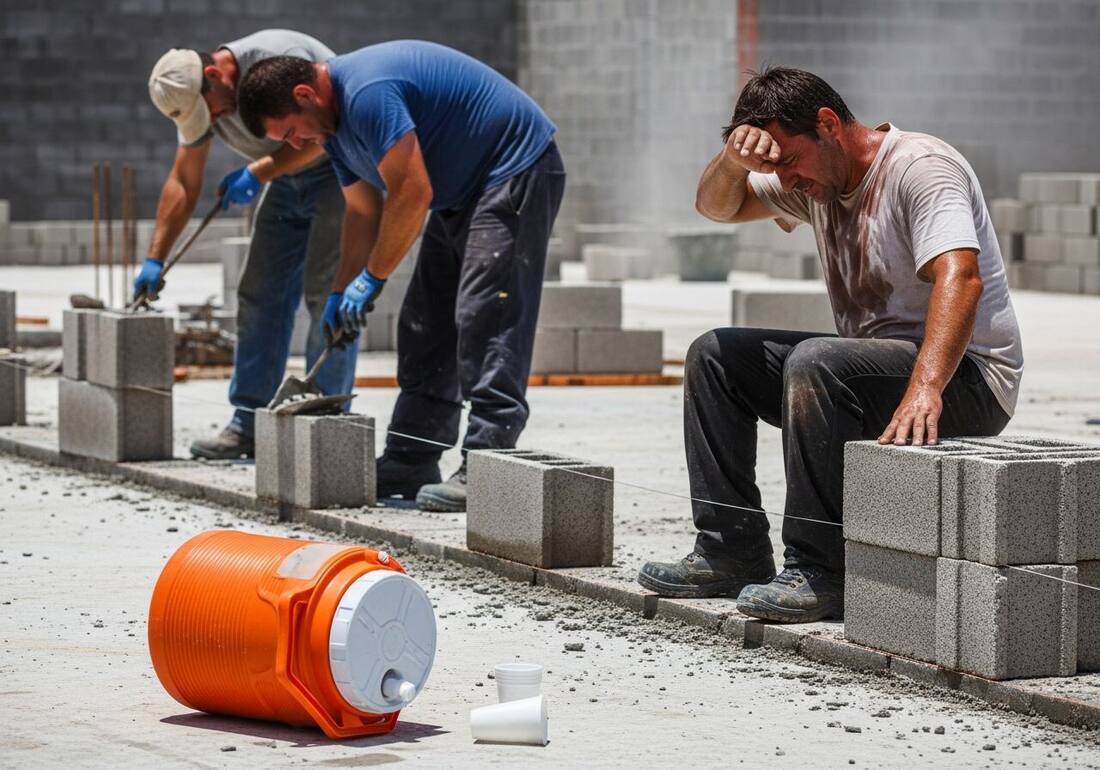
A photo tells you a surprising amount: a crew in full sun with no canopy anywhere in frame, a water cooler tipped over empty at noon, a worker sitting down mid-task with the flushed, wiped-out look supervisors are trained to catch. What a photo can't show — the acclimatization schedule, the emergency plan, the training — is in the checklist below. With OSHA's proposed federal heat rule advancing and several states already enforcing their own heat standards, the crews documenting these basics now are the ones that won't be scrambling later.
OSHA has enforced heat stress hazards under the general duty clause for decades, but is advancing a proposed federal heat injury and illness prevention standard that would establish specific requirements for water, rest, shade, acclimatization procedures, emergency response, and written heat illness prevention plans. Until a final rule takes effect, general duty clause citations remain the federal enforcement mechanism — which means OSHA must demonstrate that the heat hazard was recognized and that a feasible means of abatement was available. NIOSH's Recommended Exposure Limits and the applicable ACGIH TLVs for heat exposure are the technical references inspectors use to establish that a recognized hazard existed.
California, Minnesota, and Washington have adopted heat illness prevention standards that are currently in effect and establish specific employer obligations. California's Title 8 Section 3395 (Heat Illness Prevention) is the most comprehensive: it applies to all outdoor places of employment and to indoor workplaces with heat risks, requires employers to provide water, cool-down rest periods, shade, and emergency response, and mandates a written Heat Illness Prevention Plan that must be available at the worksite. The acclimatization requirement in California's standard — which requires a specific 14-day adjustment schedule for new employees and those returning after an absence — is among the most frequently overlooked provisions. Employers operating in California and other state-plan states must comply with the applicable state standard rather than waiting for the federal rule.
What the AI checks in a photo of outdoor or hot indoor work.
No water cooler in frame, coolers tipped over or clearly empty, or water staged so far from the work that nobody uses it.
Crews working direct sun with no canopy, tent, or shaded recovery area visible anywhere in the work zone.
Workers showing signs a supervisor should act on — sweat-soaked clothing, sitting mid-task, flushed and wiped out in full sun.
Heavy manual tasks — block laying, digging, roofing — running through the hottest part of the day with no visible rotation or relief.
Scan a photo like the one above and this is the report you get — score, findings, OSHA references, and fixes. It is an illustrative example, clearly marked — not live scan data.
Compliance score
48
Lower means more potential hazards found
5 potential hazards found
1Worker seated mid-task showing visible heat strain — sweat-soaked shirt, flushed, wiping his forehead — in direct sun with no shade structure anywhere in frame
HighPossibly related to heat illness prevention under the General Duty Clause (Section 5(a)(1)) and OSHA's heat NEP
Observed condition: Heat exhaustion escalates to heat stroke fast, and heat stroke kills — a worker showing strain with nowhere shaded to recover is the exact scenario behind most heat fatalities OSHA investigates.
Corrective action: Move the worker to shade or a cooled space now, provide water, and monitor; put up a canopy or designate a shaded recovery area before high-heat work continues.
Medium confidenceNot fully clear from the photo — verify on site.
2Water cooler tipped over and empty at the work area, cups scattered
HighPossibly related to potable water provision (29 CFR 1926.51) and heat illness prevention (5(a)(1))
Observed condition: Workers in heat need water continuously — around a quart per hour in high heat — and an empty cooler means every hour since it ran dry has been dehydration accumulating toward an incident.
Corrective action: Refill and upright the cooler immediately and assign someone to keep water stocked all shift; stage it in shade, close to the work, with cups or bottles available.
High confidence
Upload a photo like the one above and get a compliance score and hazard count in seconds. No account needed to scan — create a free account to unlock the full report.
Use the real site or facility name. If you save the scan after signup, it becomes the report name.
Three angles, one deeper scan
Only the wide shot is required — every extra angle gives the AI more places to look.
Required: Set the scene — one wide shot lets the AI sweep the whole area at once
Stand at the entry point and capture corner to corner: floors, ladders, scaffolds, and everyone at work
Drop a job-site photo or walkthrough video
Click to upload, drag & drop, or snap a photo on site. Photos scan free in about 15 seconds — no signup, no card. Video walkthroughs (up to 3 min) run on a free account.
Small habits, sharper scans
Set the scene
Start with context
Fill the frame
2–3 ft for close-ups; keep ladders, cords and workers fully in view.
Capture clearly
Make the frame usable
Light it right
Keep the sun or lights behind you — glare and shadows hide hazards.
Tap to focus
Tap the hazard on screen and hold still one second — blur can't be flagged.
Choose the useful view
Give the AI room to understand
Go landscape
Turn your phone sideways — a wider frame catches more of the scene.
Only upload photos you have permission to use, and avoid images showing personal, customer, or confidential information. Demo photos and results are held privately for up to 48 hours so you can save them to a free account; unclaimed photos are deleted automatically. Results are an AI-assisted preliminary review, not an official OSHA determination.
New: Video walkthrough scans
Record up to 3 minutes of your site — the AI extracts frames and flags every hazard with exact timestamps. Free account required.
Get the best results
Wide shot first
Stand at the entrance and photograph the entire work area so AI sees the full context
Hazard areas
Photograph elevated surfaces, equipment, electrical panels, and anywhere workers are active
Close-ups last
Move in close on anything damaged, missing, or that looks risky — the AI catches more detail
From water and shade at the work face to acclimatization and the emergency plan. The first four are free — create a free account to unlock the rest and scan your own hot-weather work.
Free checklist — 12 points
Enter your email to unlock the full checklist
We'll also send you a printable PDF copy — no account required.
One email with the checklist, one follow-up. Unsubscribe anytime.
OSHA Scan reads a single photo. That makes it fast and easy for anyone on site — but it also means it has real limits. Here's an honest look at both.
A scan is a fast first look, not the final word. Before treating this kind of area as safe, a competent person should still confirm:
There is no final federal heat standard yet — OSHA published a proposed Heat Injury and Illness Prevention rule and it remains in rulemaking. Today, federal OSHA enforces heat protection through the General Duty Clause and a National Emphasis Program that triggers inspections on high-heat days. Several states — California, Washington, Oregon, Colorado, Maryland, Minnesota, and Nevada among them — already enforce their own heat rules. Practically, the elements are the same everywhere: water, shade, rest, acclimatization, training, and an emergency plan.
Acclimatization is the body's physical adaptation to working in heat — better sweating, lower heart rate, more stable core temperature — and it takes one to two weeks of gradually increasing exposure to build. It's emphasized because the fatality data is stark: most workers who die of heat stroke die in their first week, many on their first day. The standard ramp is 20% of normal heat exposure on day one, adding 20% each day, for new workers and anyone returning from a week or more away.
It can flag the visible layer: no shade structure in frame, water coolers missing or empty, crews doing heavy work in direct sun, and workers showing visible strain. It cannot read the temperature, verify breaks are happening, or check acclimatization schedules — those need a supervisor with a thermometer and a plan. Use the scan to catch the obvious gaps on hot days between formal program reviews.
Reviewed by OSHA Scan Editorial
Last updated August 29, 2026
This content is produced by the OSHA Scan Editorial team and reviewed with AI assistance. It is general safety information, not legal or compliance advice. OSHA Scan is an independent tool and is not affiliated with, endorsed by, or certified by OSHA or the U.S. Department of Labor.
More ways to see what an AI OSHA scan can do for your site.
The overview hub — how the scanner works and every job, site, and hazard it covers.
A walkthrough of how an ordinary hot afternoon becomes a medical emergency.
The general-duty basics — water, sanitation, first aid — that heat programs build on.
How crews use photo scans across every hazard on an outdoor jobsite.
See a complete labelled example of everything a scan returns.
Start with 5 included AI site scans plus a one-time 10-scan signup bonus — no credit card. Build JHA-ready reports and catch changing conditions sooner.
Start your free trial