
1
Set the scene
Start with context
Fill the frame
2–3 ft for close-ups; keep ladders, cords and workers fully in view.
Respiratory protection under OSHA is a program, not a mask: evaluate the exposure, control it with ventilation first, and where respirators are still needed, pair the right respirator and cartridge with a medical evaluation, an annual fit test, and training. The program half is paperwork — but the failure half is often visible: a worker sanding in a dust cloud wearing a sagging paper mask while a fitted respirator hangs on the wall. OSHA Scan reads a photo of dusty or fume-producing work and flags those visible gaps, referencing the OSHA standard each may relate to. It is an AI-assisted first pass on what the photo shows — it cannot measure air concentrations or verify fit testing.
Free · No account needed to scan · Results in seconds
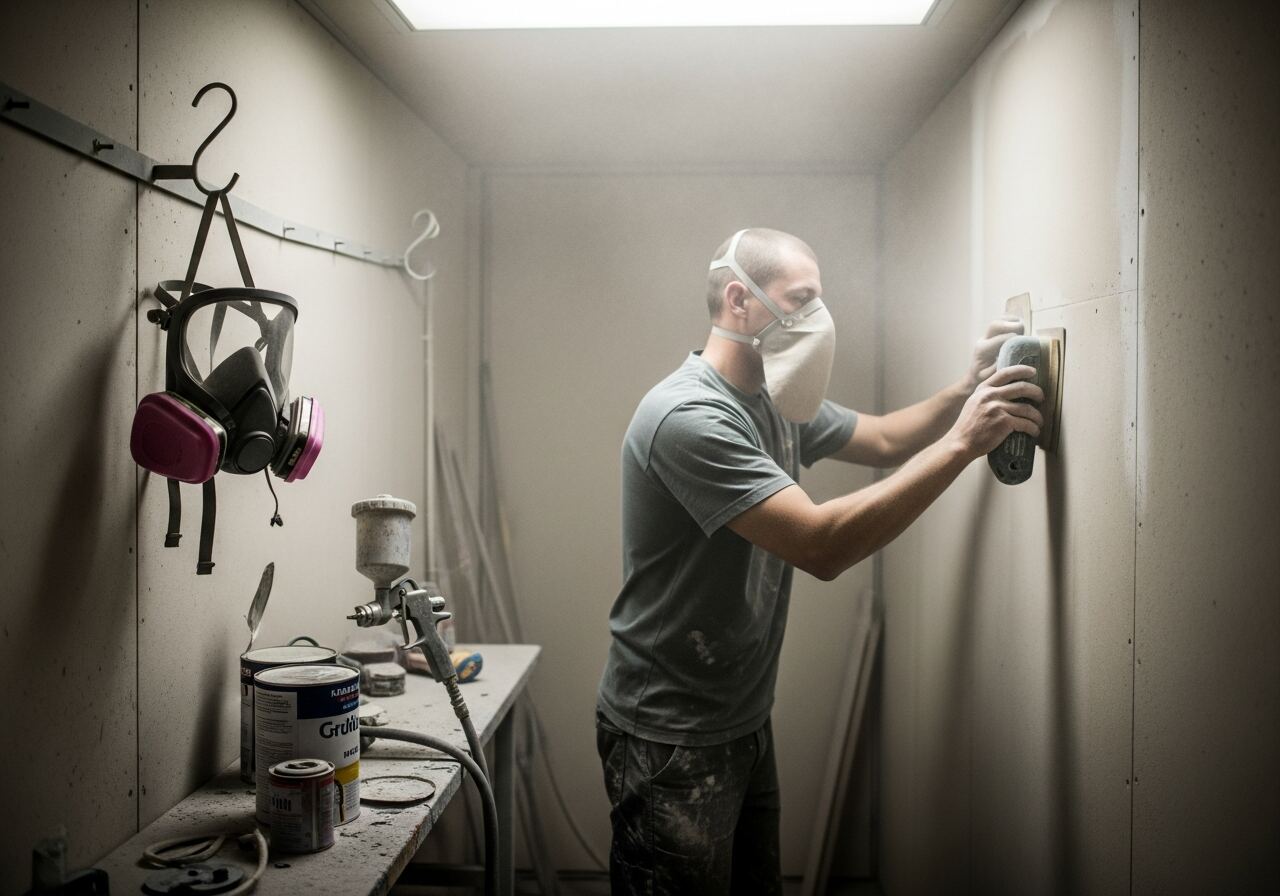
Respiratory protection is one of OSHA's most-cited standards year after year, and the citations cluster around the program pieces: no medical evaluation, no fit test, no written program. But behind almost every program failure is a visible one — the exposure itself. Dust hanging in the air of an enclosed room, spray mist drifting past the booth opening, a worker in a sagging paper mask doing work the hazard assessment says needs a fitted respirator with the right cartridge.
That visible half is what a photo can catch. The person doing the work rarely notices the haze they're standing in — they acclimated to it an hour ago. A scan of the work area sees it fresh: the airborne dust, the protection actually on the face versus the respirator hanging on the wall, the enclosed space with no ventilation in sight. The checklist below covers the rest of the chain — evaluation, medical clearance, fit testing, cartridges — that only records can prove.
OSHA's respiratory protection standard (29 CFR 1910.134) consistently ranks among the top ten most-cited OSHA violations, and the citations cluster around program elements rather than respirator hardware: no written respiratory protection program, no medical evaluation before employees wear a respirator, no fit test, or no annual training. These are not obscure requirements — they have been in the standard for decades — but each one requires administrative effort that often falls behind when respirator use is informal or intermittent. Inspectors ask for the written program first; if it doesn't exist as a document, the citation is immediate.
The medical evaluation requirement is the element employers most frequently overlook. Before any employee uses a tight-fitting respirator, a licensed health-care professional must evaluate whether the employee is medically able to wear it — even for voluntary use of a filtering facepiece. OSHA's Table 1 for silica work (29 CFR 1926.1153) and specific substance standards like asbestos (1910.1001) and lead (1910.1025) layer additional requirements on top of the general respiratory standard, making respiratory program documentation especially critical in construction and industrial settings where multiple hazardous exposures may be present simultaneously.
What the AI checks in a photo of sanding, cutting, spraying, or other exposure-producing work.
Visible dust clouds, haze, and spray mist around workers — the exposures that make respiratory protection a live question in the first place.
Loose paper masks on dusty work, respirators sagging below the nose, and masks dangling around necks while the exposure continues.
Fitted respirators visible on hooks, benches, or in the background while the person in the exposure wears something lesser — the classic photo-visible program failure.
Enclosed rooms and booths with no extraction, fan, or open airflow path in frame while dust- or vapor-producing work runs.
Scan a photo like the one above and this is the report you get — score, findings, OSHA references, and fixes. It is an illustrative example, clearly marked — not live scan data.
Compliance score
58
Lower means more potential hazards found
5 potential hazards found
1Worker sanding in an enclosed room with visible airborne dust, wearing a loose disposable mask
HighPossibly related to respiratory protection selection and use (29 CFR 1910.134)
Observed condition: A sagging paper mask on visibly dusty enclosed work provides little real protection — fine dust follows the leak paths around the nose and cheeks straight into the lungs, shift after shift.
Corrective action: Stop and reassess the exposure: add local exhaust or wet methods where feasible, and put the worker in the fit-tested respirator and cartridge the task's hazard assessment calls for.
Medium confidenceNot fully clear from the photo — verify on site.
2Half-face respirator with P100 cartridges hanging unused on the wall while the exposure continues
MediumPossibly related to respiratory protection program implementation (29 CFR 1910.134(c))
Observed condition: Protection that hangs on a hook is a program on paper only — the gap between issued equipment and worn equipment is exactly what inspectors and air-sampling results expose.
Corrective action: Find out why the respirator isn't being worn — comfort, fit, training, or enforcement — and close that gap; a respirator that isn't worn during the exposure counts for nothing.
High confidence
Upload a photo like the one above and get a compliance score and hazard count in seconds. No account needed to scan — create a free account to unlock the full report.
Use the real site or facility name. If you save the scan after signup, it becomes the report name.
Three angles, one deeper scan
Only the wide shot is required — every extra angle gives the AI more places to look.
Required: Set the scene — one wide shot lets the AI sweep the whole area at once
Stand at the entry point and capture corner to corner: floors, ladders, scaffolds, and everyone at work
Drop a job-site photo or walkthrough video
Click to upload, drag & drop, or snap a photo on site. Photos scan free in about 15 seconds — no signup, no card. Video walkthroughs (up to 3 min) run on a free account.
Small habits, sharper scans
Set the scene
Start with context
Fill the frame
2–3 ft for close-ups; keep ladders, cords and workers fully in view.
Capture clearly
Make the frame usable
Light it right
Keep the sun or lights behind you — glare and shadows hide hazards.
Tap to focus
Tap the hazard on screen and hold still one second — blur can't be flagged.
Choose the useful view
Give the AI room to understand
Go landscape
Turn your phone sideways — a wider frame catches more of the scene.
Only upload photos you have permission to use, and avoid images showing personal, customer, or confidential information. Demo photos and results are held privately for up to 48 hours so you can save them to a free account; unclaimed photos are deleted automatically. Results are an AI-assisted preliminary review, not an official OSHA determination.
New: Video walkthrough scans
Record up to 3 minutes of your site — the AI extracts frames and flags every hazard with exact timestamps. Free account required.
Get the best results
Wide shot first
Stand at the entrance and photograph the entire work area so AI sees the full context
Hazard areas
Photograph elevated surfaces, equipment, electrical panels, and anywhere workers are active
Close-ups last
Move in close on anything damaged, missing, or that looks risky — the AI catches more detail
The full 1910.134 chain, from exposure assessment to storage. The first four are free — create a free account to unlock the rest and scan your own work areas.
Free checklist — 12 points
Enter your email to unlock the full checklist
We'll also send you a printable PDF copy — no account required.
One email with the checklist, one follow-up. Unsubscribe anytime.
OSHA Scan reads a single photo. That makes it fast and easy for anyone on site — but it also means it has real limits. Here's an honest look at both.
A scan is a fast first look, not the final word. Before treating this kind of area as safe, a competent person should still confirm:
29 CFR 1910.134 requires a written program run by a trained administrator wherever respirators are needed: exposure assessment, respirator selection matched to the hazard, medical evaluation before first use, fit testing at least annually for tight-fitting respirators, training, and cleaning, storage, and inspection procedures. It is perennially one of OSHA's most-cited standards — and the most common citations are missing fit tests and missing medical evaluations, both invisible in a photo.
No. A NIOSH-approved filtering facepiece like an N95 is a real respirator; a nuisance dust mask is not, and neither works if it sags loose around the nose. When a genuine exposure requires protection, the respirator must be NIOSH-approved, matched to the contaminant, fit tested to the wearer, and worn sealed for the whole exposure — a loose paper mask on silica or fine sanding dust fails every one of those tests.
It flags what's visible: dust clouds and mist around workers, loose or missing protection during the exposure, fitted respirators hanging unused, and enclosed work with no ventilation in frame. It cannot measure concentrations, detect invisible vapors, or verify fit testing and medical clearance — those need sampling and records. Use the scan to catch the visible failures between industrial-hygiene reviews.
Reviewed by OSHA Scan Editorial
Last updated August 29, 2026
This content is produced by the OSHA Scan Editorial team and reviewed with AI assistance. It is general safety information, not legal or compliance advice. OSHA Scan is an independent tool and is not affiliated with, endorsed by, or certified by OSHA or the U.S. Department of Labor.
More ways to see what an AI OSHA scan can do for your site.
The overview hub — how the scanner works and every job, site, and hazard it covers.
The broader PPE scan — head, eye, hand, and hi-vis gaps in any photo.
The labels and SDSs that tell you which cartridge a chemical demands.
A walkthrough of how unprotected dust exposure turns into occupational disease.
The exposure respirators back up when Table 1 controls demand more.
See a complete labelled example of everything a scan returns.
Start with 5 included AI site scans plus a one-time 10-scan signup bonus — no credit card. Build JHA-ready reports and catch changing conditions sooner.
Start your free trial