
1
Set the scene
Start with context
Fill the frame
2–3 ft for close-ups; keep ladders, cords and workers fully in view.
Head, eye, hearing, respiratory, hand, and foot protection done right
Personal protective equipment is the final barrier between a worker and an injury, yet missing, wrong, or ill-fitting PPE remains one of the most common findings on any job site. PPE sits at the bottom of the hierarchy of controls for a reason — it does nothing to remove the hazard, it only reduces the harm if everything else fails. OSHA Scan reads a single photo and flags the workers who are unprotected before the moment they need protection arrives.
Free · No account needed to scan · Results in seconds

the core OSHA rule requiring a written hazard assessment
eye and face protection ranks among OSHA's most-cited standards
work-related eye injuries treated in U.S. ERs every day
PPE ranks last in the hierarchy of controls
Upload a real job-site photo and OSHA Scan detects visible ppe gaps in seconds — no account needed to run your first scan.
Use the real site or facility name. If you save the scan after signup, it becomes the report name.
Three angles, one deeper scan
Only the wide shot is required — every extra angle gives the AI more places to look.
Required: Set the scene — one wide shot lets the AI sweep the whole area at once
Stand at the entry point and capture corner to corner: floors, ladders, scaffolds, and everyone at work
Drop a job-site photo or walkthrough video
Click to upload, drag & drop, or snap a photo on site. Photos scan free in about 15 seconds — no signup, no card. Video walkthroughs (up to 3 min) run on a free account.
Small habits, sharper scans
Set the scene
Start with context
Fill the frame
2–3 ft for close-ups; keep ladders, cords and workers fully in view.
Capture clearly
Make the frame usable
Light it right
Keep the sun or lights behind you — glare and shadows hide hazards.
Tap to focus
Tap the hazard on screen and hold still one second — blur can't be flagged.
Choose the useful view
Give the AI room to understand
Go landscape
Turn your phone sideways — a wider frame catches more of the scene.
Only upload photos you have permission to use, and avoid images showing personal, customer, or confidential information. Demo photos and results are held privately for up to 48 hours so you can save them to a free account; unclaimed photos are deleted automatically. Results are an AI-assisted preliminary review, not an official OSHA determination.
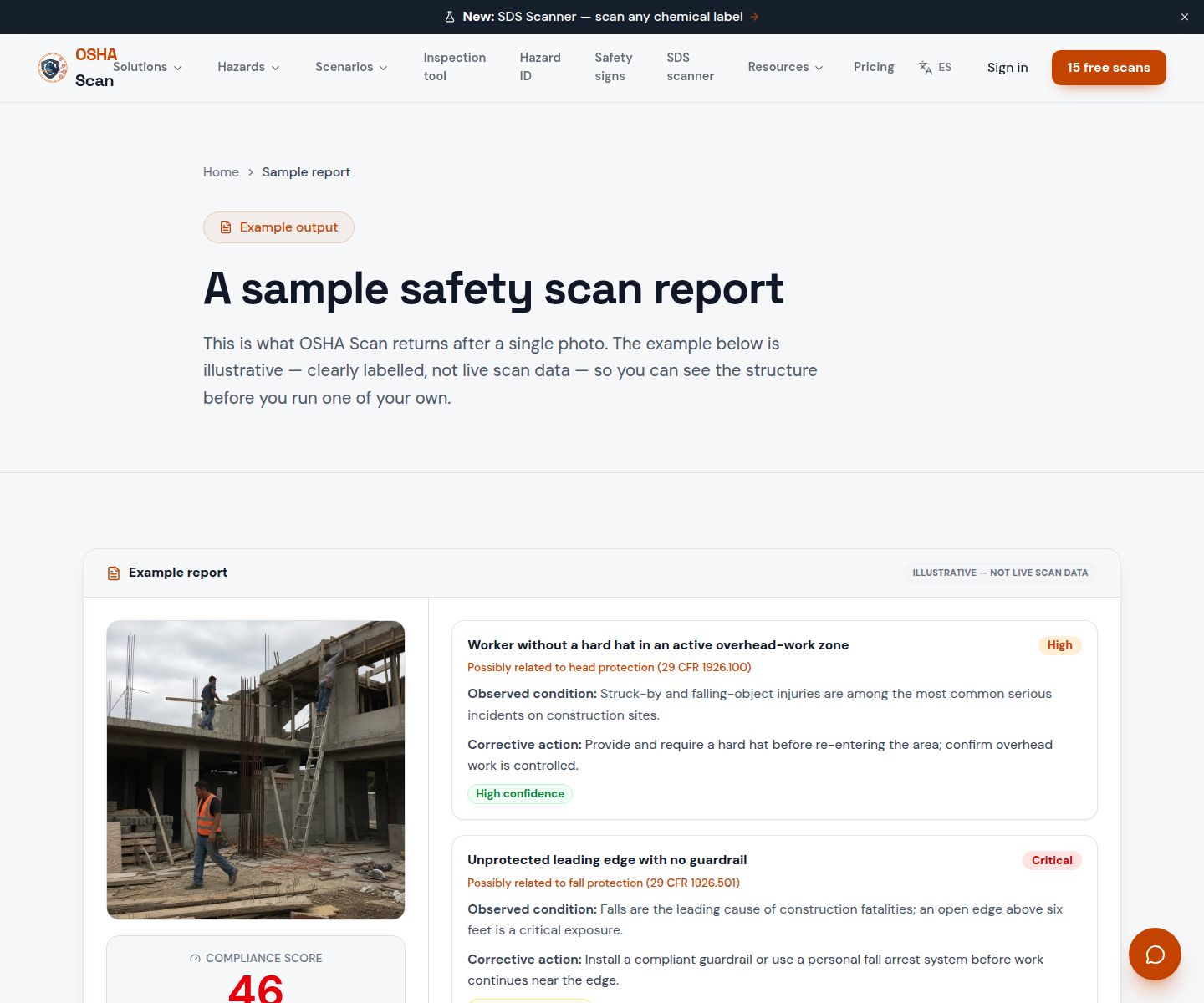
Here is what an OSHA Scan report looks like for ppe gaps. It is an illustrative example built from this trade's hazards — clearly marked, not live scan data.
Compliance score
40
Lower means more potential hazards found
3 potential hazards found
Struck-by with no hard hat
CriticalPossibly related to General requirements (PPE and written hazard assessment) (29 CFR 1910.132)
Observed condition: A laborer walks a work area beneath an active steel-erection zone without a hard hat because he was 'just grabbing a tool.' A bolt dropped from two floors up strikes his head, cau…
Corrective action: Install machine guards, barriers, and screens to stop flying debris before it reaches the worker
High confidence
Eye injury from flying debris
HighPossibly related to Criteria for personal protective equipment (construction) (29 CFR 1926.95)
Observed condition: A worker grinds metal wearing only regular prescription glasses instead of rated safety glasses or a face shield.
Corrective action: Use tools with integrated dust collection or wet-cutting to control silica and other airborne particles
Medium confidenceNot fully clear from the photo — verify on site.
Hearing loss from chronic noise
MediumPossibly related to Head protection (29 CFR 1926.100)
Observed condition: A crew runs jackhammers and saws for months in a noise environment above 90 dBA without hearing protection or a monitoring program.
Corrective action: Apply engineering noise controls — enclosures, mufflers, and quieter equipment — to bring levels below the action limit
High confidence
This sanitized screenshot of the OSHA Scan report interface is an illustrative product sample, not a live job-site scan. It shows how visible findings and suggested next steps can be documented for human review.
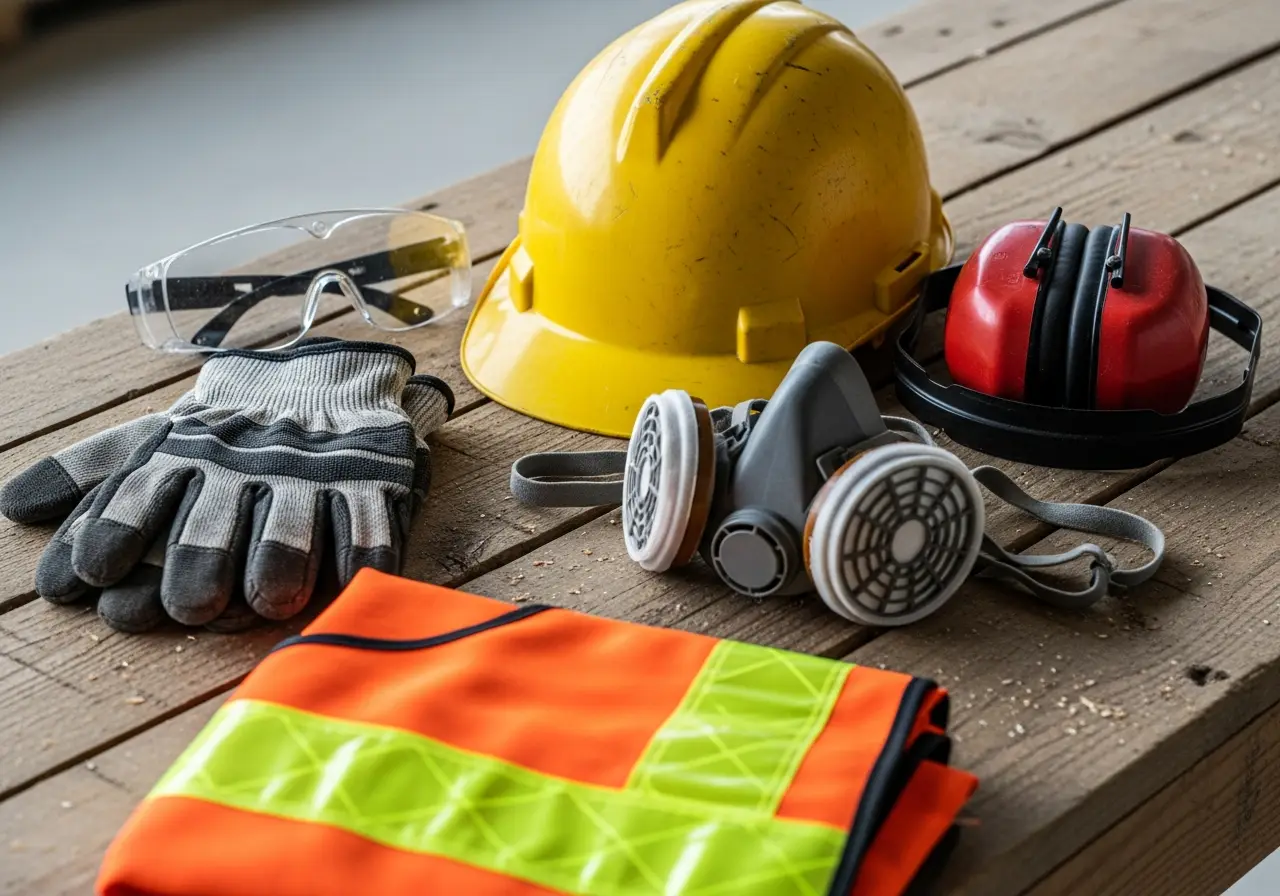
A PPE gap is any situation where a worker faces a recognized hazard without the correct protective equipment, or with equipment that is damaged, expired, wrong for the exposure, or simply not worn. This spans the full range of PPE: head protection (hard hats) against falling and struck-by objects, eye and face protection (safety glasses, goggles, face shields) against flying particles and splashes, hearing protection against damaging noise, respiratory protection against dusts, fumes, and vapors, high-visibility clothing around traffic and equipment, hand protection (gloves) matched to cuts, chemicals, or heat, and foot protection against crushing, punctures, and slips.
Primary OSHA standard: 29 CFR 1910.132
A PPE gap is any situation where a worker faces a recognized hazard without the correct protective equipment, or with equipment that is damaged, expired, wrong for the exposure, or simply not worn. This spans the full range of PPE: head protection (hard hats) against falling and struck-by objects, eye and face protection (safety glasses, goggles, face shields) against flying particles and splashes, hearing protection against damaging noise, respiratory protection against dusts, fumes, and vapors, high-visibility clothing around traffic and equipment, hand protection (gloves) matched to cuts, chemicals, or heat, and foot protection against crushing, punctures, and slips.
PPE is deliberately the last line of defense in the hierarchy of controls — after elimination, substitution, engineering controls, and administrative controls. It does not remove the hazard; it only lowers the severity of an injury if every other control fails. That is why relying on PPE alone is fragile: a moment of forgetfulness, a poor fit, or a worn-out strap can be the difference between going home and going to the hospital.
OSHA places the burden squarely on the employer. Under the general PPE rule the employer must assess the workplace for hazards, document that assessment in writing, select equipment that fits each affected worker, provide it (at no cost for most required PPE), train workers on how to use and maintain it, and enforce its use. A missing written hazard assessment is itself a citable violation, even when the right gear happens to be on the shelf.
PPE and eye/face protection are perennial fixtures on OSHA's most-cited list. A missing written hazard assessment, unpaid-for required PPE, or unprotected workers can each generate serious citations during a single inspection.
Eye injuries, hearing loss, respiratory disease, lacerations, and head trauma are largely preventable with correct PPE. Many — noise-induced hearing loss and silica-related lung disease among them — are permanent and irreversible.
Even minor PPE-related injuries drive recordables, raise the experience modification rate, and increase workers' compensation premiums. A serious head or eye injury can halt a project during investigation and litigation.
General contractors screen subs on their safety records and PPE programs. A documented hazard assessment and clean audit history win prequalification and open the door to larger contracts.
A laborer walks a work area beneath an active steel-erection zone without a hard hat because he was 'just grabbing a tool.' A bolt dropped from two floors up strikes his head, causing a concussion that a simple hard hat would have prevented.
A worker grinds metal wearing only regular prescription glasses instead of rated safety glasses or a face shield. A fragment ricochets under the lens and lodges in his eye, requiring emergency surgery and leaving permanent vision loss.
A crew runs jackhammers and saws for months in a noise environment above 90 dBA without hearing protection or a monitoring program. Audiograms later reveal a standard threshold shift — permanent noise-induced hearing loss across the crew.
A worker dry-cuts concrete containing crystalline silica without a respirator or the required fit test. The invisible dust is inhaled deep into the lungs, contributing to silicosis that will not surface for years but is irreversible when it does.
A worker wears loose, oversized gloves near a rotating drill. The excess material is caught by the bit and pulls his hand into the machine before he can react, causing a degloving injury that properly fitted, task-appropriate gloves would have avoided.
The federal regulations that govern ppe work.
Requires employers to assess the workplace for hazards, certify that assessment in writing, select and provide appropriate PPE that fits each affected worker, and train them on its use. A missing written hazard assessment is itself citable.
Establishes that PPE must be provided, used, and maintained in a sanitary and reliable condition wherever hazards are present, and that employer-required PPE is generally provided at no cost to the worker.
Requires hard hats meeting the applicable ANSI/ISEA Z89.1 standard wherever there is a danger of head injury from impact, falling or flying objects, or electrical shock and burns.
Requires eye and face protection meeting ANSI/ISEA Z87.1 whenever workers are exposed to flying particles, molten metal, chemicals, gases, vapors, or injurious light, with side protection where a hazard from flying objects exists.

Work top-down through the hierarchy of controls — eliminate the hazard first, then fall back to procedures and PPE.
Reduce or remove the hazard at the source so workers depend less on PPE as the final barrier.
Back up engineering controls with documented programs, assessments, and enforcement.
When a hazard cannot be fully eliminated, provide correctly selected and fitted PPE for every exposed worker.
PPE only protects workers who know why it is required, how to fit and inspect it, and when to replace it.
OSHA Scan analyzes photos of workers and job-site areas to flag visible PPE gaps: heads without hard hats in struck-by or overhead-work zones, faces without rated eye or face protection during grinding, cutting, or chipping, workers in high-noise or dusty operations without hearing or respiratory protection, missing high-visibility clothing near traffic and equipment, and hands or feet without task-appropriate gloves or protective footwear. It also spots damaged or improperly worn gear — cracked hard hats, chin straps hanging loose, respirators worn under the chin. Upload a photo and you get an instant report that cites the specific OSHA standard for each finding and generates a corrective-action checklist your crew can work through on site — no waiting for a scheduled audit.
PPE is the last line of defense, sitting below elimination, substitution, engineering controls, and administrative controls. It does not remove the hazard — it only reduces the severity of an injury if the other controls fail. That is why OSHA expects employers to control hazards at the source first and treat PPE as a supplement, not a substitute.
In most cases, yes. OSHA requires employers to provide required PPE at no cost to the worker, including hard hats, safety glasses, hearing protection, respirators, and most gloves and footwear. Narrow exceptions exist — such as ordinary non-specialty prescription safety eyewear allowed off-site and certain everyday footwear — but the general rule is employer-paid.
It is the employer's documented evaluation of each work area and task to identify hazards that require PPE. Under 29 CFR 1910.132 the assessment must be certified in writing, identifying the workplace evaluated, the person certifying it, and the date. Skipping the written certification is itself a citable violation even when the correct PPE is present.
Hard hats are required wherever there is a danger of head injury from impact, falling or flying objects, or electrical shock and burns. They must meet the applicable ANSI/ISEA Z89.1 standard. On active construction sites with overhead work or struck-by hazards, that generally means hard hats are worn at all times in the work area.
Whenever workers are exposed to flying particles, molten metal, liquid chemicals, acids, gases, vapors, or injurious light. Protection must meet ANSI/ISEA Z87.1, and side protection is required where flying objects are a hazard. Regular prescription glasses do not qualify unless they are rated safety eyewear or worn under approved goggles or a face shield.
Yes. Tight-fitting respirators require a fit test before first use, at least annually, and whenever facial changes could affect the seal. Respirator use also requires a medical evaluation and a written respiratory protection program. Voluntary use of filtering facepieces still triggers certain program requirements.
Match the glove to the specific hazard — cut-resistant for sharp materials, chemical-resistant for solvents and acids, and heat-resistant for hot work — and choose the correct size for each worker. Loose or oversized gloves are themselves a hazard near rotating machinery, where they can be caught and pull the hand in.
OSHA requires initial training before a worker is assigned to a task that needs PPE, and retraining whenever the workplace changes in a way that makes the previous training obsolete, when the type of PPE changes, or when a worker demonstrates a lack of understanding or is observed misusing equipment. Respirator users specifically must be retrained at least annually and re-fit-tested on the same schedule. In practice, most contractors run annual PPE refreshers because the knowledge is perishable and hazards evolve as the work progresses. Every training event should be documented with the date, the topics covered, the trainer, and the worker's demonstrated competency, so qualification can be proven during an inspection or after an incident. New hires should never work in a PPE-required area until a competent person has verified they can inspect and correctly wear the equipment.
PPE should be inspected before each use and removed from service the moment damage appears. Hard hats need a look for cracks, dents, gouges, and UV degradation, along with a check that the suspension has not exceeded its service life; safety glasses and face shields for scratches and cracks that impair vision or integrity; gloves for tears, chemical breakthrough, and wear; and respirators for a valid fit and intact valves and straps before every use. Beyond the daily check, employers should run documented periodic inspections — weekly reviews of the crew's gear and monthly audits of inventory, expiration dates, and issuance records — to catch equipment nearing the end of its life. A written inspection log turns these checks into evidence of a functioning program, which matters for OSHA compliance and for defending against liability after an incident. Photo-based tools such as OSHA Scan make it practical to capture and timestamp these inspections consistently across every crew and site.
Stop work immediately whenever a worker faces a recognized hazard without the correct, undamaged PPE — no hard hat in a struck-by zone, no rated eye protection during grinding or cutting, no respirator or fit test where airborne contaminants are present, or hearing protection missing in high-noise operations. Work should also stop when PPE is found damaged, expired, or wrong for the exposure, or when a written hazard assessment for the task has never been completed. Every worker has the right and the responsibility to stop a job that feels unsafe without fear of reprisal, and supervisors should treat a PPE gap as a hard stop rather than a warning. The cost of pausing to retrieve or replace equipment is trivial compared with a permanent eye injury, hearing loss, or head trauma, and a documented stop-work culture is one of the clearest signals to general contractors and insurers that a company manages risk seriously.
Run through this before, during, and after every job.
Free checklist — 23 points
Enter your email to unlock the full checklist
We'll also send you a printable PDF copy — no account required.
One email with the checklist, one follow-up. Unsubscribe anytime.
Unlock this page's printable PPE checklist and use the same daily, weekly, monthly, and project-completion checks with your crew.
Unlock the PPE checklistA mid-size general contractor ran multiple crews across several concurrent job sites. PPE was 'available' in the gang box, but enforcement was inconsistent and there was no certified written hazard assessment tying specific equipment to specific tasks.
A carpenter grinding metal in prescription glasses without side shields took a fragment to the eye, resulting in emergency surgery and permanent partial vision loss. The OSHA inspection that followed found no written hazard assessment and issued citations for both the assessment gap and the eye-protection violation.
The contractor built a certified written hazard assessment for every task, standardized required PPE by activity, enforced it with clear signage and supervisor accountability, and provided employer-paid rated eyewear, hearing protection, and respirators with fit testing. It adopted OSHA Scan to photo-audit crews before work and confirm the right PPE was worn.
Over the following two years the contractor recorded no PPE-related eye or head injuries, cut its recordable rate, and improved its experience modification rate. The documented assessment and audit trail helped the company prequalify for larger institutional contracts that required detailed safety records.
Review findings, organize chemical records, and open relevant official resources for your saved locations and work context.
You make the final call. Review, edit, or dismiss any AI-flagged hazard before finalizing your inspection report.
Scan chemical labels or upload legacy MSDS sheets to create structured drafts that support your team's search for and review of current official manufacturer Safety Data Sheets.
Open official OSHA and State Plan guidance, required posters, emergency contacts, and relevant publications for saved locations and work requirements.
OSHA Scan reads a single photo. That makes it fast and easy for anyone on site — but it also means it has real limits. Here's an honest look at both.
Reviewed by OSHA Scan Editorial
Last updated August 29, 2026
This content is produced by the OSHA Scan Editorial team and reviewed with AI assistance. It is general safety information, not legal or compliance advice. OSHA Scan is an independent tool and is not affiliated with, endorsed by, or certified by OSHA or the U.S. Department of Labor.
Upload a photo of your ppe job site and get an instant, OSHA-cited hazard report.
Start your free trial