
1
Set the scene
Start with context
Fill the frame
2–3 ft for close-ups; keep ladders, cords and workers fully in view.
OSHA's bloodborne pathogens standard (29 CFR 1910.1030) applies to any workplace where employees can reasonably expect contact with blood — which includes every designated first-aid responder, not just hospitals. The visible core: gloves on before touching blood, contaminated dressings and sharps into labeled containers (never loose on a table), and spill cleanup with disinfectant, not a paper towel. Behind that sits the written exposure control plan, hepatitis B vaccination offers, and post-exposure procedures. OSHA Scan reads a photo of first-aid response or cleanup and flags the visible gaps: bare-handed contact with blood, contaminated waste lying loose, and unprotected cleanup. It is an AI-assisted first pass, not an exposure determination.
Free · No account needed to scan · Results in seconds
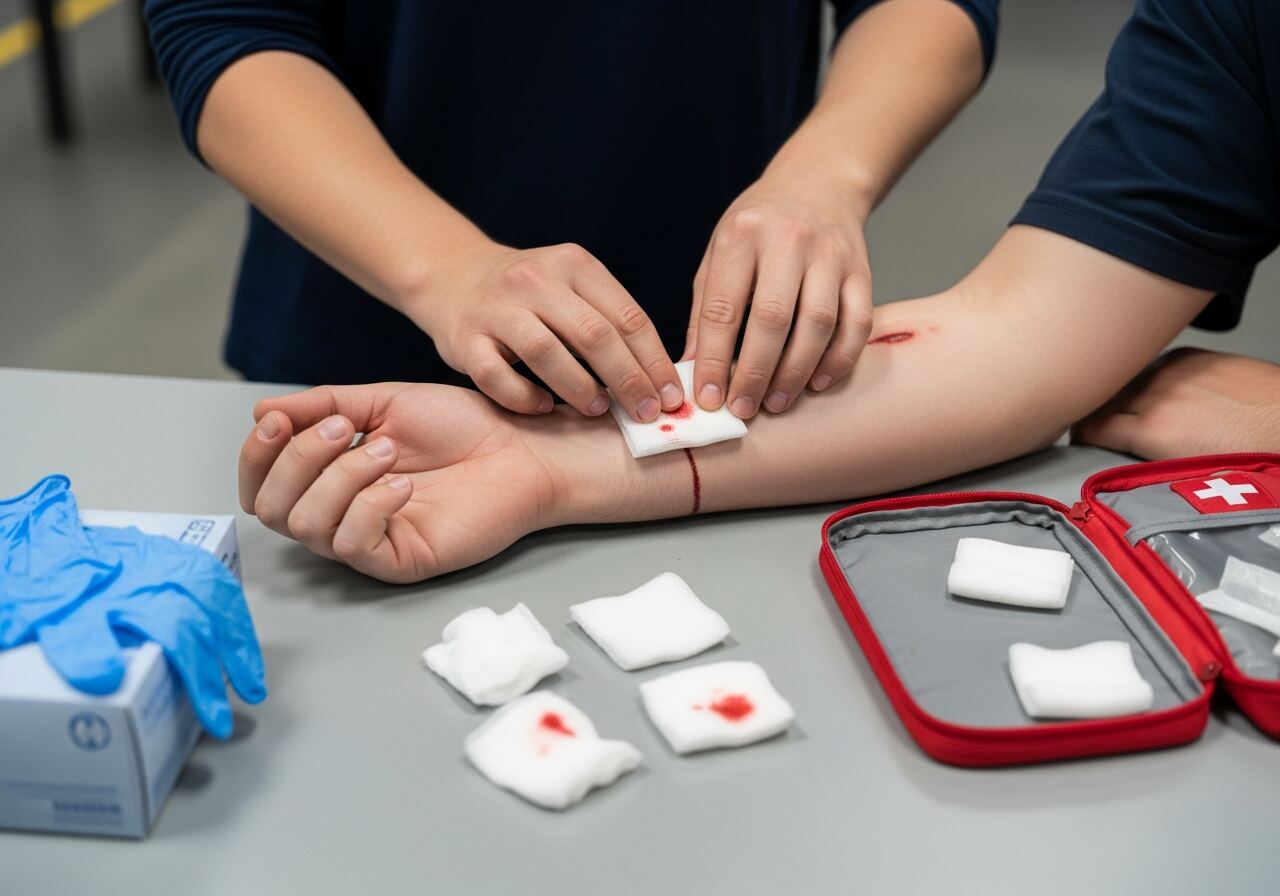
The bloodborne pathogens standard reaches much further than healthcare. If your workplace designates anyone to render first aid — a shift lead, a safety rep, the person nearest the kit — the standard's core obligations apply: universal precautions (treat all blood as infectious), gloves and PPE for any contact, proper handling of contaminated materials, a written exposure control plan, and a hepatitis B vaccination offer for designated responders. The most common real-world failure is also the most human one: a coworker is bleeding, someone rushes to help, and the gloves sitting right there in the kit never go on.
Hepatitis B survives on surfaces for up to a week, which is why the standard cares as much about what happens after the bleeding stops: contaminated dressings go into labeled or color-coded containers, contaminated surfaces get cleaned with an appropriate disinfectant, and sharps go into puncture-resistant containers immediately — never loose in the trash. A photo of a first-aid response or its aftermath catches these moments directly. The checklist below covers the program pieces — the written plan, vaccination records, post-exposure procedures — that no camera can verify.
OSHA's bloodborne pathogens standard (29 CFR 1910.1030) applies to any employer who has employees with reasonably anticipated occupational exposure to blood or other potentially infectious materials (OPIM) — not just healthcare. First-aid responders, janitorial staff, laundry workers, school employees who administer first aid, and employees who participate in body fluid cleanups all qualify as covered employees. The exposure determination must be made at the task level, not the job title level, and it must be documented in the written Exposure Control Plan that the standard requires every covered employer to maintain.
The Exposure Control Plan is the backbone of compliance: it must be updated annually, be accessible to employees, and reflect any procedure or task changes since the last update. It must include the exposure determination, the schedule and method for implementing universal precautions, post-exposure evaluation and follow-up procedures, and the hepatitis B vaccination program details. OSHA's bloodborne pathogens standard also requires employers to use engineering controls — specifically safer needle devices — and document annually that they have solicited and considered employee input on those devices. State-plan states with healthcare concentration, including California, New York, and Washington, have bloodborne pathogen regulations that in some areas exceed federal OSHA requirements.
What the AI checks in a photo of first-aid response, cleanup, or a first-aid station.
First aid being rendered without gloves — the single most common visible violation, even with gloves in the kit an arm's length away.
Blood-soaked gauze and dressings lying on tables and counters instead of going into labeled biohazard bags or containers.
Blood on tables, floors, or equipment with no cleanup or disinfection underway — surfaces stay infectious for days.
First-aid stations with no visible biohazard bags, sharps container, or disinfectant — the response fails before it starts.
Scan a photo like the one above and this is the report you get — score, findings, OSHA references, and fixes. It is an illustrative example, clearly marked — not live scan data.
Compliance score
46
Lower means more potential hazards found
5 potential hazards found
1First aid rendered with completely bare hands on a bleeding wound — unopened glove box visible on the same table
HighPossibly related to PPE requirements under the bloodborne pathogens standard (29 CFR 1910.1030(d)(3))
Observed condition: Any break in the responder's own skin — a hangnail, a cut, dry cracks — is a direct route for hepatitis B or C and HIV, and the exposure is invisible until a blood test weeks later.
Corrective action: Gloves go on before any contact with blood, every time — stage them at the top of the kit, and train designated responders that donning gloves is step one of the response, not an optional extra.
High confidence
2Used blood-stained gauze pads lying loose on the table surface, not in any labeled container
MediumPossibly related to contaminated waste handling (29 CFR 1910.1030(d)(4))
Observed condition: Loose contaminated dressings expose whoever wipes the table next — bloodborne viruses survive on surfaces for days, and the person cleaning up rarely knows what they're touching.
Corrective action: Put contaminated dressings directly into a labeled or red-bagged container as they're used, then disinfect the table surface with an appropriate disinfectant before it's used again.
High confidence
Upload a photo like the one above and get a compliance score and hazard count in seconds. No account needed to scan — create a free account to unlock the full report.
Use the real site or facility name. If you save the scan after signup, it becomes the report name.
Three angles, one deeper scan
Only the wide shot is required — every extra angle gives the AI more places to look.
Required: Set the scene — one wide shot lets the AI sweep the whole area at once
Stand at the entry point and capture corner to corner: floors, ladders, scaffolds, and everyone at work
Drop a job-site photo or walkthrough video
Click to upload, drag & drop, or snap a photo on site. Photos scan free in about 15 seconds — no signup, no card. Video walkthroughs (up to 3 min) run on a free account.
Small habits, sharper scans
Set the scene
Start with context
Fill the frame
2–3 ft for close-ups; keep ladders, cords and workers fully in view.
Capture clearly
Make the frame usable
Light it right
Keep the sun or lights behind you — glare and shadows hide hazards.
Tap to focus
Tap the hazard on screen and hold still one second — blur can't be flagged.
Choose the useful view
Give the AI room to understand
Go landscape
Turn your phone sideways — a wider frame catches more of the scene.
Only upload photos you have permission to use, and avoid images showing personal, customer, or confidential information. Demo photos and results are held privately for up to 48 hours so you can save them to a free account; unclaimed photos are deleted automatically. Results are an AI-assisted preliminary review, not an official OSHA determination.
New: Video walkthrough scans
Record up to 3 minutes of your site — the AI extracts frames and flags every hazard with exact timestamps. Free account required.
Get the best results
Wide shot first
Stand at the entrance and photograph the entire work area so AI sees the full context
Hazard areas
Photograph elevated surfaces, equipment, electrical panels, and anywhere workers are active
Close-ups last
Move in close on anything damaged, missing, or that looks risky — the AI catches more detail
From gloves-on-first to the written exposure control plan. The first four are free — create a free account to unlock the rest and scan your own first-aid setup.
Free checklist — 12 points
Enter your email to unlock the full checklist
We'll also send you a printable PDF copy — no account required.
One email with the checklist, one follow-up. Unsubscribe anytime.
OSHA Scan reads a single photo. That makes it fast and easy for anyone on site — but it also means it has real limits. Here's an honest look at both.
A scan is a fast first look, not the final word. Before treating this kind of area as safe, a competent person should still confirm:
Yes — it applies to any employee with occupational exposure, meaning reasonably anticipated contact with blood as part of their duties. Designated first-aid responders in factories, warehouses, construction offices, gyms, and schools are the classic non-healthcare case: if responding to injuries is part of someone's assigned role, the employer owes them the standard's protections, including the exposure control plan, PPE, training, and the hepatitis B vaccination offer.
Wash the exposed area with soap and water right away (flush eyes or mucous membranes with water), report the exposure immediately, and get a confidential medical evaluation — ideally within hours, because post-exposure prophylaxis for hepatitis B and HIV is most effective when started fast. The employer documents the incident, arranges source-patient testing where the law permits, and provides follow-up at no cost to the employee.
It can flag the visible response failures: bare hands on a bleeding wound, contaminated gauze loose on a table, missing sharps containers or biohazard bags at a first-aid station, and uncleaned blood on surfaces. It cannot verify the written plan, vaccination records, or training — those live in documents. Use the scan to audit first-aid stations and drill responses between formal program reviews.
Reviewed by OSHA Scan Editorial
Last updated August 29, 2026
This content is produced by the OSHA Scan Editorial team and reviewed with AI assistance. It is general safety information, not legal or compliance advice. OSHA Scan is an independent tool and is not affiliated with, endorsed by, or certified by OSHA or the U.S. Department of Labor.
More ways to see what an AI OSHA scan can do for your site.
The overview hub — how the scanner works and every job, site, and hazard it covers.
The general workplace basics — first aid, sanitation, signage — around your response program.
Cuts and burns are daily events in kitchens — where first-aid response gets tested most.
The broader facility scan that includes first-aid station readiness.
See a complete labelled example of everything a scan returns.
Start with 5 included AI site scans plus a one-time 10-scan signup bonus — no credit card. Build JHA-ready reports and catch changing conditions sooner.
Start your free trial