
Missing SDS: what to do when a chemical has no safety data sheet
If you have a chemical on the shelf and no safety data sheet in the binder, the fix is a short, documented playbook: identify the product exactly from its label, request the SDS from your supplier or the manufacturer (they are required to provide it), write down when and how you asked, apply interim precautions straight off the label until the sheet arrives, and file the SDS in your library the moment you get it. Do not skip the request — the burden is on the manufacturer to give you a current sheet. OSHA Scan helps you start that chain by scanning the label into a searchable inventory entry, so the gap is tracked and visible instead of forgotten.
Free · No account needed to scan · Results in seconds
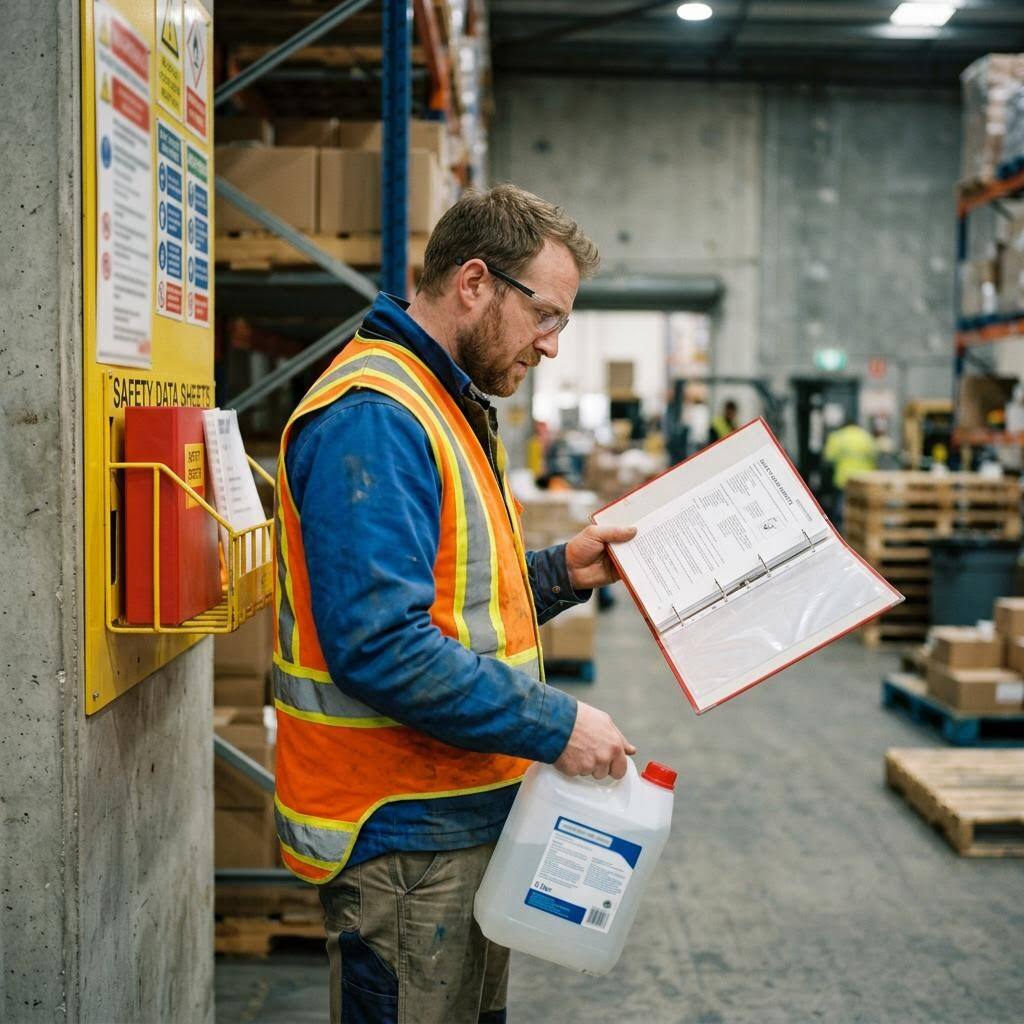
The chemical is right there. The sheet isn't. Here's the order of operations.
It happens on every site: a maintenance tech grabs a jug of degreaser, a subcontractor leaves behind a can of adhesive, or a new cleaner shows up in the janitor closet — and when someone pulls the binder, there is no matching safety data sheet. Panic is not the play. The requirement is that every hazardous chemical in your workplace has a current SDS readily accessible to workers, and the manufacturer or importer is the party responsible for producing that sheet. Your job is to identify the product precisely, ask the right party, document the ask, and protect people in the meantime.
The single most common reason a request goes nowhere is a fuzzy product identity. 'The blue cleaner' or 'Bob's spray' will not get you the right PDF. You need the exact product name, the manufacturer, and any product or version number printed on the label. That is where scanning the label pays off — it captures those identifiers into a searchable inventory entry so you can request the correct sheet and, until it arrives, the entry shows plainly that the SDS is still missing rather than letting the gap disappear into a binder nobody has opened in a year.
OSHA's 'readily accessible' standard: what it actually requires
OSHA's Hazard Communication Standard (29 CFR 1910.1200(g)) requires that safety data sheets be 'readily accessible' to workers in their work area during each work shift. OSHA has interpreted readily accessible to mean that workers can get the SDS immediately when needed — not that they have to request it from a supervisor, wait for an office to open, or search for it on a system they cannot access from the floor. A binder locked in the supervisor's office does not satisfy the standard, nor does a digital library on a workstation in a different building from where the chemical is used. The accessibility requirement applies to the work shift and the work location, not just the facility as a whole.
Missing SDS citations are one of OSHA's most straightforward enforcement actions because the gap is easy to document and hard to dispute: the inspector asks to see the SDS for a chemical they observe being used, and if it cannot be produced promptly from a location accessible to workers, the citation follows. Employers relying on a supplier to provide SDSs 'eventually' or maintaining a library that does not include recent deliveries face exactly this exposure. The documented request-and-tracking approach described on this page addresses the enforcement risk: a written request to the supplier, a flagged inventory entry showing the gap is known and being pursued, and interim precautions documented in writing are the elements of a good-faith defense while the sheet is in transit.
Manufacturer obligations and what to do when a supplier won't produce the sheet
Chemical manufacturers and importers are required under 29 CFR 1910.1200(g) to prepare an SDS for each hazardous chemical they produce or import and to provide it to downstream users with the first shipment and upon request. Distributors must pass current SDSs to their customers. This means the primary obligation to produce the sheet rests with the manufacturer or importer — an employer cannot be cited for failing to author a sheet, but can be cited for not having it, because the employer's duty is to obtain and maintain accessible SDSs for every hazardous chemical in the workplace.
When a supplier refuses to provide an SDS or claims a product is non-hazardous and therefore exempt, the employer should request the basis for the hazard determination in writing. OSHA's hazard classification criteria are specific, and many products that companies label 'non-hazardous' do meet the criteria for at least one GHS hazard category when evaluated properly. If a supplier persistently fails to provide an SDS for a product that appears hazardous based on its label, OSHA recommends contacting the nearest OSHA area office — the agency can require the manufacturer to provide the sheet. In the interim, the employer should document every request attempt and treat the chemical as hazardous based on available label information until a sheet is obtained.
How to conduct a missing sds
Run through these steps before crews start — each one covers a visible gap the AI can help you catch.
- 1
Identify the product exactly
Read and photograph the label to capture the exact product name, manufacturer, and any product or version number — the precise identity a supplier needs to send the correct SDS.
- 2
Request the SDS from supplier or manufacturer
Ask the distributor you bought it from for the current SDS; if they don't respond, contact the manufacturer, who is responsible for producing it. Most publish current sheets on their site.
- 3
Document the request
Record the date, the person or company you asked, and the method — preferably email — so you have proof of a good-faith request while you wait for the sheet.
- 4
Apply interim precautions from the label
Use the label's signal word, pictograms, and precautionary statements to set PPE, handling, and storage, and communicate them to everyone using the product until the SDS arrives.
- 5
File the SDS and make it accessible
When the current sheet arrives, attach it to the chemical's inventory entry, confirm the product and version match the container, and make it reachable to workers during their shift.
What a label scan captures while the SDS is still missing
When there is no sheet yet, a label photo still pulls the details you need to request the right one and warn workers in the meantime.
Exact product identifiers
Product name, manufacturer, and any product or version number the label shows — the precise identity you need to request the correct SDS, not a near-miss.
Label hazard cues
The signal word, GHS pictograms, and hazard statements printed on the container, so you can apply interim precautions before the full sheet lands.
A tracked inventory entry
The chemical goes into a searchable library flagged as 'SDS missing', so the gap is on a list someone owns instead of forgotten on a shelf.
An honest AI draft profile
An AI-drafted internal chemical profile clearly labeled as a draft and NOT the manufacturer's SDS — a stopgap reference, never a substitute for the real sheet.
Demo: the library entry a scanned label comes back with
An illustrative example for this trade — product identity, signal word, GHS pictograms, and hazard statements, filed and searchable.
Citrus-based degreaser concentrate
Example manufacturer
The exact degreaser that turns up on a shop shelf with no matching sheet in the binder — scan the label so the gap is tracked while you request the SDS.
- H226 — Flammable liquid and vapour
- H319 — Causes serious eye irritation
Now scan your own label — free
Photograph any chemical product on your shelf. The AI transcribes the label in seconds — no account needed to try it.
- A searchable inventory entry from one label photo — product name, manufacturer, signal word, pictograms
- An AI-drafted internal chemical profile clearly labeled NOT the manufacturer's SDS, so the gap stays visible
- A place to attach the real SDS PDF the moment your supplier sends it
Free · No account needed to scan · Results in seconds
The 11-step missing-SDS response checklist
Exactly what to do, in order, the moment you find a chemical with no sheet. The first four are free — create a free account or leave your email to unlock the rest and scan your own chemicals.
Free checklist — 11 points
Enter your email to unlock the full checklist
We'll also send you a printable PDF copy — no account required.
One email with the checklist, one follow-up. Unsubscribe anytime.
What the AI can and can't detect
OSHA Scan reads a single photo. That makes it fast and easy for anyone on site — but it also means it has real limits. Here's an honest look at both.
What it can catch from a photo
- Product name and manufacturer printed on the label
- Signal word, GHS pictograms, and hazard statements on the container
- Whether the chemical already has an entry in your library
- Whether an SDS PDF is attached to that entry or still missing
What a photo can't tell it
- Whether the supplier has actually sent the current SDS
- Whether the attached PDF is the exact right product and version (human check)
- The correct interim PPE beyond what the label states
- Whether workers can physically reach the sheet on the floor
Always confirmed by a person on site
A scan is a fast first look, not the final word. Before treating this kind of area as safe, a competent person should still confirm:
- The SDS you received matches the exact product name, manufacturer, and version on the container
- Your written request to the supplier or manufacturer is saved and dated
- Interim precautions were communicated to everyone using the product
- The chemical is reachable to workers during their shift, not locked in an office
People also ask
What do I do if I can't find a safety data sheet for a chemical?
Work the request chain. First identify the product exactly — product name, manufacturer, and version off the label. Search your existing library in case it's filed under a different name. Then ask your supplier for the current SDS; if they stall, go to the manufacturer, who is responsible for producing it. Document the request, apply the label's precautions in the meantime, and file the real sheet when it arrives. Scanning the label into a tracked inventory entry keeps the gap visible so the request doesn't get forgotten.
Who is responsible for providing a missing SDS — me or the manufacturer?
The manufacturer or importer is responsible for classifying the hazard and authoring the SDS, and suppliers must pass a current sheet to downstream users. Your responsibility as the employer is to obtain and maintain SDSs for every hazardous chemical you have and to keep them readily accessible to workers. So you request it, but you should not have to write it — and you should never fabricate one to fill the gap.
Can I use a generic or similar-product SDS while I wait for the real one?
No. A generic sheet or a near-match from a different product can carry the wrong first aid, PPE, or fire response, which is dangerous in an exposure. Until the correct sheet arrives, rely on the label's own hazard information for interim precautions. If you want an internal reference in the meantime, an AI-drafted profile is acceptable only when it's clearly marked a draft and explicitly not the manufacturer's SDS.
How does scanning the label help if the SDS is still missing?
Scanning captures the exact identifiers you need to request the right sheet — product name, manufacturer, signal word, pictograms — and drops the chemical into a searchable library flagged as 'SDS missing'. That turns an invisible gap on a shelf into a tracked item someone owns. OSHA Scan does not auto-fetch the sheet from a manufacturer database; you still request it, but the gap stays on a list until the real PDF is attached.
How long can I keep a chemical on site without its SDS?
There is no grace period that makes a hazardous chemical without an accessible SDS acceptable — the requirement is that a current sheet be available to workers. What protects you while you obtain it is a documented, good-faith request and interim precautions taken straight from the label. Move quickly: request the sheet the same day you find the gap, and don't let 'we ordered it' become a permanent state.
Reviewed by OSHA Scan Editorial
Last updated August 29, 2026
This content is produced by the OSHA Scan Editorial team and reviewed with AI assistance. It is general safety information, not legal or compliance advice. OSHA Scan is an independent tool and is not affiliated with, endorsed by, or certified by OSHA or the U.S. Department of Labor.
Keep exploring
More ways to see what an AI OSHA scan can do for your site.
The AI OSHA inspection tool
The overview hub — how the scanner works and every job, site, and hazard it covers.
SDS scanner
Scan a chemical label to build the inventory entry and attach the real SDS.
Missing safety data sheet scenario
A walkthrough of what goes wrong the day the sheet isn't there.
Chemical inventory list
Build the master list so a missing sheet shows up before an inspector finds it.
Outdated SDS
Once you have the sheet, keep it current as suppliers issue revisions.
OSHA: Steps to an Effective Hazard Communication Program
OSHA's guide covering SDS access, labels, inventory, and training requirements.
Official resource — osha.govA full sample report
See a complete labelled example of everything a scan returns.
Ready to secure your job sites?
Start with 5 included AI site scans plus a one-time 10-scan signup bonus — no credit card. Build JHA-ready reports and catch changing conditions sooner.
Start your free trial