
1
Set the scene
Start with context
Fill the frame
2–3 ft for close-ups; keep ladders, cords and workers fully in view.
Catch uncontrolled dust before it becomes silicosis
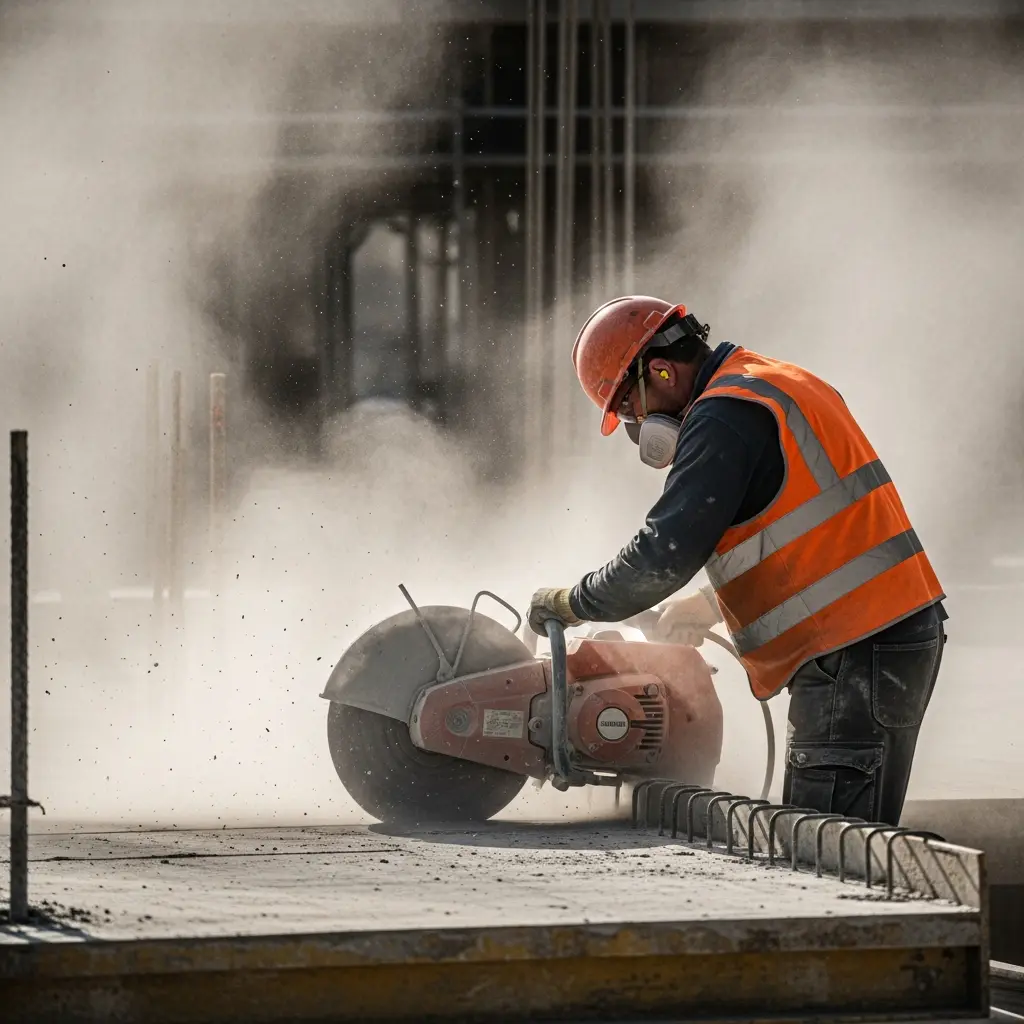
Cutting, grinding, and drilling concrete, brick, and stone release respirable crystalline silica — particles small enough to bury deep in the lungs and cause incurable silicosis, lung cancer, and COPD. The dust is often too fine to see, and symptoms may not appear for years. OSHA Scan analyzes job-site photos to flag dry cutting, dust clouds, and missing water or vacuum controls before workers breathe in a lifetime of exposure.
Free · No account needed to scan · Results in seconds
May relate to 29 CFR 1926.1153
US workers exposed to silica yearly
Per serious OSHA silica violation
OSHA permissible exposure limit (8-hr)
US silicosis deaths per year
A respirable crystalline silica hazard exists wherever workers cut, grind, drill, or crush silica-containing materials — concrete, brick, block, stone, mortar, and engineered countertops — without water suppression or vacuum dust collection. The tell-tale sign is a visible dust cloud, but the most dangerous particles are the ones too small to see hanging in the air long after the cut.
On job sites it shows up as dry saw cutting on a slab with no water hose, tuck-point grinding that coats a worker in gray powder, jackhammering with no local exhaust ventilation, or cleaning up dry debris with a broom that re-suspends settled dust. Enclosed spaces make it far worse, concentrating airborne silica with nowhere to disperse.
The insidious part is that silica exposure feels harmless in the moment — no burning, no immediate cough, no alarm. The damage accumulates silently over months and years until scar tissue stiffens the lungs. That delayed, invisible nature is exactly why photo-based detection of dry cutting and missing controls matters.
Here is what an OSHA Scan report looks like for silica dust inhalation. It is an illustrative example built from this scenario's hazards — clearly marked, not live scan data.
Compliance score
49
Lower means more potential hazards found
3 potential hazards found
Silica Dust Inhalation
CriticalPossibly related to Respirable crystalline silica (construction) (29 CFR 1926.1153)
Observed condition: A respirable crystalline silica hazard exists wherever workers cut, grind, drill, or crush silica-containing materials — concrete, brick, block, stone, mortar, and engineered coun…
Corrective action: Use integrated water delivery on saws and grinders to suppress dust at the blade
High confidence
Silica Dust Inhalation: Respiratory protection
HighPossibly related to Respiratory protection (29 CFR 1910.134)
Observed condition: Requires a respiratory protection program including medical evaluation, fit testing, and proper selection whenever respirators are used to control silica exposure.
Corrective action: Fit tools with dust-collection shrouds vented to a HEPA-filtered vacuum
Medium confidenceNot fully clear from the photo — verify on site.
Silica Dust Inhalation: Hazard communication
MediumPossibly related to Hazard communication (29 CFR 1910.1200)
Observed condition: Requires labeling, safety data sheets, and worker training on the hazards of crystalline silica-containing materials on site.
Corrective action: Follow OSHA Table 1 specified control methods for each task
High confidence
High short-term exposures can cause acute silicosis within weeks, and every uncontrolled cut adds irreversible scarring. There is no cure for silicosis — once lung tissue hardens, the damage is permanent.
OSHA's respirable crystalline silica standard is heavily enforced. A serious violation exceeds $16,000, willful or repeat violations top $165,000, and long-latency disease claims drive massive workers' compensation and litigation costs.
A silica citation triggers exposure assessments, medical surveillance, and engineering upgrades that halt production. Retrofitting water and vacuum controls mid-project is far costlier than building them in from the start.
Concrete cutting, masonry, demolition, tunneling, and stone-countertop fabrication carry the highest silica risk, often with small crews on dry saws who underestimate an invisible, delayed-onset hazard.
OSHA Scan uses an AI vision model to spot the signatures of uncontrolled silica exposure. Upload a photo of a cutting, grinding, or drilling task and it detects visible dust clouds, identifies dry cutting without water suppression, checks for vacuum dust collection and respirators, flags the task with a severity rating, and cites 29 CFR 1926.1153 — in seconds, before the crew keeps working in the dust.
Analyze your first photo freeUpload a real job-site photo and OSHA Scan detects visible hazards in seconds — no account needed to run your first scan.
Use the real site or facility name. If you save the scan after signup, it becomes the report name.
Three angles, one deeper scan
Only the wide shot is required — every extra angle gives the AI more places to look.
Required: Set the scene — one wide shot lets the AI sweep the whole area at once
Stand at the entry point and capture corner to corner: floors, ladders, scaffolds, and everyone at work
Drop a job-site photo or walkthrough video
Click to upload, drag & drop, or snap a photo on site. Photos scan free in about 15 seconds — no signup, no card. Video walkthroughs (up to 3 min) run on a free account.
Small habits, sharper scans
Set the scene
Start with context
Fill the frame
2–3 ft for close-ups; keep ladders, cords and workers fully in view.
Capture clearly
Make the frame usable
Light it right
Keep the sun or lights behind you — glare and shadows hide hazards.
Tap to focus
Tap the hazard on screen and hold still one second — blur can't be flagged.
Choose the useful view
Give the AI room to understand
Go landscape
Turn your phone sideways — a wider frame catches more of the scene.
Only upload photos you have permission to use, and avoid images showing personal, customer, or confidential information. Demo photos and results are held privately for up to 48 hours so you can save them to a free account; unclaimed photos are deleted automatically. Results are an AI-assisted preliminary review, not an official OSHA determination.
New: Video walkthrough scans
Record up to 3 minutes of your site — the AI extracts frames and flags every hazard with exact timestamps. Free account required.
Get the best results
Wide shot first
Stand at the entrance and photograph the entire work area so AI sees the full context
Hazard areas
Photograph elevated surfaces, equipment, electrical panels, and anywhere workers are active
Close-ups last
Move in close on anything damaged, missing, or that looks risky — the AI catches more detail
A two-person crew was cutting a network of trenches into a concrete basement floor for new plumbing. To avoid the mess of water slurry indoors, they used a dry gas-powered saw with no vacuum attachment and the basement doors closed against the cold.
Within minutes the basement filled with a gray haze. Neither worker wore a respirator because 'it was just a quick job.' They breathed high concentrations of respirable silica for nearly three hours. A follow-up exposure assessment measured airborne silica at more than ten times the permissible limit.
A single photo of the setup run through OSHA Scan before cutting began would have flagged dry cutting in an enclosed space with no dust control as a critical silica hazard, cited 29 CFR 1926.1153, and prompted the crew to switch to a wet saw or vacuum-equipped saw and don proper respirators before the first cut.
'Quick' dry cuts in enclosed spaces are among the highest silica exposures on any job. Water suppression or vacuum collection is not optional, and a respirator is required whenever controls cannot keep exposure below the limit.
Layered controls, from most to least effective.
Stop silica from becoming airborne at the point of the cut.
Manage exposure through planning, monitoring, and housekeeping.
Protect the lungs when engineering controls cannot fully eliminate exposure.
The federal standards this hazard may relate to.
Sets a permissible exposure limit of 50 µg/m³ over an 8-hour shift and requires engineering controls, a written exposure control plan, medical surveillance, and either Table 1 controls or exposure assessment.
Up to $16,550 per serious violation; $165,514 for willful or repeat
Requires a respiratory protection program including medical evaluation, fit testing, and proper selection whenever respirators are used to control silica exposure.
Up to $16,550 per serious violation
Requires labeling, safety data sheets, and worker training on the hazards of crystalline silica-containing materials on site.
Up to $16,550 per serious violation
If an incident occurs, act fast and in order.
Workers will understand how silica exposure damages the lungs, recognize tasks that generate respirable silica, and correctly use water suppression, vacuum collection, and respirators to stay below the exposure limit.
Train before any silica-generating work, refresh annually, and reinforce with a toolbox talk at the start of each cutting or grinding task using real photos of controlled and uncontrolled dust.
Run these checks to stay ahead of citations.
10 more checklist points are waiting. Register with your email to reveal every item and download the complete OSHA compliance checklist as a printable PDF. Free, and it only takes a few seconds.
Already have an account? Sign in
Respirable crystalline silica is the fraction of silica dust small enough (generally under 10 microns) to reach deep into the lungs. It is released when cutting, grinding, drilling, or crushing concrete, brick, stone, mortar, and engineered stone, and it causes silicosis, lung cancer, and COPD.
OSHA's permissible exposure limit for respirable crystalline silica is 50 micrograms per cubic meter of air averaged over an 8-hour shift, with an action level of 25 µg/m³ (29 CFR 1926.1153). Exposure above the action level triggers monitoring and medical surveillance requirements.
Table 1 in the silica standard lists specific control methods — such as water delivery or dust collection — for common tasks. If you fully implement the controls for your task, you are deemed compliant without separate air monitoring, making it the simplest path to compliance.
Often the water suppression or vacuum controls in Table 1 reduce exposure enough that respirators are only required for longer durations or enclosed work. Follow the respirator requirements listed for your specific task in Table 1, and always provide respirators when controls cannot keep exposure below the limit.
Dry sweeping and compressed-air cleaning re-suspend settled silica into the breathing zone, often creating higher exposures than the original cutting. OSHA prohibits these methods for silica cleanup — use HEPA-filtered vacuums or wet methods instead.
Silica causes silicosis (irreversible lung scarring), lung cancer, chronic obstructive pulmonary disease, and kidney disease. Silicosis can be chronic, developing over 10 or more years, or acute, appearing within weeks after very high exposures. There is no cure.
Employers must offer medical exams every three years to workers who wear a respirator for silica for 30 or more days a year. The exam includes a chest X-ray and lung function test to catch early disease before it becomes disabling.
OSHA Scan detects the visual signatures of uncontrolled silica exposure — dust clouds, dry cutting, and missing water or vacuum controls. It flags the task and cites 29 CFR 1926.1153 so you can add controls before exposure occurs.
Upload a photo of your cutting or grinding task and get instant feedback on dust controls in your exact environment.
Get startedPut our expert silica-control checklist to work on your next job to stay ahead of citations and disease.
Get startedSee how OSHA Scan fits your concrete or masonry operation and get recommendations for your specific tasks.
Get startedSee how other contractors use OSHA Scan to control silica dust before it damages workers' lungs.
Get startedReview findings, organize chemical records, and open relevant official resources for your saved locations and work context.
You make the final call. Review, edit, or dismiss any AI-flagged hazard before finalizing your inspection report.
Scan chemical labels or upload legacy MSDS sheets to create structured drafts that support your team's search for and review of current official manufacturer Safety Data Sheets.
Open official OSHA and State Plan guidance, required posters, emergency contacts, and relevant publications for saved locations and work requirements.
OSHA Scan reads a single photo. That makes it fast and easy for anyone on site — but it also means it has real limits. Here's an honest look at both.
Reviewed by OSHA Scan Editorial
Last updated August 29, 2026
This content is produced by the OSHA Scan Editorial team and reviewed with AI assistance. It is general safety information, not legal or compliance advice. OSHA Scan is an independent tool and is not affiliated with, endorsed by, or certified by OSHA or the U.S. Department of Labor.
Start with 5 included AI site scans plus a one-time 10-scan signup bonus — no credit card. Build JHA-ready reports and catch changing conditions sooner.
Start your free trial