
1
Set the scene
Start with context
Fill the frame
2–3 ft for close-ups; keep ladders, cords and workers fully in view.
A food processing safety inspection checklist covers the occupational hazards specific to food manufacturing and processing plants: highly slippery wet floors from wash-down operations, unguarded or inadequately guarded conveyor and slicing equipment, chemical sanitizer storage and labeling, cold-storage entry hazards, and ammonia refrigeration exposure risks. OSHA Scan lets a production supervisor or safety officer photograph a processing line, a wet-floor zone, a chemical storage room, or a cooler entry and get an instant read on visible workplace safety hazards. It covers OSHA-regulated occupational safety, not food-safety or HACCP compliance, which are regulated separately.
Free · No account needed to scan · Results in seconds
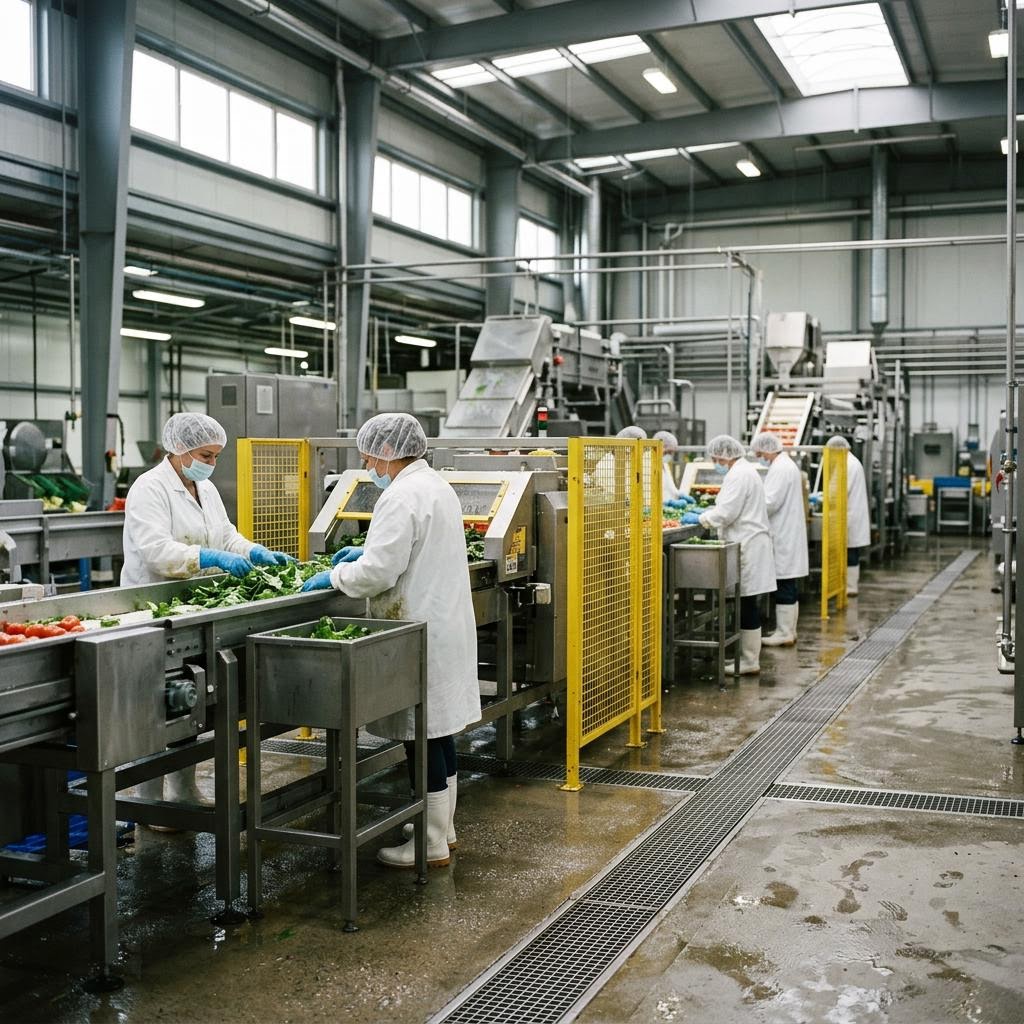
Food processing plants face a distinctive safety profile: floors are intentionally wet from sanitation, knives and slicers are everywhere, ammonia or CO2 refrigeration presents inhalation risk, and confined spaces for tanks and hoppers are common. OSHA's food-processing citations consistently include guarding on processing equipment, slip-and-fall conditions from wet-floor operations, and chemical handling in sanitizer and cleaning programs.
The scanner focuses on the visible, OSHA-addressable conditions in a processing environment: a meat or vegetable slicer without the blade guard in place, standing water on a production floor without signage, a sanitizer drum without a label, or a freezer-room door left open without a temperature sign for confined-space classification. It does not evaluate HACCP plans, FSMA compliance, or food-safety practices — those are FDA and USDA territory.
Food processing is among OSHA's targeted inspection sectors, with the food manufacturing National Emphasis Program focusing on amputation hazards from machine guarding deficiencies, lockout/tagout failures, and ergonomic risk factors from repetitive processing tasks. The combination of cold wet environments, cutting tools, high-speed machinery, and sanitation chemical exposure creates a hazard profile that spans multiple OSHA standards simultaneously — a single food processing inspection typically evaluates machine guarding, LOTO, hazard communication, personal protective equipment, and walking-working surfaces in the same walk.
Anhydrous ammonia refrigeration systems, common in large food processing facilities, are subject to both OSHA's Process Safety Management standard (29 CFR 1910.119) if quantities exceed 10,000 pounds, and EPA's Risk Management Program. PSM compliance involves process hazard analyses, management of change procedures, mechanical integrity programs, and emergency response planning — a compliance load distinct from the general safety standards that apply to the rest of the facility. OSHA has cited food processing facilities for inadequate hazard communication on sanitation chemicals that workers mix and apply daily without access to current Safety Data Sheets.
Run through these steps before crews start — each one covers a visible gap the AI can help you catch.
Start at the slicers, dicers, and conveyors. Confirm blade guards and nip-point guards are in place and that any equipment being cleaned is locked and tagged out — unguarded blades and cleaning without lockout are serious amputation exposures in food plants.
Move through wash-down and sanitation areas. Look for standing water without wet-floor signs, drains that are backing up, and missing anti-slip matting at fixed stations — slips on wet floors are a constant exposure in wash-down environments and may relate to 29 CFR 1910.22.
Check that every sanitizer and cleaning-chemical container is labeled and stored away from food-contact surfaces, and that PPE for chemical handling is available. Unlabeled containers and improper storage may relate to 29 CFR 1910.1200.
At walk-in coolers and freezers, confirm interior emergency-release hardware is present and unobstructed and that temperature and refrigerant signage is posted. Trapped-worker and ammonia-release exposures may relate to 29 CFR 1910.36 and the ammonia refrigeration provisions of 1910.119.
Photograph the line, wet-floor zone, or chemical area and upload it to OSHA Scan for an AI second-pass. The AI flags visible hazards it can see, notes the OSHA standard each may relate to, and suggests a fix — treat the findings as a draft to verify on site. Free, no account needed.
The occupational-safety core of a food manufacturing checklist, read from an image.
Standing water from sanitation wash-down, uncontained drainage, and missing wet-floor signs in production and cooler areas — the top injury category in food plants.
Missing blade guards on slicers, open nip points on conveyors, and unguarded cutting and portioning equipment accessible to the operator.
Freezer and cooler rooms without temperature signage, missing emergency-egress hardware on walk-in doors, and refrigerant-leak indicators missing.
Unlabeled sanitizer and cleaning-chemical containers, improper chemical storage near food-contact surfaces, and missing PPE for chemical-handling tasks.
Scan a photo like the one above and this is the report you get — score, findings, OSHA references, and fixes. It is an illustrative example, clearly marked — not live scan data.
Compliance score
63
Lower means more potential hazards found
5 potential hazards found
1Standing water pooling on the production floor beyond the drainage grate
HighPossibly related to walking-working surfaces (29 CFR 1910.22(a)(3))
Observed condition: Washdown floors are expected to be wet, but pooling beyond the drains means the slope or drainage is failing — workers crossing between lines hit standing water in rubber boots at pace.
Corrective action: Squeegee standing water to the drains between washdowns; report low spots for regrading; verify drain grates are clear of debris.
High confidence
2Open transfer point on the conveyor beside workers' gloved hands — verify pinch-point guarding
MediumPossibly related to machine guarding (29 CFR 1910.212)
Observed condition: Gloved hands working product next to a moving belt can be drawn into an unguarded transfer point — glove entanglement turns a brush contact into a caught-in injury.
Corrective action: Verify fixed guards cover the drive and transfer points within reach of work positions; train workers to stop the belt before clearing jams.
Medium confidenceNot fully clear from the photo — verify on site.
Upload a photo like the one above and get a compliance score and hazard count in seconds. No account needed to scan — create a free account to unlock the full report.
Use the real site or facility name. If you save the scan after signup, it becomes the report name.
Three angles, one deeper scan
Only the wide shot is required — every extra angle gives the AI more places to look.
Required: Set the scene — one wide shot lets the AI sweep the whole area at once
Stand at the entry point and capture corner to corner: floors, ladders, scaffolds, and everyone at work
Drop a job-site photo or walkthrough video
Click to upload, drag & drop, or snap a photo on site. Photos scan free in about 15 seconds — no signup, no card. Video walkthroughs (up to 3 min) run on a free account.
Small habits, sharper scans
Set the scene
Start with context
Fill the frame
2–3 ft for close-ups; keep ladders, cords and workers fully in view.
Capture clearly
Make the frame usable
Light it right
Keep the sun or lights behind you — glare and shadows hide hazards.
Tap to focus
Tap the hazard on screen and hold still one second — blur can't be flagged.
Choose the useful view
Give the AI room to understand
Go landscape
Turn your phone sideways — a wider frame catches more of the scene.
Only upload photos you have permission to use, and avoid images showing personal, customer, or confidential information. Demo photos and results are held privately for up to 48 hours so you can save them to a free account; unclaimed photos are deleted automatically. Results are an AI-assisted preliminary review, not an official OSHA determination.
New: Video walkthrough scans
Record up to 3 minutes of your site — the AI extracts frames and flags every hazard with exact timestamps. Free account required.
Get the best results
Wide shot first
Stand at the entrance and photograph the entire work area so AI sees the full context
Hazard areas
Photograph elevated surfaces, equipment, electrical panels, and anywhere workers are active
Close-ups last
Move in close on anything damaged, missing, or that looks risky — the AI catches more detail
Walk production lines, wet-floor zones, cold storage, and chemical areas with these points. The first four are free — create a free account to unlock the full checklist and scan your own plant photos.
Free checklist — 12 points
Enter your email to unlock the full checklist
We'll also send you a printable PDF copy — no account required.
One email with the checklist, one follow-up. Unsubscribe anytime.
OSHA Scan reads a single photo. That makes it fast and easy for anyone on site — but it also means it has real limits. Here's an honest look at both.
A scan is a fast first look, not the final word. Before treating this kind of area as safe, a competent person should still confirm:
Key standards include machine guarding (29 CFR 1910.212), lockout/tagout (1910.147), hazard communication (1910.1200), walking-working surfaces (1910.22), and the ammonia refrigeration standards under Process Safety Management (1910.119) for covered quantities. Bloodborne pathogens (1910.1030) applies where workers handle raw meat. The scan references the most applicable standard for each visible finding.
No. HACCP and FDA/USDA food-safety compliance are separate from OSHA occupational safety. OSHA Scan covers worker safety hazards — slips, machine guarding, chemical exposure, and ergonomics. Food-safety audits are conducted by qualified food-safety professionals under FDA's FSMA rules.
The combination of wet floors from sanitation, sharp equipment, cold environments, and high repetition creates injury risks across multiple categories simultaneously. OSHA's food-manufacturing inspection data shows above-average injury rates compared to other manufacturing sectors.
Production lines benefit from a pre-shift check before each start. Sanitation and wet-floor conditions should be checked hourly during processing. Formal EHS audits typically happen quarterly; the scan sits between them to catch day-to-day drift.
Any shift supervisor or line lead can run it. The report gives a specific suggested fix for each finding in plain language — making it practical as a pre-shift tool without requiring a dedicated safety officer on each shift.
Reviewed by OSHA Scan Editorial
Last updated August 29, 2026
This content is produced by the OSHA Scan Editorial team and reviewed with AI assistance. It is general safety information, not legal or compliance advice. OSHA Scan is an independent tool and is not affiliated with, endorsed by, or certified by OSHA or the U.S. Department of Labor.
More ways to see what an AI OSHA scan can do for your site.
The overview hub — how the scanner works and every job, site, and hazard it covers.
AI detection of unguarded blades, nip points, and rotating parts.
Catch wet-floor and drainage hazards in processing areas.
LOTO compliance before equipment cleaning and maintenance.
Slip, egress, and kitchen hazards for food-service operations.
Machine guarding, LOTO, and industrial hazards across manufacturing.
The full software platform behind every industry safety scan.
See a complete labelled example of everything a scan returns.
Start with 5 included AI site scans plus a one-time 10-scan signup bonus — no credit card. Build JHA-ready reports and catch changing conditions sooner.
Start your free trial