
1
Set the scene
Start with context
Fill the frame
2–3 ft for close-ups; keep ladders, cords and workers fully in view.
An electrical hazard photo scanner analyzes a job-site image for visible electrical risks: damaged or daisy-chained extension cords, missing covers on panels and boxes, blocked electrical panel clearance, cords run through water or across walkways, and work close to overhead lines. Upload a photo and OSHA Scan's AI flags each visible issue, references the OSHA standard it may relate to, and suggests a fix. It reports what is visible in the frame — it cannot measure voltage, test GFCI protection, or see inside enclosures — so it is an AI-assisted preliminary review, not an electrical inspection or compliance determination.
Free · No account needed to scan · Results in seconds
Electrical hazards are unusual: many of the most dangerous conditions are completely visible — a cord with the ground pin snapped off, a panel with a missing breaker blank, temporary wiring lying in a puddle — yet they blend into the background of a busy site until someone gets hurt. Crews walk past them because they have walked past them a hundred times.
A photo scan breaks that blindness: photograph the work area and the AI calls out visible electrical conditions with fresh eyes, every time, with the OSHA standard each may relate to. Electricians use it to document conditions before starting work; general contractors use it to sweep temporary power on multi-trade sites where nobody owns the cords.
OSHA's electrical standards (29 CFR 1910 Subpart S for general industry; 29 CFR 1926 Subpart K for construction) govern wiring design, equipment use, and safe work practices, supported by NFPA 70E (Standard for Electrical Safety in the Workplace), which provides the arc flash and shock protection framework most employers use alongside OSHA requirements. OSHA cites electrical violations heavily in both sectors: missing breaker blanks, damaged extension cords, improper use of flexible cords as permanent wiring, and work performed on energized equipment without an energized electrical work permit. The penalty per serious violation can reach $16,550, and fatalities trigger a willful-violation classification with a maximum of $165,514.
The visible electrical hazards — exposed wiring, missing covers, cords in water — are exactly the conditions a site photo captures. But an effective electrical safety program also requires documentation that no camera can create: an arc flash hazard analysis for equipment above the minimum threshold, up-to-date single-line diagrams, PPE selection based on incident-energy calculations, and an energized work permit for any task inside the restricted approach boundary. These program elements convert OSHA compliance from 'we fixed the cord' to 'we have a defensible electrical safety program' — the distinction that matters most during an inspection following an incident.
Run through these steps before crews start — each one covers a visible gap the AI can help you catch.
Start at the temporary power panel and trace every feeder. Check that the panel is not damaged, covers are in place on all open knockouts, and the panel clearance zone (36-inch minimum) is free of stored materials.
Look for damaged insulation, cut or abraded cord jackets, daisy-chained extension cords, and any cord run through water, across walkways where it can be damaged, or under doors or carpets. Remove damaged cords from service immediately.
Confirm that every 15A and 20A, 125V receptacle used outdoors or in a wet environment is GFCI-protected — either at the outlet or via a portable GFCI. Check that GFCI devices test and reset correctly before use.
Identify any overhead power lines within the work zone. Minimum clearance is 10 ft for lines up to 50 kV (29 CFR 1926.1408). Flag any cranes, lifts, or dump trucks that could contact lines during operation.
Photograph the panel area, cord runs, and any flagged locations, then upload to OSHA Scan. The AI identifies visible electrical risks, references the likely OSHA standard (1926.404, 1910.303), and suggests corrections — free, no account required.
Visible electrical risks the AI checks in a job-site photo.
Visibly damaged cords, taped repairs, daisy-chained power strips, and cords crossing walkways or pinch points unprotected.
Missing covers, open knockouts, blocked panel clearance, and boxes with exposed conductors.
Cords and connections lying in standing water or run through visibly wet zones.
Equipment, ladders, or scaffolds positioned visibly close to overhead power lines.
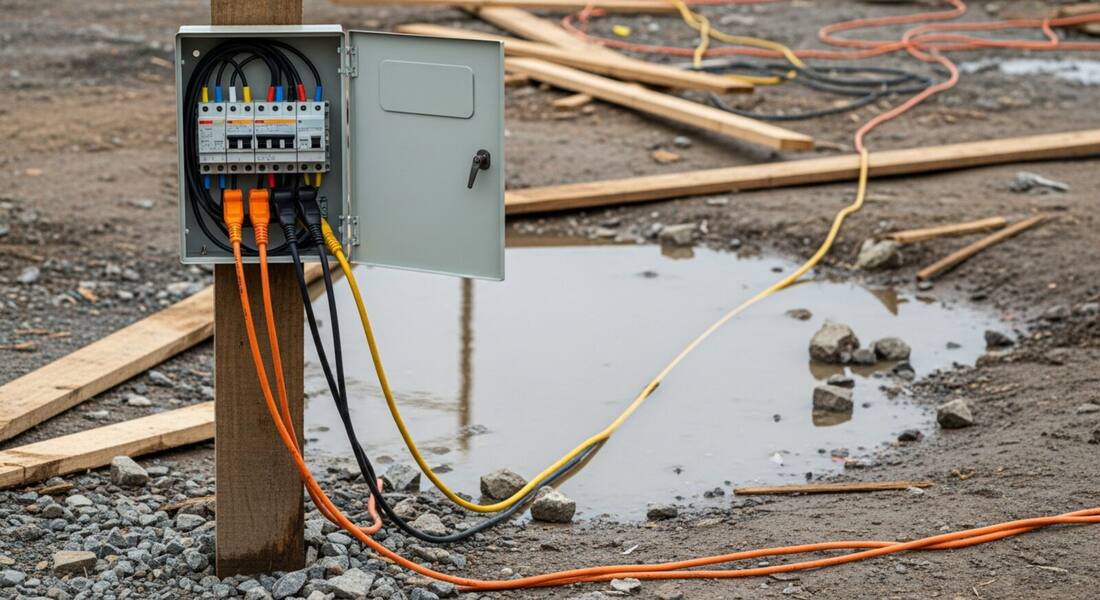
Scan a photo like the one above and this is the report you get — score, findings, OSHA references, and fixes. It is an illustrative example, clearly marked — not live scan data.
Compliance score
47
Lower means more potential hazards found
5 potential hazards found
1Extension cords run across a wet walkway
HighPossibly related to flexible cords and cables (29 CFR 1926.405)
Observed condition: Foot traffic grinds cord insulation down, and standing water accelerates faults until contact or arcing occurs.
Corrective action: Remove the cords from the wet path and route replacements overhead or under protective covers.
High confidence
2Electrical panel left open with cords exiting the enclosure
MediumPossibly related to cabinets, boxes, and fittings (29 CFR 1926.405)
Observed condition: An open panel exposes energized parts, and unmanaged cords strain terminations and invite accidental contact.
Corrective action: Close and secure the panel door and route cords through proper strain-relief fittings.
Medium confidenceNot fully clear from the photo — verify on site.
Upload a photo like the one above and get a compliance score and hazard count in seconds. No account needed to scan — create a free account to unlock the full report.
Use the real site or facility name. If you save the scan after signup, it becomes the report name.
Three angles, one deeper scan
Only the wide shot is required — every extra angle gives the AI more places to look.
Required: Set the scene — one wide shot lets the AI sweep the whole area at once
Stand at the entry point and capture corner to corner: floors, ladders, scaffolds, and everyone at work
Drop a job-site photo or walkthrough video
Click to upload, drag & drop, or snap a photo on site. Photos scan free in about 15 seconds — no signup, no card. Video walkthroughs (up to 3 min) run on a free account.
Small habits, sharper scans
Set the scene
Start with context
Fill the frame
2–3 ft for close-ups; keep ladders, cords and workers fully in view.
Capture clearly
Make the frame usable
Light it right
Keep the sun or lights behind you — glare and shadows hide hazards.
Tap to focus
Tap the hazard on screen and hold still one second — blur can't be flagged.
Choose the useful view
Give the AI room to understand
Go landscape
Turn your phone sideways — a wider frame catches more of the scene.
Only upload photos you have permission to use, and avoid images showing personal, customer, or confidential information. Demo photos and results are held privately for up to 48 hours so you can save them to a free account; unclaimed photos are deleted automatically. Results are an AI-assisted preliminary review, not an official OSHA determination.
New: Video walkthrough scans
Record up to 3 minutes of your site — the AI extracts frames and flags every hazard with exact timestamps. Free account required.
Get the best results
Wide shot first
Stand at the entrance and photograph the entire work area so AI sees the full context
Hazard areas
Photograph elevated surfaces, equipment, electrical panels, and anywhere workers are active
Close-ups last
Move in close on anything damaged, missing, or that looks risky — the AI catches more detail
Walk your temporary power and permanent electrical with these points. The first four are free — create a free account to unlock the full checklist and scan your own electrical photos.
GFCI protection on temporary power
Every receptacle feeding cord-and-plug equipment on a construction site runs through GFCI protection — at the source or the first point of use.
Cords undamaged and rated for the use
No cut jackets, exposed conductors, missing ground pins, or taped-over repairs. Hard-service cords outdoors, not household-grade extension leads.
Panel and box covers in place
Dead fronts on panels, covers on junction boxes, filler plates in unused breaker slots — no energized parts reachable by a finger or a dropped tool.
Working clearance in front of panels
At least three feet of clear space in front of electrical panels and disconnects, so someone can operate or de-energize them without moving stock first.
OSHA Scan reads a single photo. That makes it fast and easy for anyone on site — but it also means it has real limits. Here's an honest look at both.
A scan is a fast first look, not the final word. Before treating this kind of area as safe, a competent person should still confirm:
The visible ones: damaged or poorly routed cords, missing covers and blanks, blocked panel clearance, wiring in wet areas, and work close to overhead lines. That covers a surprising share of everyday jobsite electrical risk, because so much of it is visual — but anything requiring measurement or opening an enclosure is out of scope.
No. Energization, GFCI function, grounding, and bonding require test instruments and a qualified person. The scan lists those under what to verify manually so the photo check never substitutes for electrical testing.
No — it is an AI-assisted preliminary review of visible conditions, with references to the OSHA standards each finding may relate to. Formal electrical inspections, code compliance, and energized-work decisions belong to qualified electricians and inspectors.
Reviewed by OSHA Scan Editorial
Last updated August 29, 2026
This content is produced by the OSHA Scan Editorial team and reviewed with AI assistance. It is general safety information, not legal or compliance advice. OSHA Scan is an independent tool and is not affiliated with, endorsed by, or certified by OSHA or the U.S. Department of Labor.
Free PDF checklist
33 critical checks across 7 categories — the same visible gaps the AI scanner looks for. Sent to your inbox as a free PDF.
More ways to see what an AI OSHA scan can do for your site.
The overview hub — how the scanner works and every job, site, and hazard it covers.
Boundaries, arc-rated PPE, and the visible gaps before the blast.
The full electrical hazard guide for job sites.
Energy control before hands go into electrical equipment.
The most common temporary-power mistake.
When water and temporary power meet.
The vision pipeline behind this scanner.
The step-by-step JHA behind these electrical hazards.
See a complete labelled example of everything a scan returns.
Start with 5 included AI site scans plus a one-time 10-scan signup bonus — no credit card. Build JHA-ready reports and catch changing conditions sooner.
Start your free trial