
1
Set the scene
Start with context
Fill the frame
2–3 ft for close-ups; keep ladders, cords and workers fully in view.
A construction site safety score is a 0-100 grade of the visible conditions in a job-site photo. Upload a picture of any work area and the AI identifies each visible hazard — open edges, ladder setup, housekeeping, PPE, electrical — weighs them by severity, and returns the score with a finding-by-finding breakdown referencing the OSHA standard each hazard may relate to. Scanning the same areas week over week turns the score into a trend you can put in front of a GC, an owner, or an insurer. It is free to try with no account, and it is an AI-assisted snapshot of what the camera can see — not a formal compliance rating.
Free · No account needed to scan · Results in seconds
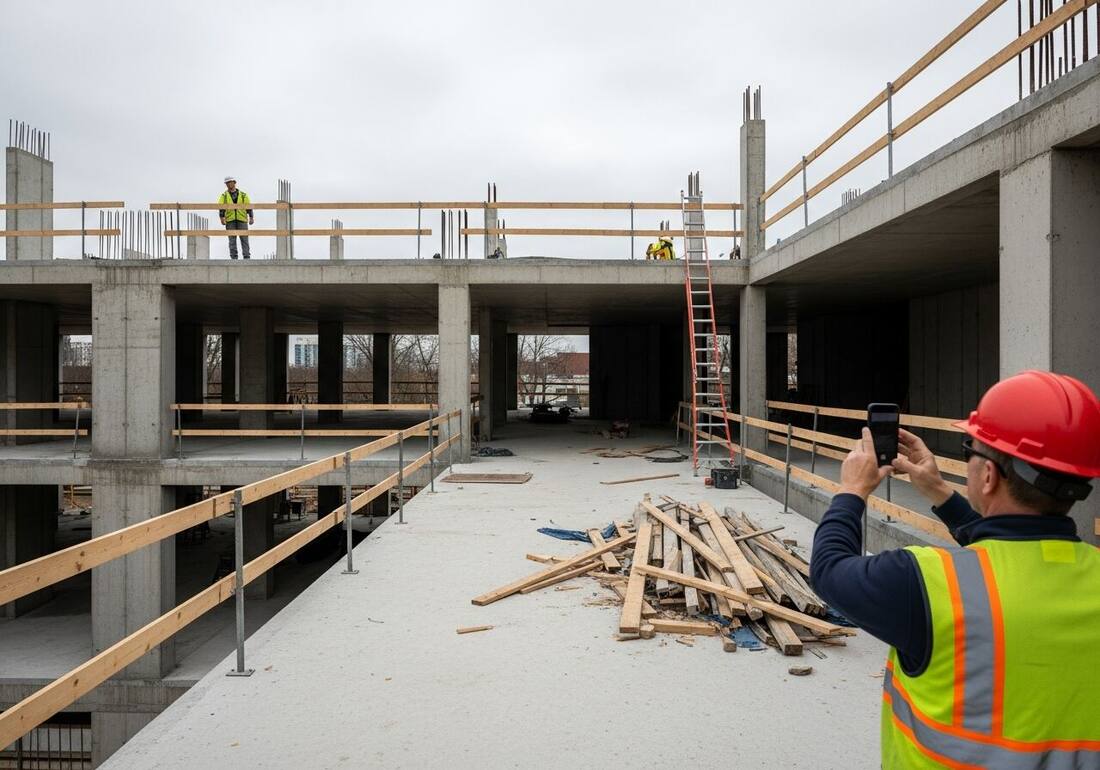
"Be safer" is not an instruction anyone can act on. A score is. When the Tuesday scan of the third floor comes back 54 because of an open slab edge and a walkway full of scrap, the crew knows exactly what drops and exactly what to fix — and when Friday's re-scan comes back 81, everyone can see the site got better. The score compresses a page of findings into a number that superintendents can compare across floors, areas, and weeks.
The comparison is where it earns its keep. One low score is a to-do list; the same area scoring low three weeks running is a management signal. Subcontractor areas can be scanned on the same standard, so the conversation moves from impressions to evidence. And because every score is backed by its finding list — each hazard referenced to the OSHA standard it may relate to — the number never floats free of the specifics behind it.
Falls remain the leading cause of construction fatalities, and fall-protection standards top OSHA's most-cited list year after year — which is why open edges and ladder problems weigh heavily in the grade. A rising score, documented weekly, is the kind of record that helps with GC prequalification, owner reporting, and the insurer conversation about your experience rating.
Traditional construction site walkthrough notes — 'general housekeeping fair, some cords to clean up' — are difficult to act on, impossible to trend, and legally thin. OSHA compliance officers evaluating post-incident employer files look for evidence that specific hazards were identified, corrected, and documented, not general impressions. A numbered score derived from a complete finding list addresses all three criteria: it identifies each hazard by category, it creates a before/after baseline when re-scanned after correction, and it is dated and exportable in a format inspectors and insurers can read.
The scoring approach also changes crew behavior in ways general encouragement does not. When a foreman knows that the same work area is scored every Monday morning, the Friday afternoon cleanup becomes a concrete task with a measurable outcome, not an aspiration. Construction safety research consistently shows that the sites with the lowest incident rates use short, frequent, objective inspection cycles rather than longer periodic audits — which is the operational pattern that weekly or daily photo scoring enables.
Falls are the leading cause of construction fatalities and the most frequently cited hazard category in OSHA construction inspections. The core fall-protection standards — 29 CFR 1926.501 (fall protection duties) and 1926.502 (fall protection systems criteria) — require fall protection at six feet or more above a lower level on most construction surfaces, with specific provisions for roofing, scaffolding, leading edges, and floor openings. OSHA's fall protection citations year after year list unprotected edges and openings, lack of fall-arrest systems for workers above six feet, and improperly used or damaged equipment as the most common specific violations.
A photo-based safety score for a construction site will almost always reflect fall-protection conditions more than any other single factor — because fall exposures are both the most severe and the most visible. An open edge, a gap in scaffold guardrails, a worker without a harness above the threshold height, or a floor opening without a cover are all camera-detectable. Construction safety professionals use the fall-protection component of a site score as the leading indicator of overall site hazard management: sites that consistently score well on fall protection tend to score well across all hazard categories because the underlying management discipline is the same.
The score is severity-weighted: the hazards that hurt people most pull it down hardest.
Open slab edges, missing guardrails, floor holes, ladder angle and extension, and workers at height without visible fall protection — the heaviest weights in the grade.
Scrap and debris in walkways, blocked access routes, protruding nails and rebar, and materials staged where people move.
Hard hats, eye protection, and hi-vis on everyone in the frame, judged against the exposures around them.
Re-scanning the same areas builds a week-over-week trend line — the difference between a snapshot and a safety program you can show.
Scan a photo like the one above and this is the report you get — score, findings, OSHA references, and fixes. It is an illustrative example, clearly marked — not live scan data.
Compliance score
47
Lower means more potential hazards found
5 potential hazards found
1Worker at an upper slab edge behind an incomplete single-rail barrier
HighPossibly related to guardrail systems (29 CFR 1926.502(b))
Observed condition: A single wood rail with no midrail is not a complete guardrail system — falls remain the leading cause of construction fatalities, and edges like this are why.
Corrective action: Complete the guardrail with a midrail and toeboard, or keep workers at the edge in personal fall arrest until it is done.
High confidence
2Extension ladder set steeper than the 4-to-1 climbing angle
MediumPossibly related to ladders (29 CFR 1926.1053)
Observed condition: A near-vertical ladder puts the climber's weight behind the rails — the setup that kicks out at the base or peels away from the wall.
Corrective action: Reset the base one foot out for every four feet of working height and secure the top before the next climb.
High confidence
Upload a photo like the one above and get a compliance score and hazard count in seconds. No account needed to scan — create a free account to unlock the full report.
Use the real site or facility name. If you save the scan after signup, it becomes the report name.
Three angles, one deeper scan
Only the wide shot is required — every extra angle gives the AI more places to look.
Required: Set the scene — one wide shot lets the AI sweep the whole area at once
Stand at the entry point and capture corner to corner: floors, ladders, scaffolds, and everyone at work
Drop a job-site photo or walkthrough video
Click to upload, drag & drop, or snap a photo on site. Photos scan free in about 15 seconds — no signup, no card. Video walkthroughs (up to 3 min) run on a free account.
Small habits, sharper scans
Set the scene
Start with context
Fill the frame
2–3 ft for close-ups; keep ladders, cords and workers fully in view.
Capture clearly
Make the frame usable
Light it right
Keep the sun or lights behind you — glare and shadows hide hazards.
Tap to focus
Tap the hazard on screen and hold still one second — blur can't be flagged.
Choose the useful view
Give the AI room to understand
Go landscape
Turn your phone sideways — a wider frame catches more of the scene.
Only upload photos you have permission to use, and avoid images showing personal, customer, or confidential information. Demo photos and results are held privately for up to 48 hours so you can save them to a free account; unclaimed photos are deleted automatically. Results are an AI-assisted preliminary review, not an official OSHA determination.
New: Video walkthrough scans
Record up to 3 minutes of your site — the AI extracts frames and flags every hazard with exact timestamps. Free account required.
Get the best results
Wide shot first
Stand at the entrance and photograph the entire work area so AI sees the full context
Hazard areas
Photograph elevated surfaces, equipment, electrical panels, and anywhere workers are active
Close-ups last
Move in close on anything damaged, missing, or that looks risky — the AI catches more detail
The findings that pull scores down most, in the order to fix them. The first four points are free — create a free account to unlock the full checklist and start scoring your own site.
Close every open edge
Guardrails on slab edges, covers on floor holes, rails on stair openings — fall exposures are the heaviest weight in any score.
Fix ladder setup everywhere
Four-to-one angle, three feet above the landing, feet on solid ground, rungs clean — ladder findings are frequent, serious, and quick to correct.
Clear the walkways daily
Scrap, cords, and staged material out of paths; protruding nails pulled or bent — housekeeping drives more findings than any other family.
Cap or guard protruding rebar
Every exposed dowel gets a rated cap or a barrier — an impalement hazard scores as severely as it reads.
OSHA Scan reads a single photo. That makes it fast and easy for anyone on site — but it also means it has real limits. Here's an honest look at both.
A scan is a fast first look, not the final word. Before treating this kind of area as safe, a competent person should still confirm:
The AI identifies each visible hazard in the photo, weighs it by severity — imminent-danger findings like open edges pull the score down far more than low-risk housekeeping items — and grades the frame 0-100. Every score comes with the finding list behind it, each referenced to the OSHA standard it may relate to, so the number is always traceable to specifics.
No. OSHA does not issue site scores, and no photo tool can certify compliance. The score is an AI-assisted snapshot of visible conditions, useful for tracking, prioritizing, and reporting — a formal compliance determination still requires a qualified professional reviewing the site itself.
Treat the trend as the target rather than a magic number. Scores in the 90s mean the camera found little to flag; scores in the 40s-50s usually mean at least one serious exposure is visible. The most useful pattern is the same areas scanned weekly, moving up — and staying up.
Yes — any area you can photograph, you can score, and every area is graded on the same standard. Many supervisors scan each sub's zone during the morning walk so the weekly safety conversation starts from the same evidence instead of competing impressions.
Reviewed by OSHA Scan Editorial
Last updated August 29, 2026
This content is produced by the OSHA Scan Editorial team and reviewed with AI assistance. It is general safety information, not legal or compliance advice. OSHA Scan is an independent tool and is not affiliated with, endorsed by, or certified by OSHA or the U.S. Department of Labor.
Free PDF checklist
33 critical checks across 7 categories — the same visible gaps the AI scanner looks for. Sent to your inbox as a free PDF.
More ways to see what an AI OSHA scan can do for your site.
The overview hub — how the scanner works and every job, site, and hazard it covers.
The scanner applied to active construction sites.
One scan across every hazard family in a single photo.
The full area-by-area self-inspection walkthrough.
Angle, extension, condition, and setup from a photo.
Drop zones, suspended loads, and equipment traffic.
See a complete labelled example of everything a scan returns.
Start with 5 included AI site scans plus a one-time 10-scan signup bonus — no credit card. Build JHA-ready reports and catch changing conditions sooner.
Start your free trial