
SDS management for hotels — four chemical families, one roof, high turnover
SDS management for hotels means keeping a current safety data sheet for every hazardous product across four or five departments — housekeeping cleaners and disinfectants, laundry brighteners and softeners, pool chlorine and acid, kitchen degreasers and sanitizers, and maintenance solvents — and making those sheets readily accessible to staff during their shifts. Hotels struggle because chemicals live in separate closets, staff turn over constantly, and many housekeepers and pool techs read Spanish first. OSHA Scan builds the inventory the fast way: photograph each product label and the AI reads the name, manufacturer, signal word, and GHS pictograms into a searchable chemical library, then you print a QR poster for the housekeeping closet and pool pump room so any worker reaches the sheets from a phone — no login.
Free · No account needed to scan · Results in seconds
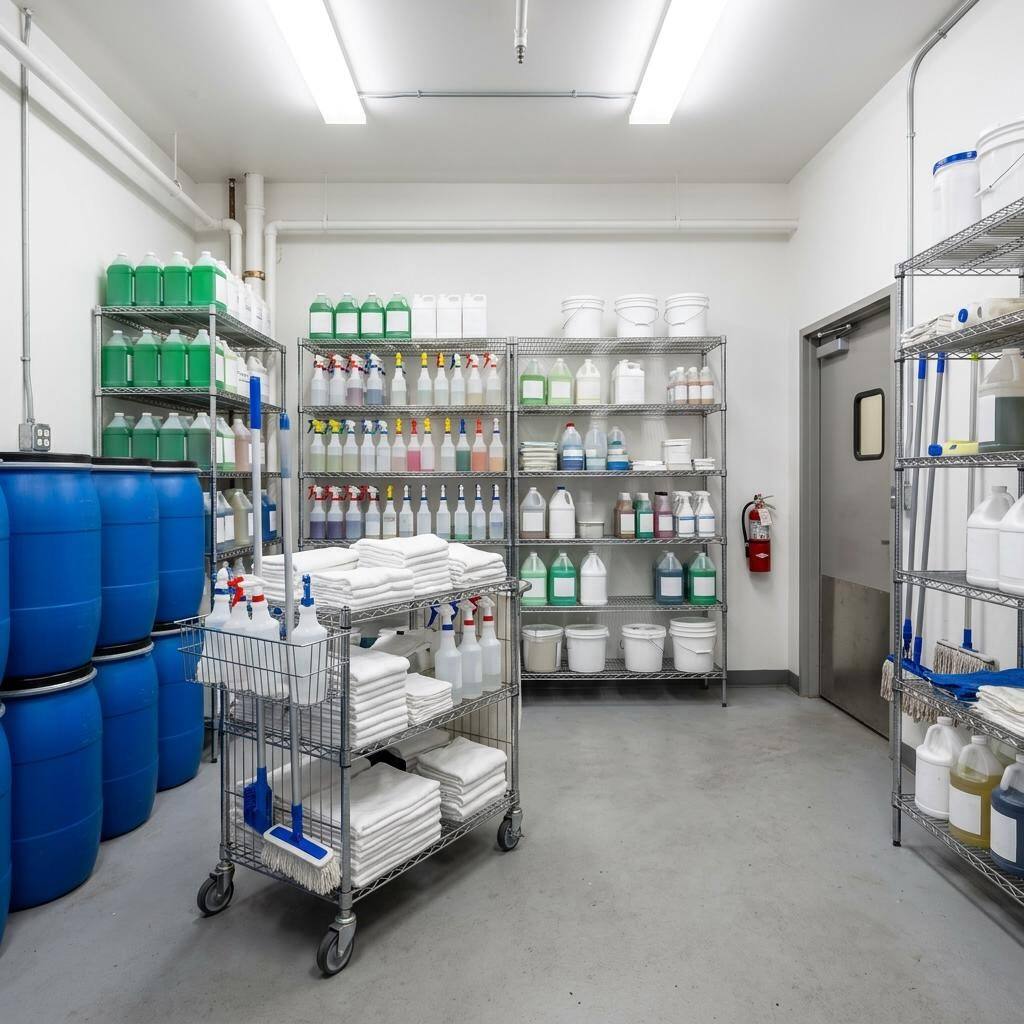
One property, four chemical closets, and a workforce that changes every month
A single mid-size hotel runs more chemical families than most people expect. Housekeeping carries multi-surface cleaners, bathroom acids, glass cleaner, and quaternary disinfectants. Laundry adds detergent, bleach, sour, and softener drums. The pool pump room stores chlorine tablets or liquid sodium hypochlorite alongside muriatic acid — an incompatible pair that shares a small, humid room. The kitchen line keeps degreaser, sanitizer, and dish machine chemicals, and maintenance has its own shelf of solvents, drain openers, and lubricants. Each department buys and swaps products on its own schedule, so the master SDS binder in the manager's office is out of date the week it is printed.
The people who actually touch these chemicals turn over fast and often read Spanish first, yet OSHA still requires the safety data sheets to be readily accessible to them during their shift. A binder locked in an office fails that test at 2am when a housekeeper mixes the wrong two bottles. OSHA Scan closes the gap by letting a supervisor photograph every label into one searchable library, attach the manufacturer's SDS PDF to each entry, and print a QR poster for each room. The app UI runs in English and Spanish, and the worker QR page shows the room's chemicals with pictograms and the attached sheets — no account, no login.
Why hotels land HazCom citations: separate closets, fast turnover, and the pool room
Hotels are covered by OSHA's general industry standards, and Hazard Communication (29 CFR 1910.1200) is among the standards most likely to surface when an inspector responds to a worker injury or complaint at a lodging property. The citations rarely come from a hotel ignoring chemicals — they come from the structure of the operation. Chemicals are decentralized across housekeeping, laundry, the pool, the kitchen, and maintenance, and each area buys from its own supplier catalog. A master binder assembled once cannot keep pace with five departments swapping products independently, so the inventory and the SDS library drift apart. High front-line turnover compounds it: the person who built the binder leaves, and the next supervisor inherits a folder they did not assemble and cannot verify.
The pool pump room deserves specific attention. Sodium hypochlorite or calcium hypochlorite tablets and muriatic acid are a classic incompatible pair, and hotel pump rooms are frequently small and humid with drums stored close together. Both products' SDS sections on handling, storage, and incompatibility exist precisely to keep them apart, and both sheets need to be reachable by the pool tech at the point of use — not filed at the front desk. A per-room QR poster listing the pump room's chemicals with their pictograms and attached sheets is a direct, defensible answer to the readily-accessible requirement for a worker who never sets foot in the office.
What one label scan captures for the hotel library
Photograph a product label from any department and the AI reads these elements into a searchable chemical entry.
Product identity
Product name and manufacturer read straight off the label — so the pool pump room's chlorine and the housekeeping glass cleaner each become their own searchable entry.
Signal word & pictograms
The signal word (Danger or Warning) and GHS pictograms captured from the label, giving front-line staff the at-a-glance hazard read they need before mixing anything.
Attached manufacturer SDS
Attach the manufacturer's SDS PDF to each entry; the file is checked to look like a real SDS on upload, and it stays one tap away for every worker.
Per-room QR access
Print a QR poster for the housekeeping closet, laundry room, or pool pump room; workers scan it for a no-login page listing that room's chemicals and sheets.
Demo: the library entry a scanned label comes back with
An illustrative example for this trade — product identity, signal word, GHS pictograms, and hazard statements, filed and searchable.
Quaternary sanitizer concentrate (housekeeping)
Example manufacturer
Housekeeping dilutes this quat concentrate at the closet dispenser on every floor, so an attendant handling the neat product needs the corrosive-burn hazard on the room's QR page.
- H314 — Causes severe skin burns and eye damage
- H412 — Harmful to aquatic life with long lasting effects
Now scan your own label — free
Photograph any chemical product on your shelf. The AI transcribes the label in seconds — no account needed to try it.
- A searchable chemical library built from label photos across housekeeping, laundry, pool, and kitchen
- The signal word, GHS pictograms, and hazard statements read off each product label
- A printable QR poster for the housekeeping closet or pool room so any worker reaches the SDS from a phone
Free · No account needed to scan · Results in seconds
The 12-point hotel SDS management checklist
Walk every department that touches chemicals with these points. The first four are free — leave an email to unlock the rest and start scanning your own product labels.
Free checklist — 12 points
Enter your email to unlock the full checklist
We'll also send you a printable PDF copy — no account required.
One email with the checklist, one follow-up. Unsubscribe anytime.
What the AI can and can't detect
OSHA Scan reads a single photo. That makes it fast and easy for anyone on site — but it also means it has real limits. Here's an honest look at both.
What it can catch from a photo
- Product name and manufacturer from a photographed label
- Signal word and GHS pictograms on the label
- Whether a container on a cart or shelf has any visible label
- Visible storage red flags like incompatibles sharing a small room
What a photo can't tell it
- Whether the SDS library covers every product on property
- The exact concentration inside a refilled or decanted bottle
- Ventilation adequacy in the pool pump room
- Whether staff were trained on the chemicals they handle
Always confirmed by a person on site
A scan is a fast first look, not the final word. Before treating this kind of area as safe, a competent person should still confirm:
- The inventory matches every product actually stocked in each department
- Each attached SDS is the current version for the product on the shelf
- Pool chemical storage separation against both products' SDS guidance
- Staff know how to scan the QR poster and read the sheets in their language
People also ask
What chemicals in a hotel need a safety data sheet?
Any hazardous chemical a hotel employee uses or is exposed to needs a current SDS — that spans housekeeping cleaners and disinfectants, laundry detergent, bleach, sour, and softener, pool chlorine and acid, kitchen degreasers and sanitizers, and maintenance solvents and drain chemicals. OSHA's Hazard Communication Standard (29 CFR 1910.1200) requires the sheets to be readily accessible to workers during their shift. Scanning each product label is the fastest way to build the inventory those sheets attach to.
How do I make SDS accessible to housekeeping staff who move room to room?
The cleanest answer to OSHA's readily-accessible requirement for mobile staff is a QR poster in each chemical location. OSHA Scan prints a QR poster for the housekeeping closet, laundry room, or pool pump room; a worker scans it with their phone and gets a no-login page listing that room's chemicals with signal word, pictograms, hazards, precautions, and the attached SDS PDFs. No app install and no account are needed to view.
Does OSHA Scan work for our Spanish-speaking staff?
Yes. The app interface runs in English and Spanish, so supervisors can build and search the library in the language they prefer. Keep in mind the manufacturer's SDS PDF itself is whatever language the manufacturer provided — the app does not translate the sheet — but the library entry, pictograms, and QR access page make the core hazard information reachable for a bilingual crew.
Does the app automatically find the SDS for a hotel chemical?
No — OSHA Scan reads the product label to identify the chemical and build the library entry, but it does not fetch sheets from manufacturer databases or monitor for new versions. You attach the manufacturer's SDS PDF yourself, and the file is checked to look like a real SDS on upload. When no sheet is on file, the app can hold an AI-drafted chemical profile clearly labeled as an internal draft — never a substitute for the manufacturer's authoritative SDS.
How many chemicals does a typical hotel actually manage?
Even a limited-service property usually runs a few dozen distinct hazardous products once you count every department, and a full-service resort with a spa, multiple kitchens, and a large pool complex runs well into the hundreds. The challenge is rarely the count itself — it is that products live in separate closets and change on separate schedules, which is exactly why a single scanned library beats five department binders.
Reviewed by OSHA Scan Editorial
Last updated August 29, 2026
This content is produced by the OSHA Scan Editorial team and reviewed with AI assistance. It is general safety information, not legal or compliance advice. OSHA Scan is an independent tool and is not affiliated with, endorsed by, or certified by OSHA or the U.S. Department of Labor.
Keep exploring
More ways to see what an AI OSHA scan can do for your site.
The AI OSHA inspection tool
The overview hub — how the scanner works and every job, site, and hazard it covers.
SDS scanner
Photograph any chemical label to build a searchable SDS library.
Hotel safety inspection checklist
The full staff-safety walk-through for housekeeping, kitchen, and pool.
SDS management for cleaning companies
The same chemical library approach for janitorial and commercial cleaning crews.
SDS accessibility requirements
What 'readily accessible during the shift' actually means for your staff.
OSHA 29 CFR 1910.1200 — Hazard Communication
The full text of the standard governing SDS, labels, and chemical inventory.
Official resource — osha.govA full sample report
See a complete labelled example of everything a scan returns.
Ready to secure your job sites?
Start with 5 included AI site scans plus a one-time 10-scan signup bonus — no credit card. Build JHA-ready reports and catch changing conditions sooner.
Start your free trial