
1
Set the scene
Start with context
Fill the frame
2–3 ft for close-ups; keep ladders, cords and workers fully in view.
OSHA's respirable crystalline silica rule (29 CFR 1926.1153 in construction) is built around one visible idea: if you can see a dust cloud coming off a saw, grinder, or drill cutting concrete, masonry, or stone, the controls aren't working. Table 1 of the standard specifies the fix for each task — water fed to the blade, a vacuum dust-collection shroud, and respirators where the table requires them. OSHA Scan reads a photo of cutting, grinding, or drilling work and flags the visible gaps: dry cutting with no water or vacuum attachment, thick dust clouds, and people standing in them. It is an AI-assisted first pass, not an exposure assessment or air monitoring.
Free · No account needed to scan · Results in seconds
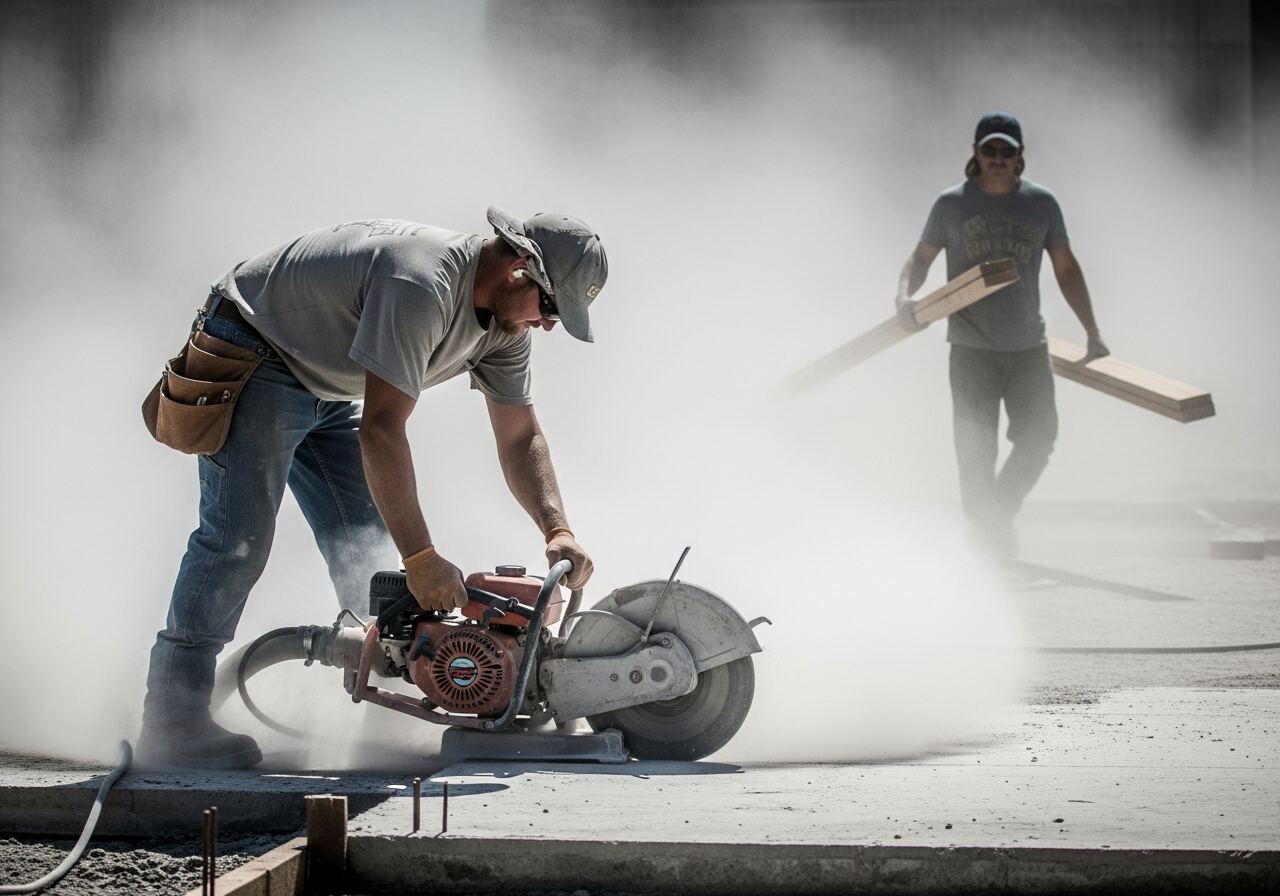
Respirable crystalline silica is the dust produced whenever concrete, masonry, brick, stone, or mortar is cut, ground, or drilled — and breathing it scars lung tissue permanently. Silicosis has no cure; the only control is keeping the dust out of the air in the first place. That's why OSHA's construction silica standard works the way it does: Table 1 lists the common tasks and the exact engineering control each one requires — water to the blade for a cut-off saw, a shroud and vacuum for a grinder — plus when a respirator is required on top. A crew dry-cutting a slab with a visible plume is one of the most citable sights on a jobsite.
The exposure also doesn't stay with the person holding the saw. Dust clouds drift across the work area into the lungs of laborers, spotters, and anyone walking through — which is why the standard also expects the work zone to be managed, not just the operator protected. A photo catches the moments that matter: the missing water hose, the missing vacuum shroud, the cloud itself, and the coworker in the middle of it. The checklist below covers the rest of the program — the written exposure control plan, medical surveillance, and training — that no camera can verify.
OSHA's respirable crystalline silica standards (29 CFR 1926.1153 for construction; 29 CFR 1910.1053 for general industry and maritime) established a permissible exposure limit of 50 micrograms per cubic meter as an 8-hour TWA — half the previous PEL — when they took effect in 2017. For construction, OSHA created Table 1, which specifies the engineering controls required for common silica-generating tasks (cut-off saws with integrated water delivery, grinders with shroud and HEPA vacuum, jackhammers with water or vacuum). Using the Table 1 controls fully and correctly constitutes compliance without air monitoring; deviating from Table 1 or using methods not listed requires air monitoring to demonstrate the PEL is met.
OSHA launched a Silica National Emphasis Program targeting construction, maritime, and general industry operations with silica exposure potential. Under the NEP, inspectors conduct programmed silica inspections at covered industries and evaluate Table 1 compliance directly — observing whether the correct engineering control is in use, whether water flow is active and reaching the blade, and whether a respirator is being worn when Table 1 requires one. The medical surveillance requirement for workers exposed above the action level (25 µg/m³) for 30 or more days per year includes a medical examination every three years. Silicosis has no cure and a long latency period, which is why OSHA considers silica one of its highest-priority health enforcement issues.
What the AI checks in a photo of concrete or masonry cutting, grinding, or drilling work.
Saws, grinders, and drills working concrete or masonry with no water feed to the blade and no dust-collection shroud attached — the core Table 1 failure.
A plume coming off the cut is direct visual evidence the engineering controls are missing or not working.
Laborers, spotters, and passers-by inside the drifting cloud without respiratory protection — exposure isn't limited to the operator.
Tasks where Table 1 requires a respirator on top of wet methods, with no respirator visible on the operator.
Scan a photo like the one above and this is the report you get — score, findings, OSHA references, and fixes. It is an illustrative example, clearly marked — not live scan data.
Compliance score
42
Lower means more potential hazards found
5 potential hazards found
1Cut-off saw dry-cutting a concrete slab — no water feed or vacuum dust collection visible, heavy dust plume at the blade
HighPossibly related to respirable crystalline silica controls, Table 1 (29 CFR 1926.1153)
Observed condition: Dry-cutting concrete can put an operator far over the permissible exposure limit in minutes, and every minute of visible plume is respirable silica going into lungs that never heal from it.
Corrective action: Stop the cut and attach the integrated water delivery system (or a shroud with a compliant vacuum) before resuming; follow Table 1 for this saw type, including any respirator requirement.
High confidence
2Second worker walking through the drifting dust cloud carrying material, with no respiratory protection
HighPossibly related to exposure control planning and respiratory protection (29 CFR 1926.1153(g), 1910.134)
Observed condition: Silica exposure hits everyone in the cloud, not just the operator — bystander exposure is the piece most crews never measure and OSHA increasingly cites.
Corrective action: Keep the work zone clear of other workers while cutting, or re-route foot traffic upwind; the exposure control plan should designate who may be in the area during dust-generating tasks.
High confidence
Upload a photo like the one above and get a compliance score and hazard count in seconds. No account needed to scan — create a free account to unlock the full report.
Use the real site or facility name. If you save the scan after signup, it becomes the report name.
Three angles, one deeper scan
Only the wide shot is required — every extra angle gives the AI more places to look.
Required: Set the scene — one wide shot lets the AI sweep the whole area at once
Stand at the entry point and capture corner to corner: floors, ladders, scaffolds, and everyone at work
Drop a job-site photo or walkthrough video
Click to upload, drag & drop, or snap a photo on site. Photos scan free in about 15 seconds — no signup, no card. Video walkthroughs (up to 3 min) run on a free account.
Small habits, sharper scans
Set the scene
Start with context
Fill the frame
2–3 ft for close-ups; keep ladders, cords and workers fully in view.
Capture clearly
Make the frame usable
Light it right
Keep the sun or lights behind you — glare and shadows hide hazards.
Tap to focus
Tap the hazard on screen and hold still one second — blur can't be flagged.
Choose the useful view
Give the AI room to understand
Go landscape
Turn your phone sideways — a wider frame catches more of the scene.
Only upload photos you have permission to use, and avoid images showing personal, customer, or confidential information. Demo photos and results are held privately for up to 48 hours so you can save them to a free account; unclaimed photos are deleted automatically. Results are an AI-assisted preliminary review, not an official OSHA determination.
New: Video walkthrough scans
Record up to 3 minutes of your site — the AI extracts frames and flags every hazard with exact timestamps. Free account required.
Get the best results
Wide shot first
Stand at the entrance and photograph the entire work area so AI sees the full context
Hazard areas
Photograph elevated surfaces, equipment, electrical panels, and anywhere workers are active
Close-ups last
Move in close on anything damaged, missing, or that looks risky — the AI catches more detail
From Table 1 controls at the blade to the written exposure control plan behind them. The first four are free — create a free account to unlock the rest and scan your own cutting work.
Free checklist — 12 points
Enter your email to unlock the full checklist
We'll also send you a printable PDF copy — no account required.
One email with the checklist, one follow-up. Unsubscribe anytime.
OSHA Scan reads a single photo. That makes it fast and easy for anyone on site — but it also means it has real limits. Here's an honest look at both.
A scan is a fast first look, not the final word. Before treating this kind of area as safe, a competent person should still confirm:
29 CFR 1926.1153 gives construction employers two paths: follow Table 1, which lists 18 common tasks with the exact engineering controls and respirator requirements for each, or do your own exposure assessment and keep exposures under the permissible limit of 50 µg/m³ as an 8-hour average. Nearly every contractor uses Table 1 — it's simpler and doesn't require air monitoring. Either way, you also need a written exposure control plan, a competent person, restricted housekeeping methods, and medical surveillance for workers in respirators 30+ days a year.
Table 1 effectively removes dry cutting as an option for the tasks it lists — a handheld power saw, for example, must have an integrated water delivery system. An employer could theoretically dry-cut under the alternative exposure-assessment path, but they'd have to prove with monitoring data that exposures stay under the limit, which dry cutting almost never does. In practice, a visible dust plume from a dry cut is one of the fastest silica citations OSHA writes.
It can flag the visible failures: a saw or grinder with no water hose or vacuum shroud attached, a dust cloud at the cut, workers standing in drifting dust without respirators, and dry sweeping. It cannot measure airborne concentration, verify Table 1 flow rates, or confirm the written plan and medical surveillance exist — those need your competent person. Use the scan to catch the obvious gaps between formal assessments.
Reviewed by OSHA Scan Editorial
Last updated August 29, 2026
This content is produced by the OSHA Scan Editorial team and reviewed with AI assistance. It is general safety information, not legal or compliance advice. OSHA Scan is an independent tool and is not affiliated with, endorsed by, or certified by OSHA or the U.S. Department of Labor.
More ways to see what an AI OSHA scan can do for your site.
The overview hub — how the scanner works and every job, site, and hazard it covers.
A walkthrough of how a routine cutting task becomes a permanent lung injury.
The respirator program that backs up engineering controls when Table 1 requires one.
The broader tool-safety scan — guards, cords, and condition of the saw itself.
See a complete labelled example of everything a scan returns.
Start with 5 included AI site scans plus a one-time 10-scan signup bonus — no credit card. Build JHA-ready reports and catch changing conditions sooner.
Start your free trial