
1
Set the scene
Start with context
Fill the frame
2–3 ft for close-ups; keep ladders, cords and workers fully in view.
Structural collapse, hazardous materials, and struck-by
Demolition means deliberately destabilizing a structure while workers are still near it — a job where an unplanned collapse or a hidden asbestos release can be catastrophic. OSHA Scan analyzes demolition photos to catch missing engineering surveys, hazard controls, and struck-by risks before the work begins.
Free · No account needed to scan · Results in seconds
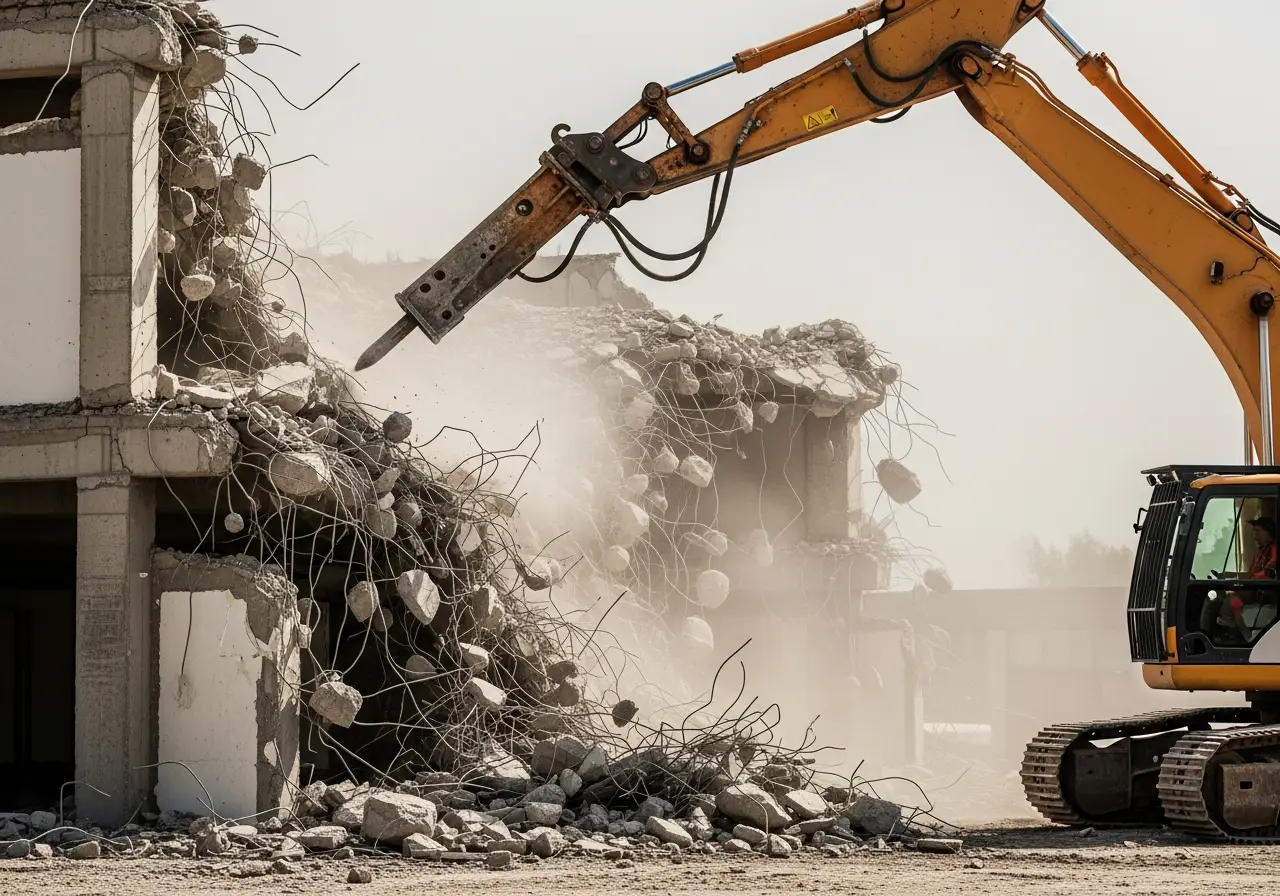
an engineering survey is required before demo
buildings before this often contain asbestos
concrete demolition releases hazardous dust
falling debris is a leading demolition killer
Upload a real job-site photo and OSHA Scan detects visible demolition hazards in seconds — no account needed to run your first scan.
Use the real site or facility name. If you save the scan after signup, it becomes the report name.
Three angles, one deeper scan
Only the wide shot is required — every extra angle gives the AI more places to look.
Required: Set the scene — one wide shot lets the AI sweep the whole area at once
Stand at the entry point and capture corner to corner: floors, ladders, scaffolds, and everyone at work
Drop a job-site photo or walkthrough video
Click to upload, drag & drop, or snap a photo on site. Photos scan free in about 15 seconds — no signup, no card. Video walkthroughs (up to 3 min) run on a free account.
Small habits, sharper scans
Set the scene
Start with context
Fill the frame
2–3 ft for close-ups; keep ladders, cords and workers fully in view.
Capture clearly
Make the frame usable
Light it right
Keep the sun or lights behind you — glare and shadows hide hazards.
Tap to focus
Tap the hazard on screen and hold still one second — blur can't be flagged.
Choose the useful view
Give the AI room to understand
Go landscape
Turn your phone sideways — a wider frame catches more of the scene.
Only upload photos you have permission to use, and avoid images showing personal, customer, or confidential information. Demo photos and results are held privately for up to 48 hours so you can save them to a free account; unclaimed photos are deleted automatically. Results are an AI-assisted preliminary review, not an official OSHA determination.
Here is what an OSHA Scan report looks like for demolition hazards. It is an illustrative example built from this trade's hazards — clearly marked, not live scan data.
Compliance score
43
Lower means more potential hazards found
3 potential hazards found
Unplanned structural collapse
CriticalPossibly related to Preparatory operations (29 CFR 1926.850)
Observed condition: A crew removes a load-bearing element out of sequence without an engineering survey.
Corrective action: Complete an engineering survey and demolition plan before starting
High confidence
Undisturbed asbestos released
HighPossibly related to Demolition (29 CFR 1926 Subpart T)
Observed condition: Demolition begins on a pre-1978 building without an asbestos survey.
Corrective action: Disconnect and confirm all utilities are de-energized and drained
Medium confidenceNot fully clear from the photo — verify on site.
Silica dust from concrete breaking
MediumPossibly related to Asbestos (construction) (29 CFR 1926.1101)
Observed condition: Workers break and crush concrete with no water or dust suppression, creating clouds of respirable silica in their breathing zones.
Corrective action: Abate asbestos and lead before disturbing the structure
High confidence
Demolition inverts normal construction risk: the goal is to bring a structure down, so the work deliberately weakens load paths while people are nearby. Unplanned structural collapse — from removing a bearing element in the wrong order, undermining a wall, or misjudging how a damaged structure will behave — is the signature hazard and is frequently fatal.
Primary OSHA standard: 29 CFR 1926.850
Demolition inverts normal construction risk: the goal is to bring a structure down, so the work deliberately weakens load paths while people are nearby. Unplanned structural collapse — from removing a bearing element in the wrong order, undermining a wall, or misjudging how a damaged structure will behave — is the signature hazard and is frequently fatal.
Older buildings hide serious health hazards. Structures built before 1978 commonly contain asbestos in insulation, tile, and lagging, and lead in paint, both of which become airborne when materials are broken up. Cutting and breaking concrete and masonry releases respirable silica dust, and disturbed utilities can expose workers to live electrical, gas, and pressurized systems that were assumed to be dead.
Layered on top are struck-by hazards from falling debris and swinging equipment, fire and explosion from residual fuels and gases, noise and vibration from heavy breaking, and fall hazards as floors and openings appear. Because a demolition site changes minute to minute, a thorough pre-demolition engineering survey and continuous hazard control are the foundation of safe work.
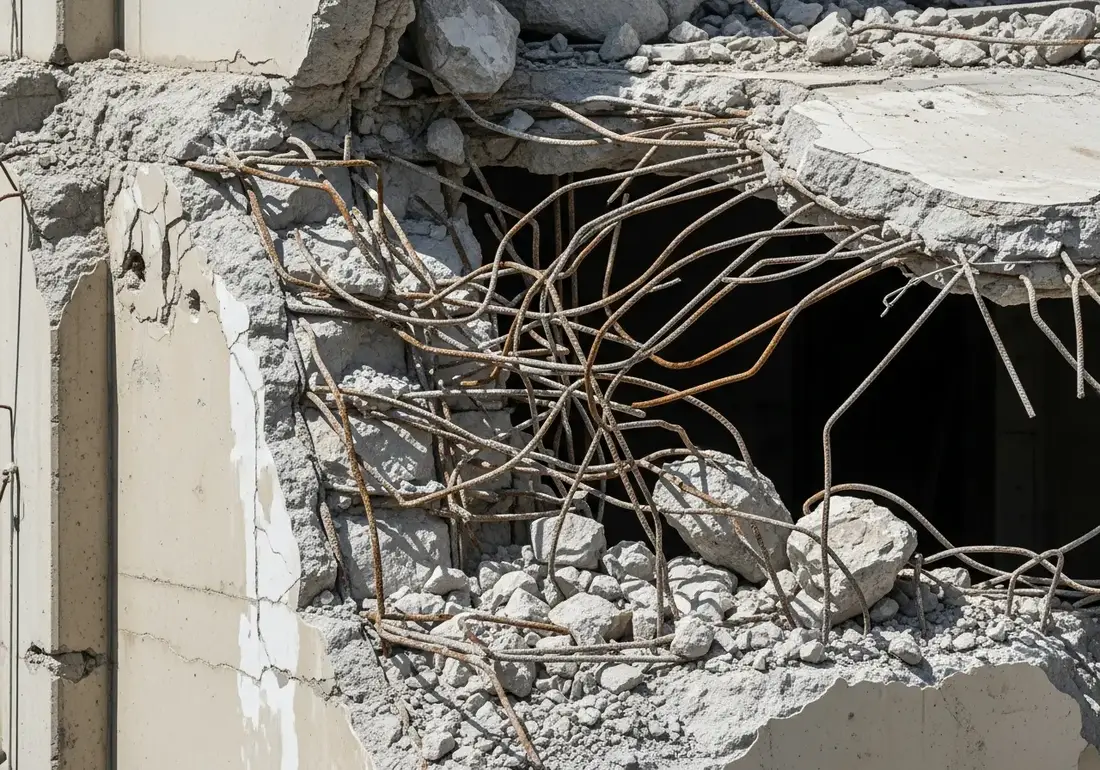
OSHA requires an engineering survey and specific controls before demolition. Asbestos and collapse violations are cited severely.
Collapse and struck-by incidents are often fatal, while asbestos and silica cause disease that appears years later.
A collapse or uncontained asbestos release halts the project and creates major liability and cleanup costs.
Demolition contractors with engineering rigor and abatement discipline win regulated and high-profile projects.
A crew removes a load-bearing element out of sequence without an engineering survey. The structure shifts and a section collapses onto workers below.
Demolition begins on a pre-1978 building without an asbestos survey. Breaking up insulation releases fibers that contaminate the site and expose the crew.
Workers break and crush concrete with no water or dust suppression, creating clouds of respirable silica in their breathing zones.
Debris is pushed off an upper floor into an area that was not cleared and barricaded, striking a worker below.
A wall is demolished over a gas or electrical line that was never confirmed disconnected, causing a release or shock.
The federal regulations that govern demolition work.
Requires an engineering survey by a competent person and disconnection of utilities before demolition begins.
Governs demolition operations, including floor openings, debris removal, and stability during the work.
Requires survey, containment, and abatement of asbestos-containing materials before or during demolition.
Requires dust controls and respiratory protection when breaking, cutting, or crushing concrete and masonry.
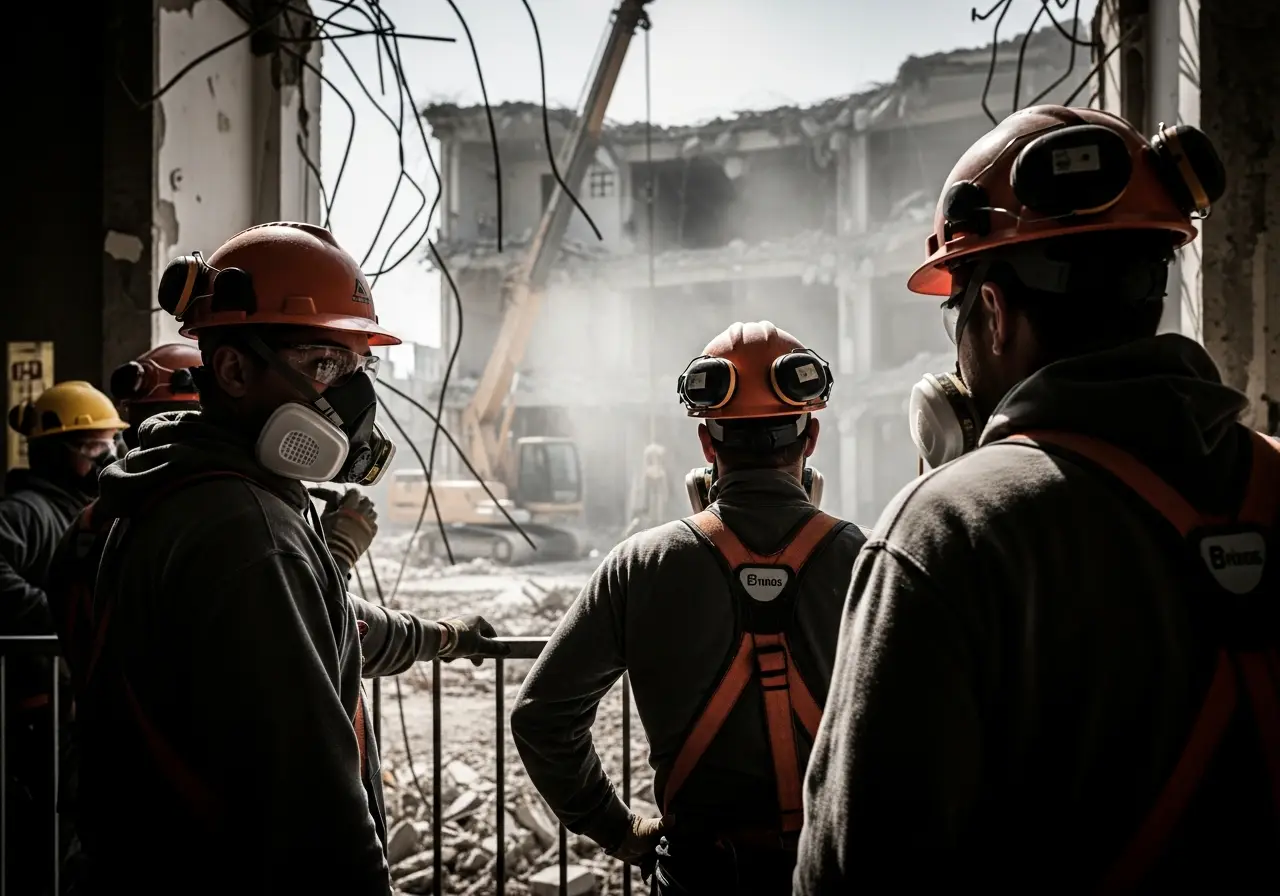
Work top-down through the hierarchy of controls — eliminate the hazard first, then fall back to procedures and PPE.
Plan the takedown and control hazardous materials.
Sequence the work and control the site.
Protect against dust, debris, and noise.
Demolition safety depends on a qualified competent person and trained crews who understand the engineering survey and sequence, because a single wrong cut or missed hazard can bring the structure down or release fibers on everyone nearby.
OSHA Scan analyzes demolition photos to flag work proceeding without evidence of hazard controls: unbarricaded drop zones below active demolition, concrete breaking without dust suppression, workers without respiratory protection near likely asbestos or silica, and equipment operating near unsupported structures. Each finding cites the relevant OSHA standard and generates a corrective-action checklist covering drop zones, dust control, and PPE — so a supervisor can catch a collapse or exposure setup from a photo.
Before demolition begins, OSHA requires a competent person to survey the structure to determine its condition and the possibility of unplanned collapse. The survey informs the demolition plan and sequence, identifies load-bearing elements and weakened areas, and is essential to preventing the structure from coming down unexpectedly on workers.
Yes. Buildings constructed before 1978 commonly contain asbestos, and breaking up materials releases fibers. An asbestos survey must be performed, and any asbestos-containing materials must be abated under the asbestos standard before or during demolition, using containment and wet methods to prevent contamination.
Collapse is prevented by following an engineering survey and a planned demolition sequence that removes elements in an order that keeps the remaining structure stable, supervised by a competent person. Stability is monitored continuously, and workers are kept out of areas that could be affected as load paths change.
Demolishing a structure over live electrical, gas, water, or steam lines can cause electrocution, fire, explosion, or flooding. OSHA requires utilities to be located, disconnected, and confirmed de-energized or drained before demolition begins, with any lines that must remain protected and clearly marked.
A drop zone is the barricaded area below where debris is being removed or where a section may fall. Establishing and enforcing drop zones keeps workers clear of falling debris and swinging equipment — a leading cause of struck-by injuries in demolition — and only authorized workers should enter them under controlled conditions.
Breaking, cutting, and crushing concrete and masonry releases respirable silica. Control it with water suppression and, where feasible, vacuum dust collection, and provide respiratory protection when controls cannot keep exposure below the permissible limit. Dry demolition of concrete without dust control can expose workers far above safe levels.
Demolition draws intense OSHA scrutiny because the failures are so often fatal, and penalties reflect that. Serious violations run several thousand dollars each, while willful or repeat violations — such as demolishing without an engineering survey, ignoring an asbestos survey, or leaving drop zones unbarricaded — can reach six figures per violation, with each unprotected worker or missing control counted separately. Asbestos releases add EPA NESHAP penalties and potential criminal liability, and a collapse fatality can trigger willful citations and even criminal referral. Beyond fines, a collapse or uncontained release shuts the project down, invites litigation, and drives up insurance for years. Because the survey, sequencing, and abatement that prevent these outcomes cost a fraction of a single incident, documented engineering-first demolition is by far the cheaper path.
The competent person who conducts the engineering survey and oversees the sequence must be trained and demonstrably qualified for that role, not simply experienced. Asbestos abatement requires accredited workers and supervisors who complete an annual refresher every year to stay certified. Workers exposed to silica need training on the exposure-control plan, and respirator users require annual fit testing and periodic medical evaluations. Equipment operators must be trained and, for some machines, certified. Hazard-communication and site-specific training should be delivered before each project because every structure presents different materials and hazards. Because crews and buildings change constantly, strong contractors track each worker's certification and medical-clearance dates and refuse to put anyone with lapsed credentials on a demolition where a single error can be catastrophic.
A demolition emergency plan must anticipate collapse, entrapment, utility strikes, and hazardous-material releases. It should define evacuation signals and routes that account for a site changing hour by hour, procedures for a partial or full collapse including how to account for every worker, and a rescue approach that does not send untrained people into an unstable structure. For utility incidents, workers need to know how to respond to a gas release, electrical contact, or water main break and who to call to isolate the system. Asbestos or chemical releases require containment and decontamination steps. First-aid and trauma response must be immediate given the severity of struck-by and crush injuries, with clear directions for emergency responders to a site that may lack normal access. Crews should rehearse the plan, and everyone must know who can stop work.
Demolition sites demand continuous inspection because conditions degrade as the structure comes down. The competent person should assess structural stability, drop zones, and hazard controls at the start of every shift and monitor them throughout, since a weakened wall or a compromised floor can appear within hours. Dust-suppression equipment, barricades, and respiratory protection need daily pre-use checks. Air monitoring for asbestos and silica runs on the schedule the exposure assessment sets. After any significant change — a section removed, a storm, or new openings created — the area should be re-inspected before work resumes. Logging each inspection with date, findings, and corrective actions demonstrates compliance and, more importantly, catches an emerging collapse or exposure hazard before it reaches a worker.
Run through this before, during, and after every job.
14 more checklist points are waiting. Register with your email to reveal every item and download the complete OSHA compliance checklist as a printable PDF. Free, and it only takes a few seconds.
Already have an account? Sign in
A contractor began demolishing a mid-century commercial building on a tight turnaround. To save time, the crew started tearing into walls before completing an engineering survey and before confirming which elements were load-bearing.
A section removed out of sequence shifted the load path, and part of an upper floor collapsed while workers were still below. Compounding the problem, the pre-1978 building contained asbestos that had not been surveyed, so the collapse also released fibers across the site.
The contractor made engineering surveys, utility disconnection, and asbestos surveys mandatory before any demolition, adopted planned demolition sequencing under a competent person, and used OSHA Scan to photo-verify drop zones, dust controls, and PPE before and during the work.
The contractor recorded no further collapse incidents and no uncontained asbestos releases, and passed subsequent OSHA inspections without demolition citations. Its documented engineering-first process helped it win larger, regulated demolition contracts.
Review findings, organize chemical records, and open relevant official resources for your saved locations and work context.
You make the final call. Review, edit, or dismiss any AI-flagged hazard before finalizing your inspection report.
Scan chemical labels or upload legacy MSDS sheets to create structured drafts that support your team's search for and review of current official manufacturer Safety Data Sheets.
Open official OSHA and State Plan guidance, required posters, emergency contacts, and relevant publications for saved locations and work requirements.
OSHA Scan reads a single photo. That makes it fast and easy for anyone on site — but it also means it has real limits. Here's an honest look at both.
Reviewed by OSHA Scan Editorial
Last updated August 29, 2026
This content is produced by the OSHA Scan Editorial team and reviewed with AI assistance. It is general safety information, not legal or compliance advice. OSHA Scan is an independent tool and is not affiliated with, endorsed by, or certified by OSHA or the U.S. Department of Labor.
Upload a photo of your demolition job site and get an instant, OSHA-cited hazard report.
Start your free trial