
1
Set the scene
Start with context
Fill the frame
2–3 ft for close-ups; keep ladders, cords and workers fully in view.
A harness only saves a life when the whole system is set up right
A personal fall arrest system is only as good as its weakest link — the anchor, the connectors, the harness fit, and the clearance below. A wrong anchor, an overlong lanyard, or a loose harness turns life-saving gear into false confidence that fails on impact. OSHA Scan analyzes job-site photos to flag improper anchors, incorrect connectors, poor harness use, and inadequate fall clearance before a worker trusts their life to the setup.
Free · No account needed to scan · Results in seconds
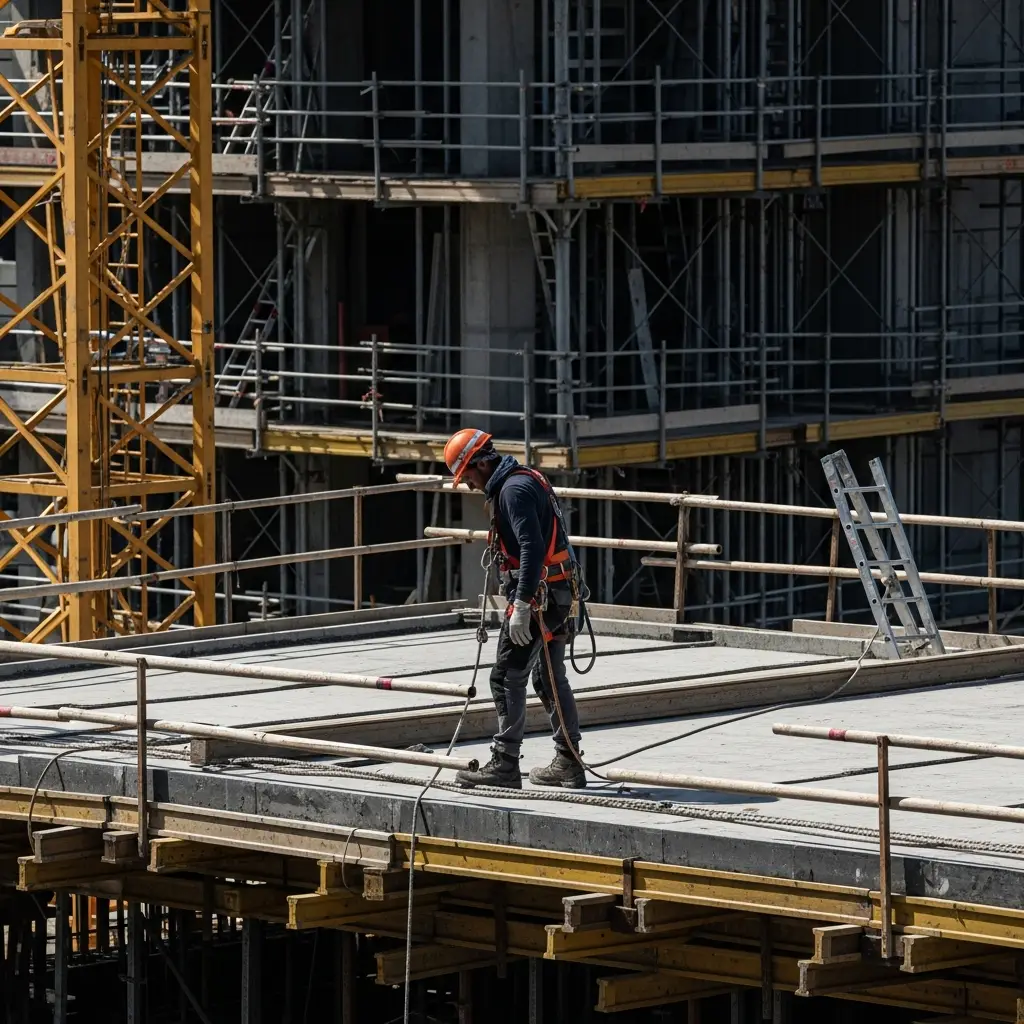
May relate to 29 CFR 1926.502
Minimum anchor strength per worker
Max free-fall distance OSHA allows
Max arresting force on the body
Typical time to get scan results
An improper fall arrest system is a personal fall arrest system (PFAS) that is missing a component, uses the wrong component, or is set up so it cannot stop a fall safely. A complete PFAS needs an anchor rated for 5,000 pounds per worker (or engineered to a 2:1 safety factor), a full-body harness, and a connector such as a shock-absorbing lanyard or self-retracting lifeline — all rigged to limit free fall to 6 feet and arresting force to 1,800 pounds.
In the field, problems show up as anchoring to inadequate points like guardrails, rebar, or conduit; using a body belt instead of a full-body harness; connecting a long lanyard that allows too much free fall; leaving harness straps loose or twisted; and choking lanyards around beams instead of using rated connectors. The most overlooked error is inadequate fall clearance — not enough distance below the worker for the system to deploy before they hit a lower level.
The danger is that an improper system looks like protection. The worker is clipped in and feels safe, so they lean, reach, and work at the edge with confidence. The failure only reveals itself during the fall — when the anchor pulls out, the lanyard is too long, or the worker hits the ground before the deceleration device engages. That hidden gap is exactly what photo-based detection is built to expose.
Here is what an OSHA Scan report looks like for improper fall arrest system. It is an illustrative example built from this scenario's hazards — clearly marked, not live scan data.
Compliance score
45
Lower means more potential hazards found
3 potential hazards found
Improper Fall Arrest System
CriticalPossibly related to Fall protection systems criteria and practices (29 CFR 1926.502)
Observed condition: An improper fall arrest system is a personal fall arrest system (PFAS) that is missing a component, uses the wrong component, or is set up so it cannot stop a fall safely.
Corrective action: Use anchor points rated for 5,000 lb per worker, or engineered to a 2:1 factor
High confidence
Improper Fall Arrest System: Duty to have fall protection
HighPossibly related to Duty to have fall protection (29 CFR 1926.501)
Observed condition: Requires fall protection for workers exposed to falls of 6 feet or more, which must be provided by a properly designed and used personal fall arrest system where guardrails or net…
Corrective action: Select self-retracting lifelines to minimize free fall in low-clearance areas
Medium confidenceNot fully clear from the photo — verify on site.
Improper Fall Arrest System: Training requirements
MediumPossibly related to Training requirements (29 CFR 1926.503)
Observed condition: Requires a competent person to train workers to properly select, inspect, wear, and use personal fall arrest systems and to recognize the hazards of improper setups.
Corrective action: Use shock-absorbing lanyards that limit arresting force to 1,800 lb or less
High confidence
When a fall arrest system fails, the worker falls to a lower level or is subjected to dangerous arresting forces, causing fatal or catastrophic injuries. Suspension trauma can also injure a worker left hanging after a successful arrest.
OSHA cites deficient fall arrest systems under 29 CFR 1926.502, with serious penalties over $16,000 and willful or repeat citations exceeding $160,000. A fatality invites litigation, criminal referral, and lasting insurance costs.
A fall arrest failure stops the job for investigation, spikes insurance premiums, raises your experience modification rate, and undermines crew trust in the safety program.
Steel erection, roofing, tower work, window and facade crews, and utility work depend on PFAS daily, often at extreme heights where anchor selection and clearance are unforgiving of mistakes.
OSHA Scan uses an AI vision model to evaluate fall arrest setups. Upload a photo of a worker clipped in and it checks for a full-body harness that is worn and adjusted correctly, verifies the anchor appears rated and properly located, flags long or improperly connected lanyards, estimates available fall clearance below the work, and returns each deficiency with a severity rating and the OSHA citation it may relate to — in seconds.
Analyze your first photo freeUpload a real job-site photo and OSHA Scan detects visible hazards in seconds — no account needed to run your first scan.
Use the real site or facility name. If you save the scan after signup, it becomes the report name.
Three angles, one deeper scan
Only the wide shot is required — every extra angle gives the AI more places to look.
Required: Set the scene — one wide shot lets the AI sweep the whole area at once
Stand at the entry point and capture corner to corner: floors, ladders, scaffolds, and everyone at work
Drop a job-site photo or walkthrough video
Click to upload, drag & drop, or snap a photo on site. Photos scan free in about 15 seconds — no signup, no card. Video walkthroughs (up to 3 min) run on a free account.
Small habits, sharper scans
Set the scene
Start with context
Fill the frame
2–3 ft for close-ups; keep ladders, cords and workers fully in view.
Capture clearly
Make the frame usable
Light it right
Keep the sun or lights behind you — glare and shadows hide hazards.
Tap to focus
Tap the hazard on screen and hold still one second — blur can't be flagged.
Choose the useful view
Give the AI room to understand
Go landscape
Turn your phone sideways — a wider frame catches more of the scene.
Only upload photos you have permission to use, and avoid images showing personal, customer, or confidential information. Demo photos and results are held privately for up to 48 hours so you can save them to a free account; unclaimed photos are deleted automatically. Results are an AI-assisted preliminary review, not an official OSHA determination.
New: Video walkthrough scans
Record up to 3 minutes of your site — the AI extracts frames and flags every hazard with exact timestamps. Free account required.
Get the best results
Wide shot first
Stand at the entrance and photograph the entire work area so AI sees the full context
Hazard areas
Photograph elevated surfaces, equipment, electrical panels, and anywhere workers are active
Close-ups last
Move in close on anything damaged, missing, or that looks risky — the AI catches more detail
An ironworker installing decking clipped his shock-absorbing lanyard to a nearby guardrail post because it was the closest thing to reach. The post looked solid and the worker assumed it would hold.
The guardrail was never designed as an anchor. When the worker slipped and the system loaded, the post bent and tore loose, and he fell to the level below. The lanyard was also long enough to allow more free fall than the clearance permitted, compounding the injury.
A photo of the worker clipped in, run through OSHA Scan, would have flagged the guardrail as an inadequate anchor point, noted the excessive lanyard length for the available clearance, cited 29 CFR 1926.502, and prompted the foreman to relocate the tie-off to a 5,000-pound rated anchor and switch to a self-retracting lifeline.
The closest attachment point is rarely a rated anchor. Every tie-off and connector should be verified against the anchor rating and available fall clearance — a quick photo scan catches the mismatch before the worker leans on it.
Layered controls, from most to least effective.
Build a complete, correctly rated system with adequate clearance.
Verify the setup and the worker's competence before each use.
Ensure each worker wears and uses the gear correctly.
The federal standards this hazard may relate to.
Specifies personal fall arrest system criteria, including 5,000-pound anchor strength, full-body harness requirement, 6-foot maximum free fall, 1,800-pound maximum arresting force, and prompt-rescue provisions.
Up to $16,550 per serious violation; $165,514 for willful or repeat
Requires fall protection for workers exposed to falls of 6 feet or more, which must be provided by a properly designed and used personal fall arrest system where guardrails or nets are not used.
Up to $16,550 per serious violation
Requires a competent person to train workers to properly select, inspect, wear, and use personal fall arrest systems and to recognize the hazards of improper setups.
Up to $16,550 per serious violation
If an incident occurs, act fast and in order.
Workers will understand how fall arrest systems fail, correctly select anchors and connectors, don and adjust a full-body harness, calculate fall clearance, and execute a rescue.
Train before any PFAS work begins, refresh annually, and reinforce with a toolbox talk each shift using real photos of correct and improper setups.
Run these checks to stay ahead of citations.
10 more checklist points are waiting. Register with your email to reveal every item and download the complete OSHA compliance checklist as a printable PDF. Free, and it only takes a few seconds.
Already have an account? Sign in
Each anchor point used for personal fall arrest must support at least 5,000 pounds per attached worker, or be part of a system designed and installed under the supervision of a qualified person with a safety factor of at least two.
No. Body belts have been prohibited for fall arrest since 1998 because they concentrate arresting forces on the abdomen and can cause serious internal injury. Only a full-body harness is permitted for personal fall arrest.
A personal fall arrest system must limit free fall to 6 feet or less and prevent the worker from contacting a lower level. It must also limit the maximum arresting force on the body to 1,800 pounds when used with a full-body harness.
You must have enough distance below the worker for the system to stop the fall before they hit a lower level. Clearance includes lanyard length, deceleration distance, harness stretch, the worker's height, and a safety margin — miscalculating it is a leading cause of fatal arrests.
No. Guardrails, rebar, conduit, and similar points are not rated anchors and can fail under fall forces. Always connect to an engineered anchor rated for 5,000 pounds per worker or an approved anchorage connector.
Yes. OSHA requires provisions for prompt rescue of a worker after a fall. A suspended worker can suffer suspension trauma within minutes, so you must have equipment, trained rescuers, and a written, practiced plan ready before work begins.
Remove and destroy any component that has arrested a fall or shows cuts, frays, burns, chemical damage, deployed shock absorbers, or corroded hardware. Inspect the full system before every use and remove anything that fails inspection.
OSHA Scan evaluates fall arrest setups. It checks harness fit, anchor location, connector type, and available clearance, and returns each deficiency with the specific OSHA citation.
Upload a photo of your fall arrest setup and get instant, specific feedback on anchors, connectors, harness use, and clearance.
Get startedPut our expert fall arrest checklist to work on your next job to stay ahead of citations and failures.
Get startedSee how OSHA Scan fits your at-height work and get recommendations for your specific anchors and tasks.
Get startedSee how other crews use OSHA Scan to verify fall arrest setups before a worker trusts their life to them.
Get startedReview findings, organize chemical records, and open relevant official resources for your saved locations and work context.
You make the final call. Review, edit, or dismiss any AI-flagged hazard before finalizing your inspection report.
Scan chemical labels or upload legacy MSDS sheets to create structured drafts that support your team's search for and review of current official manufacturer Safety Data Sheets.
Open official OSHA and State Plan guidance, required posters, emergency contacts, and relevant publications for saved locations and work requirements.
OSHA Scan reads a single photo. That makes it fast and easy for anyone on site — but it also means it has real limits. Here's an honest look at both.
Reviewed by OSHA Scan Editorial
Last updated August 29, 2026
This content is produced by the OSHA Scan Editorial team and reviewed with AI assistance. It is general safety information, not legal or compliance advice. OSHA Scan is an independent tool and is not affiliated with, endorsed by, or certified by OSHA or the U.S. Department of Labor.
Start with 5 included AI site scans plus a one-time 10-scan signup bonus — no credit card. Build JHA-ready reports and catch changing conditions sooner.
Start your free trial