
1
Set the scene
Start with context
Fill the frame
2–3 ft for close-ups; keep ladders, cords and workers fully in view.
Roof edges, fall arrest, ladders, and weather
Roofers fall more than any other trade in construction, and most falls are from unprotected edges that a photo would have revealed. OSHA Scan analyzes roofing job-site photos to catch missing edge protection, improper tie-off, and ladder hazards before someone goes over the side.
Free · No account needed to scan · Results in seconds
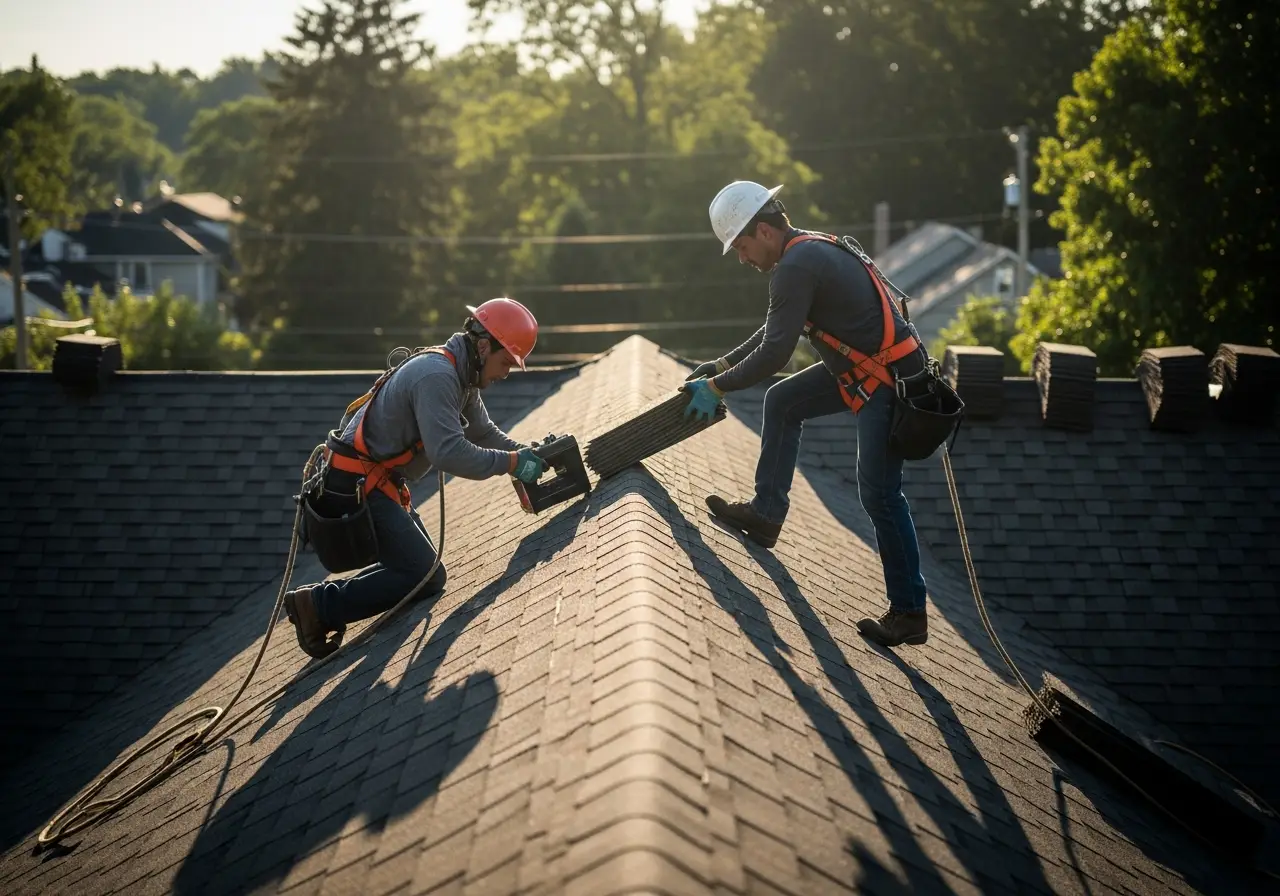
roofing has the highest fall fatality rate
construction fall deaths a year, many roofers
height that triggers OSHA fall protection
annual cost of fall injuries in construction
Upload a real job-site photo and OSHA Scan detects visible roofing hazards in seconds — no account needed to run your first scan.
Use the real site or facility name. If you save the scan after signup, it becomes the report name.
Three angles, one deeper scan
Only the wide shot is required — every extra angle gives the AI more places to look.
Required: Set the scene — one wide shot lets the AI sweep the whole area at once
Stand at the entry point and capture corner to corner: floors, ladders, scaffolds, and everyone at work
Drop a job-site photo or walkthrough video
Click to upload, drag & drop, or snap a photo on site. Photos scan free in about 15 seconds — no signup, no card. Video walkthroughs (up to 3 min) run on a free account.
Small habits, sharper scans
Set the scene
Start with context
Fill the frame
2–3 ft for close-ups; keep ladders, cords and workers fully in view.
Capture clearly
Make the frame usable
Light it right
Keep the sun or lights behind you — glare and shadows hide hazards.
Tap to focus
Tap the hazard on screen and hold still one second — blur can't be flagged.
Choose the useful view
Give the AI room to understand
Go landscape
Turn your phone sideways — a wider frame catches more of the scene.
Only upload photos you have permission to use, and avoid images showing personal, customer, or confidential information. Demo photos and results are held privately for up to 48 hours so you can save them to a free account; unclaimed photos are deleted automatically. Results are an AI-assisted preliminary review, not an official OSHA determination.
Here is what an OSHA Scan report looks like for roofing hazards. It is an illustrative example built from this trade's hazards — clearly marked, not live scan data.
Compliance score
52
Lower means more potential hazards found
3 potential hazards found
Fall from an unprotected edge
CriticalPossibly related to Duty to have fall protection (29 CFR 1926.501)
Observed condition: A roofer works near the eave of a steep roof without guardrails or a harness.
Corrective action: Install guardrails along roof edges wherever feasible
High confidence
Fall through a skylight
HighPossibly related to Fall protection systems criteria (29 CFR 1926.502)
Observed condition: A worker steps back onto a skylight covered in dust, mistaking it for solid decking.
Corrective action: Cover and secure skylights and roof openings with rated covers
Medium confidenceNot fully clear from the photo — verify on site.
Ladder failure at access point
MediumPossibly related to Ladders (29 CFR 1926.1053)
Observed condition: An extension ladder set at too shallow an angle and not tied off slides out as a worker climbs down, dropping him to the ground.
Corrective action: Use safety-net systems where guardrails are impractical
High confidence
Roofing hazards are dominated by falls — from roof edges, through skylights and fragile surfaces, off ladders, and from elevated work platforms. Roofers spend nearly all of their time at height on surfaces that are often sloped, wet, or covered in loose debris, making a loss of footing far more likely than on level ground.
Primary OSHA standard: 29 CFR 1926.501
Roofing hazards are dominated by falls — from roof edges, through skylights and fragile surfaces, off ladders, and from elevated work platforms. Roofers spend nearly all of their time at height on surfaces that are often sloped, wet, or covered in loose debris, making a loss of footing far more likely than on level ground.
Unprotected roof edges are the single greatest danger: without guardrails, safety nets, or a personal fall arrest system, a slip or misstep near the edge becomes a fatal fall. Skylights and weakened decking create hidden fall-through hazards, and ladders — the primary means of access — cause their own serious injuries when set up or used improperly.
The outdoor environment layers on more risk. Heat stress in summer, ice and wind in winter, and sudden weather changes all raise the likelihood of a fall. Because roofers face these conditions on every job, fall protection is not a special case for roofing — it is the core of the work.
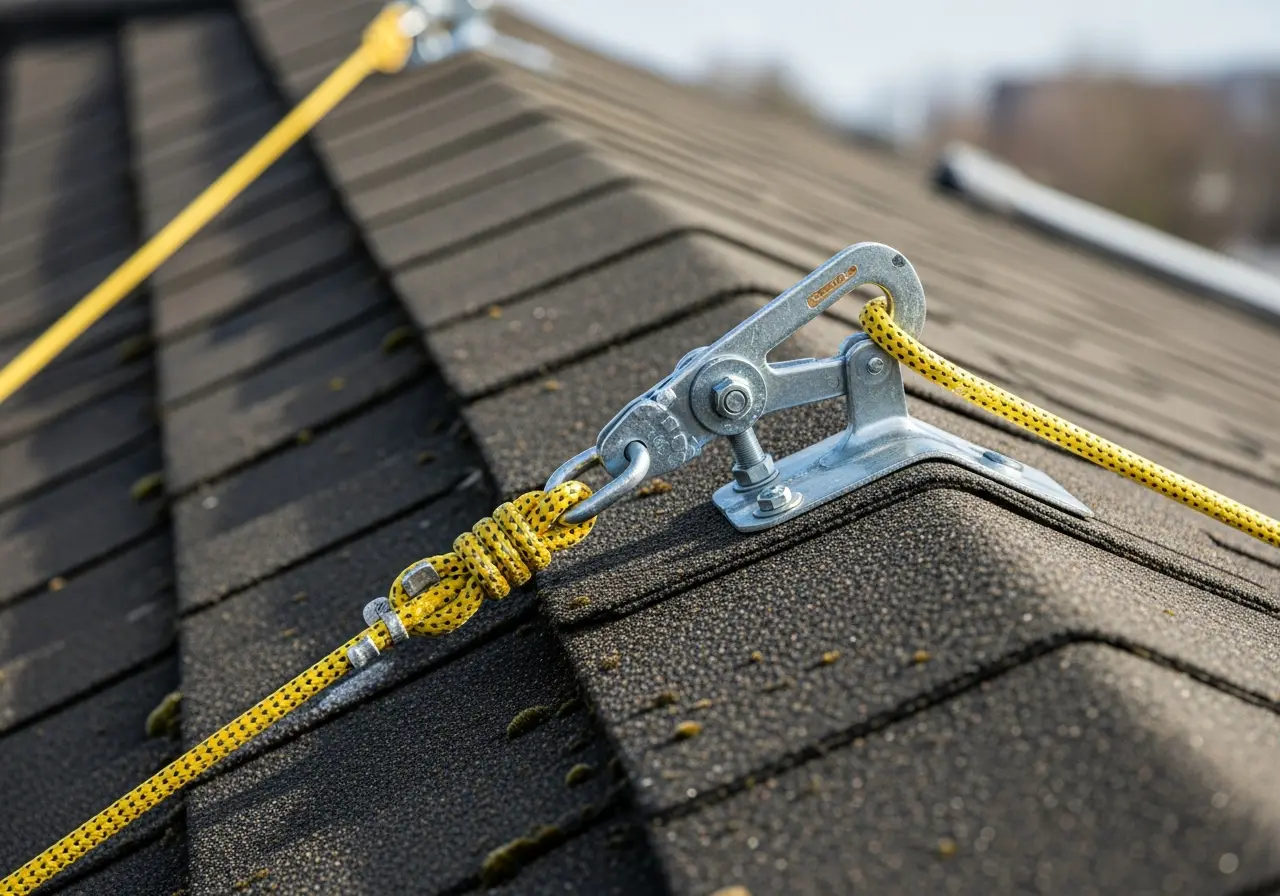
Fall protection is OSHA's most-cited standard year after year. Roofing contractors are inspected closely and fined heavily for edge and tie-off violations.
Falls from roof height cause catastrophic and often fatal injuries. Survivors frequently face permanent disability.
A fall fatality can bankrupt a small roofing company through fines, litigation, and lost work while the investigation proceeds.
General contractors increasingly require documented fall-protection plans before allowing roofers on site.
A roofer works near the eave of a steep roof without guardrails or a harness. A slip on loose granules sends him over the edge to the ground below.
A worker steps back onto a skylight covered in dust, mistaking it for solid decking. The plastic gives way and he falls through to the floor inside.
An extension ladder set at too shallow an angle and not tied off slides out as a worker climbs down, dropping him to the ground.
A roofer ties his lanyard to a vent pipe rather than a rated anchor. When he slips, the pipe pulls loose and the fall is not arrested.
A crew stays on a low-slope roof as light rain begins. The membrane becomes slick, a worker loses footing, and slides toward the unguarded edge.
The federal regulations that govern roofing work.
Requires fall protection for workers at six feet or more, including guardrails, safety nets, or personal fall arrest systems for roofing work.
Specifies the design and performance requirements for guardrails, nets, anchors, and personal fall arrest components.
Sets requirements for ladder capacity, setup angle, extension above the landing, and securing to prevent slipping.
Requires each worker exposed to fall hazards to be trained by a competent person to recognize hazards and use protection correctly.
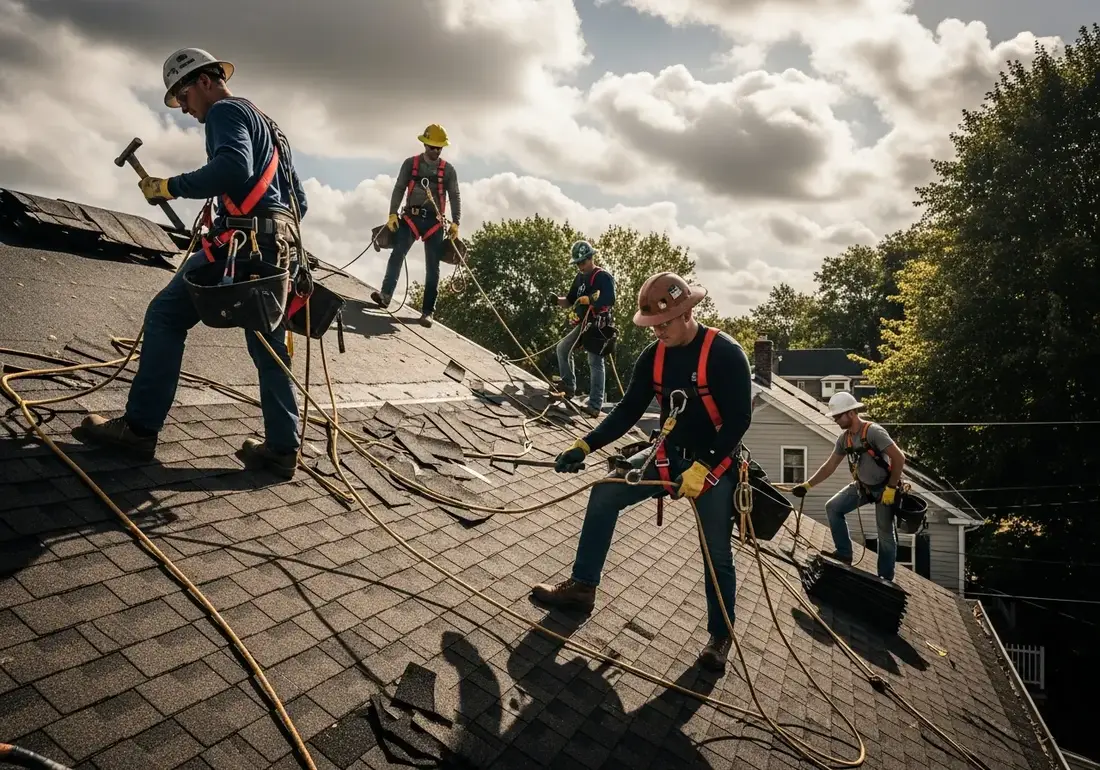
Work top-down through the hierarchy of controls — eliminate the hazard first, then fall back to procedures and PPE.
Guard the edge and the openings before work begins.
Plan the work and the access around fall hazards.
Keep every exposed worker tied off to a rated system.
Fall protection only works when a competent person and trained crew know how to select, inspect, and use it correctly on every roof.
OSHA Scan analyzes roofing job-site photos to flag unprotected roof edges, uncovered skylights and openings, workers without visible harnesses or tie-off, and improperly set or unsecured ladders. Upload a photo of the roof and OSHA Scan returns an instant report citing OSHA 1926.501 and related standards for each finding, plus a corrective-action checklist — letting a foreman confirm edge protection and tie-off remotely before the crew steps onto the roof.
In construction, OSHA requires fall protection at six feet or more above a lower level, which covers virtually all roofing work. Acceptable systems include guardrails, safety nets, and personal fall arrest systems, and on certain low-slope roofs a warning line with a safety monitor may be permitted.
No. Anchors for personal fall arrest must be capable of supporting 5,000 pounds per worker or be designed by a qualified person with a safety factor. Vent pipes, small fixtures, and unrated points can fail under fall forces, so only engineered or rated anchors should be used.
Treat every skylight and roof opening as a fall hazard. Cover them with rated covers, install screens or guardrails around them, or protect workers with a personal fall arrest system. Never assume a skylight will bear a worker's weight — many are thin plastic that shatters instantly.
Set extension ladders at about a 4:1 angle (one foot out for every four feet of height), extend them at least three feet above the landing, place them on firm level ground, and secure the top to prevent movement. Maintain three points of contact and never carry loads that compromise your grip while climbing.
No. Rain, ice, snow, and high winds dramatically increase the risk of slips and falls and can make fall-protection anchors and footing unreliable. Roof work should stop when weather makes surfaces slick or footing unstable, and resume only once conditions are safe.
Inspect harnesses, lanyards, lifelines, and anchors before every use and after any fall or impact. A competent person should perform a documented inspection at least annually, and any component with cuts, fraying, corrosion, or deformation must be removed from service immediately.
Fall protection is consistently OSHA's most-cited standard, and roofing contractors are inspected and penalized aggressively. Serious violations run into the thousands of dollars per instance, while willful or repeat violations can reach the statutory maximum of well over $160,000 each, with amounts adjusted for inflation annually. Common roofing citations involve missing edge protection under 1926.501, deficient fall-arrest systems under 1926.502, unsafe ladders under 1926.1053, and lack of training under 1926.503. Because falls are a national emphasis for OSHA, inspectors frequently stop at residential and commercial roofing sites without notice. A fall fatality typically triggers a full inspection that uncovers additional citations, and willful violations linked to a death can lead to criminal referral. For a small roofing company, the combined fines, litigation, and lost work from a single fall can be enough to end the business.
OSHA requires that each worker exposed to fall hazards be trained by a competent person before starting work, covering hazard recognition and the correct use of the fall-protection systems in place. Retraining is required whenever there are changes in the workplace or equipment that make earlier training obsolete, or when a worker shows through their actions that they have not retained the knowledge. While OSHA does not set a fixed annual interval, most roofing contractors conduct refresher training at least yearly and reinforce it with job-specific toolbox talks on each new roof. Competent persons and rescue personnel need additional, documented training for their roles. Keeping signed training records with dates and topics is essential, because OSHA inspectors and general contractors routinely request proof that every worker on the roof has current, task-specific fall-protection training.
OSHA requires employers to provide for prompt rescue of workers in the event of a fall, and roofing crews cannot rely solely on calling 911. A worker left hanging in a harness can develop suspension trauma within minutes as blood pools in the legs, so the plan must enable rescue quickly. Options include a controlled descent device, a rescue ladder or aerial lift positioned nearby, or a pre-rigged retrieval system. Suspension-relief straps let a suspended worker take pressure off their legs while awaiting rescue. The plan must identify who performs the rescue, the equipment staged on site, and how to contact emergency services with the exact location. Crews should practice the plan so roles are clear, and after any arrested fall the worker needs medical evaluation and the equipment must be removed from service.
Fall protection is one of the best returns on investment in construction. A full-body harness, lanyard, and rated anchor cost a few hundred dollars per worker, guardrail and warning-line systems are modest rental or purchase items, and a written fall-protection plan costs only planning time. By contrast, a single fall injury averages tens of thousands of dollars in direct costs, and a fatality drives OSHA penalties, litigation, and workers' compensation into the hundreds of thousands or more. Indirect costs — project shutdowns during investigation, higher experience-modification insurance rates, crew downtime, and lost bidding opportunities — often exceed the direct costs. Many general contractors now require documented fall-protection programs before allowing roofers on site, so compliance directly wins work. For a small roofing company, the price of complete edge protection and tie-off for the whole crew is far less than the cost of even one serious fall.
Run through this before, during, and after every job.
14 more checklist points are waiting. Register with your email to reveal every item and download the complete OSHA compliance checklist as a printable PDF. Free, and it only takes a few seconds.
Already have an account? Sign in
A residential roofing crew was tearing off and replacing shingles on a two-story home with a steep pitch. To save setup time, the crew skipped edge guardrails and relied on workers 'being careful' near the eaves.
A roofer stepped on a patch of loose granules near the edge, lost his footing, and slid off the roof. He was not tied off and fell to the driveway, suffering serious fractures. The OSHA investigation cited the contractor for missing fall protection.
The contractor made tie-off to rated anchors mandatory for all roof work, standardized ladder setup and skylight covers, and wrote a fall-protection plan for every job. It adopted OSHA Scan to photo-verify edge protection and harness use before crews climbed onto each roof.
The company recorded no further roof falls, passed subsequent OSHA inspections without fall-protection citations, and used its documented safety record to qualify for larger commercial roofing contracts that required it.
Review findings, organize chemical records, and open relevant official resources for your saved locations and work context.
You make the final call. Review, edit, or dismiss any AI-flagged hazard before finalizing your inspection report.
Scan chemical labels or upload legacy MSDS sheets to create structured drafts that support your team's search for and review of current official manufacturer Safety Data Sheets.
Open official OSHA and State Plan guidance, required posters, emergency contacts, and relevant publications for saved locations and work requirements.
OSHA Scan reads a single photo. That makes it fast and easy for anyone on site — but it also means it has real limits. Here's an honest look at both.
Reviewed by OSHA Scan Editorial
Last updated August 29, 2026
This content is produced by the OSHA Scan Editorial team and reviewed with AI assistance. It is general safety information, not legal or compliance advice. OSHA Scan is an independent tool and is not affiliated with, endorsed by, or certified by OSHA or the U.S. Department of Labor.
Upload a photo of your roofing job site and get an instant, OSHA-cited hazard report.
Start your free trial