
1
Set the scene
Start with context
Fill the frame
2–3 ft for close-ups; keep ladders, cords and workers fully in view.
Falls, structural failure, and overloading
Scaffolds put workers high above the ground on structures that are only as safe as their assembly and inspection. Missing guardrails, bad planking, and overloading cause falls and collapses every year. OSHA Scan analyzes scaffold photos to catch these defects before workers climb on.
Free · No account needed to scan · Results in seconds

U.S. workers use scaffolds regularly
scaffold injuries reported each year
scaffold-related deaths annually
the rated load a scaffold must support
Upload a real job-site photo and OSHA Scan detects visible scaffolding hazards in seconds — no account needed to run your first scan.
Use the real site or facility name. If you save the scan after signup, it becomes the report name.
Three angles, one deeper scan
Only the wide shot is required — every extra angle gives the AI more places to look.
Required: Set the scene — one wide shot lets the AI sweep the whole area at once
Stand at the entry point and capture corner to corner: floors, ladders, scaffolds, and everyone at work
Drop a job-site photo or walkthrough video
Click to upload, drag & drop, or snap a photo on site. Photos scan free in about 15 seconds — no signup, no card. Video walkthroughs (up to 3 min) run on a free account.
Small habits, sharper scans
Set the scene
Start with context
Fill the frame
2–3 ft for close-ups; keep ladders, cords and workers fully in view.
Capture clearly
Make the frame usable
Light it right
Keep the sun or lights behind you — glare and shadows hide hazards.
Tap to focus
Tap the hazard on screen and hold still one second — blur can't be flagged.
Choose the useful view
Give the AI room to understand
Go landscape
Turn your phone sideways — a wider frame catches more of the scene.
Only upload photos you have permission to use, and avoid images showing personal, customer, or confidential information. Demo photos and results are held privately for up to 48 hours so you can save them to a free account; unclaimed photos are deleted automatically. Results are an AI-assisted preliminary review, not an official OSHA determination.
Here is what an OSHA Scan report looks like for scaffolding hazards. It is an illustrative example built from this trade's hazards — clearly marked, not live scan data.
Compliance score
46
Lower means more potential hazards found
3 potential hazards found
Fall from an unguarded platform
CriticalPossibly related to Scaffolds — general requirements (29 CFR 1926.451)
Observed condition: A worker moves along a scaffold platform ten feet up that is missing its guardrail on the open side.
Corrective action: Erect scaffolds on firm, level foundations with base plates and mud sills
High confidence
Planking failure
HighPossibly related to Additional requirements for specific scaffolds (29 CFR 1926.452)
Observed condition: A damaged or under-rated plank spans two supports.
Corrective action: Fully plank platforms with rated, undamaged planks
Medium confidenceNot fully clear from the photo — verify on site.
Overloaded platform collapse
MediumPossibly related to Scaffold training requirements (29 CFR 1926.454)
Observed condition: A crew stacks masonry and mortar on a platform beyond its rated capacity.
Corrective action: Install guardrails, midrails, and toeboards on open sides
High confidence
Scaffolding hazards begin with falls — from platforms without guardrails, through gaps in planking, or during erection and dismantling before protection is in place. Because scaffold work happens at height, a fall from a platform is frequently serious or fatal, and falls are the leading cause of scaffold injuries.
Primary OSHA standard: 29 CFR 1926.451
Scaffolding hazards begin with falls — from platforms without guardrails, through gaps in planking, or during erection and dismantling before protection is in place. Because scaffold work happens at height, a fall from a platform is frequently serious or fatal, and falls are the leading cause of scaffold injuries.
Structural failure is the other major danger. Scaffolds are temporary structures assembled on site, so improper erection, inadequate foundation or base plates, missing braces, and damaged components can lead to partial or total collapse. Overloading a platform beyond its rated capacity with workers and materials is a common trigger.
Additional hazards include being struck by falling tools and materials, electrocution when scaffolds are erected too close to power lines, and unstable footing on mud-set or uneven ground. Because scaffolds are put up and taken down repeatedly, competent-person inspection at each stage is central to keeping them safe.
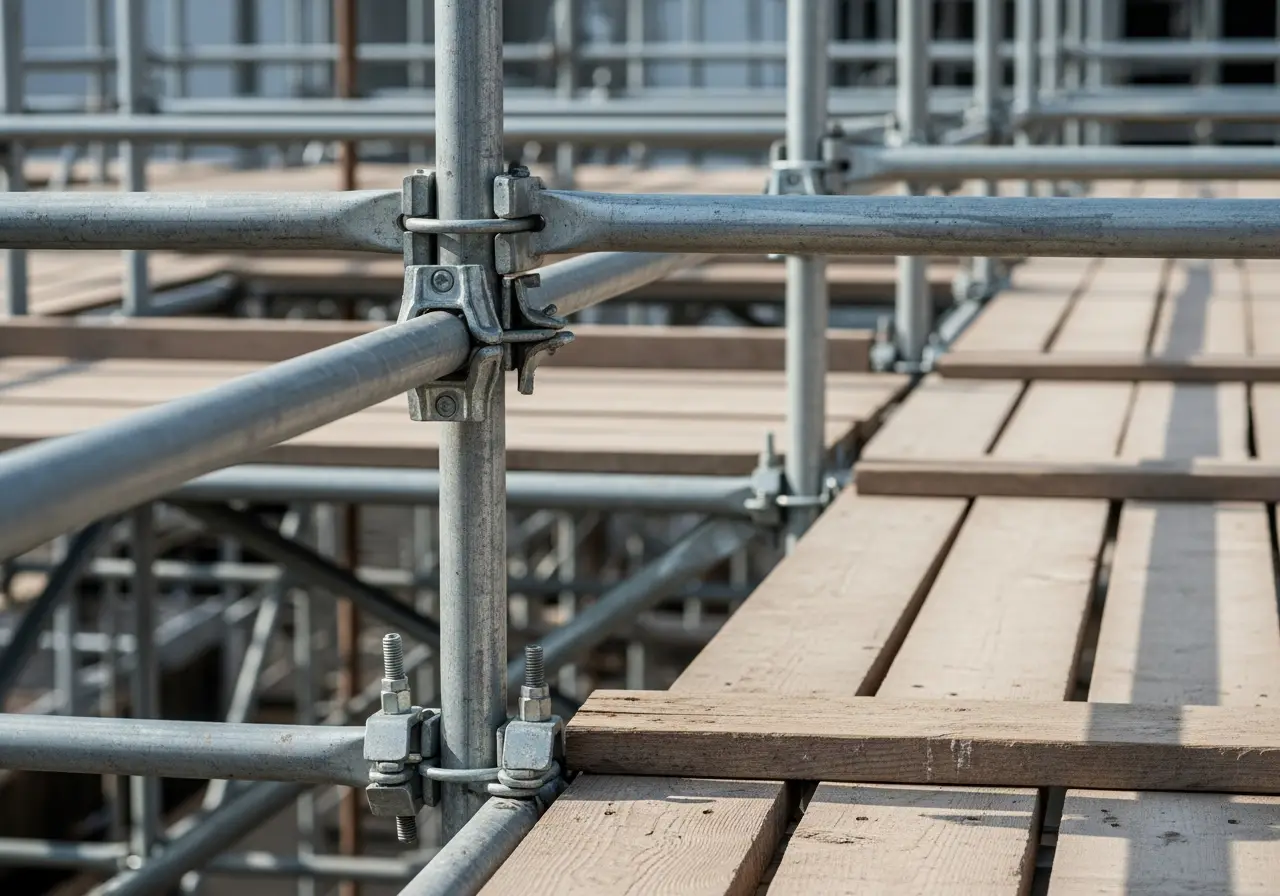
Scaffolding is consistently among OSHA's most-cited standards. Guardrail, planking, and inspection violations draw frequent, serious citations.
Falls and collapses from scaffolds cause catastrophic and often fatal injuries to workers on and beneath the structure.
A scaffold collapse or fall triggers investigation, work stoppage, and liability that can be severe for the responsible contractor.
General contractors require competent-person scaffold programs and inspection records before allowing scaffold work on site.
A worker moves along a scaffold platform ten feet up that is missing its guardrail on the open side. He loses balance while handling materials and falls to the ground.
A damaged or under-rated plank spans two supports. Under the weight of a worker and materials it breaks, dropping the worker through the gap.
A crew stacks masonry and mortar on a platform beyond its rated capacity. The overloaded scaffold buckles and collapses with workers on it.
During assembly, workers climb the partially built scaffold without fall protection because guardrails are not yet installed, and one falls from the incomplete structure.
A scaffold is erected close to an overhead line. A worker or metal component contacts the line and the scaffold is energized.
The federal regulations that govern scaffolding work.
Sets requirements for capacity, platform construction, access, guardrails, and support for supported scaffolds.
Provides detailed rules for particular scaffold types, including tube-and-coupler, frame, and suspended scaffolds.
Requires workers to be trained by a qualified person to recognize scaffold hazards and use scaffolds correctly.
Requires a competent person to inspect scaffolds before each work shift and after any event that could affect integrity.

Work top-down through the hierarchy of controls — eliminate the hazard first, then fall back to procedures and PPE.
Build a sound structure with fall protection designed in.
Put a competent person in charge of erection and inspection.
Protect workers on and beneath the scaffold.
Because scaffolds are assembled and inspected on site, trained users and a qualified competent person are the backbone of catching guardrail, planking, and stability defects before anyone climbs on.
OSHA Scan analyzes scaffold photos to flag missing guardrails and toeboards, incomplete or damaged planking, unstable or unlevel foundations, and scaffolds erected close to power lines. Each finding cites the relevant OSHA Subpart L standard and generates a corrective-action checklist covering guardrails, planking, and access — so a competent person can verify a scaffold is safe from a photo before the crew is allowed to climb on.
Guardrail systems are generally required on scaffold platforms more than ten feet above a lower level. They must include a top rail, midrail, and, where needed, toeboards on open sides and ends. For some scaffold types and heights, personal fall arrest is required in addition to or instead of guardrails.
A competent person must inspect the scaffold before each work shift and after any occurrence that could affect its structural integrity, such as a storm, an impact, or an alteration. Any defects found must be corrected before the scaffold is used.
Scaffolds and their components must support their own weight plus at least four times the maximum intended load. Overloading a platform with workers, materials, and equipment beyond its rated capacity is a leading cause of collapse, so posted load limits must be enforced.
Scaffold erection, alteration, and dismantling must be supervised and directed by a competent person and performed by trained, experienced workers. During these operations, fall protection must be provided when feasible, since guardrails may not yet be in place.
Access must be by a proper means such as a ladder, stair tower, or integrated access — never by climbing the cross-bracing. Safe access must be provided when the platform is more than two feet above or below a point of access.
OSHA requires minimum clearances between scaffolds and energized power lines based on voltage — for insulated lines up to 300 volts, at least three feet, and greater distances for higher voltages. Where clearance cannot be maintained, the lines must be de-energized, relocated, or insulated.
Scaffolding is perennially one of OSHA's most-cited standards in construction, so defects draw frequent and serious enforcement. Missing guardrails, inadequate or damaged planking, no competent-person inspection, and unsafe access each carry penalties that can reach the tens of thousands of dollars per item, with willful or repeat citations climbing into six figures. When a fall or collapse causes serious injury or death, inspectors often classify the underlying violations as willful and may pursue additional enforcement. Beyond fines, a scaffold incident typically triggers a work stoppage, an investigation, higher insurance and bonding costs, and civil liability from injured workers or bystanders. General contractors also drop subcontractors with poor scaffold records. Against these costs, the price of proper guardrails, rated planking, and a few minutes of competent-person inspection is negligible, which is why documented scaffold programs are treated as a baseline requirement on well-run job sites.
Treat any scaffold collapse or fall as a medical emergency and a scene that may still be unstable. Call 911 immediately, do not move a fallen worker unless there is an ongoing danger, and provide first aid within your training while keeping the person still in case of spinal injury. Clear everyone out from under and around the affected scaffold, since partially collapsed structures and loose materials can fall further, and shut down adjacent work that could add vibration or load. Do not re-erect or disturb the scaffold until it has been evaluated, because it is both a safety hazard and evidence. Preserve the scene for the investigation, notify management, and report the incident to OSHA within the required timeframe for hospitalizations or fatalities. Afterward, a competent person should determine the cause and correct the program before any similar scaffold is used again.
A competent person must inspect the scaffold and its components before each work shift and after any occurrence that could affect structural integrity — a storm, high winds, an impact from equipment, an overload, or any alteration. Any defect found, such as damaged planks, missing guardrails, loose braces, or a settled foundation, must be corrected before the scaffold is used. While OSHA does not mandate a specific paper form for every inspection, keeping dated, signed inspection records with the tag or logbook is strong practice: it proves the inspection happened, tracks recurring defects, and satisfies general-contractor documentation requirements. Many sites use a scaffold tagging system — green, yellow, or red tags — so workers can see at a glance whether a scaffold has passed its pre-shift inspection and is cleared for use.
Take a scaffold out of service, tag it, and keep workers off it any time its safety is in doubt. Clear triggers include missing or removed guardrails, damaged or under-rated planking, a foundation that has settled or is not level, bent or missing braces and components, an overload beyond rated capacity, or damage from an impact or storm. It should also come down or be barred from use during high winds, ice, or lightning, and whenever it has been altered but not yet re-inspected by a competent person. Any worker who spots a defect should stop and report it rather than climbing on. The scaffold may return to service only after the competent person inspects it, confirms the defect is corrected, and re-tags it as safe. No schedule pressure justifies working from a scaffold that has not passed inspection.
Run through this before, during, and after every job.
15 more checklist points are waiting. Register with your email to reveal every item and download the complete OSHA compliance checklist as a printable PDF. Free, and it only takes a few seconds.
Already have an account? Sign in
A masonry crew erected a frame scaffold to work a two-story wall. To start laying block sooner, they began working from a platform before the guardrails on the open side had been installed, planning to add them later.
A worker carrying block stepped back toward the unguarded edge, lost his balance, and fell about twelve feet to the ground, suffering serious injuries. The scaffold had not been inspected by a competent person before use.
The contractor required full guardrail installation and a competent-person inspection before any scaffold could be used, trained crews on scaffold hazards, and adopted OSHA Scan to photo-verify guardrails, planking, and access before work started on any platform.
The company recorded no further scaffold falls and cleared subsequent OSHA inspections without scaffold citations. Supervisors credited the pre-use photo check with catching several scaffolds missing rails or proper planking before anyone climbed on.
Review findings, organize chemical records, and open relevant official resources for your saved locations and work context.
You make the final call. Review, edit, or dismiss any AI-flagged hazard before finalizing your inspection report.
Scan chemical labels or upload legacy MSDS sheets to create structured drafts that support your team's search for and review of current official manufacturer Safety Data Sheets.
Open official OSHA and State Plan guidance, required posters, emergency contacts, and relevant publications for saved locations and work requirements.
OSHA Scan reads a single photo. That makes it fast and easy for anyone on site — but it also means it has real limits. Here's an honest look at both.
Reviewed by OSHA Scan Editorial
Last updated August 29, 2026
This content is produced by the OSHA Scan Editorial team and reviewed with AI assistance. It is general safety information, not legal or compliance advice. OSHA Scan is an independent tool and is not affiliated with, endorsed by, or certified by OSHA or the U.S. Department of Labor.
Upload a photo of your scaffolding job site and get an instant, OSHA-cited hazard report.
Start your free trial