
1
Set the scene
Start with context
Fill the frame
2–3 ft for close-ups; keep ladders, cords and workers fully in view.
A roofing safety inspection checklist centers on one thing above all: keeping workers from falling. That means protected roof edges and openings, correct ladder setup and access, fall-protection systems in use, and safe handling of materials at height. OSHA Scan lets you photograph a roof or access point and get an instant read — the AI flags visible fall exposures, missing or improperly used protection, and unsafe access, references the OSHA standard each may relate to, scores the work area, and suggests a fix. It gives roofing crews a fast pre-work check that catches the exposures that cause most roofing fatalities. It is an AI-assisted preliminary review, not a replacement for a competent person.
Free · No account needed to scan · Results in seconds
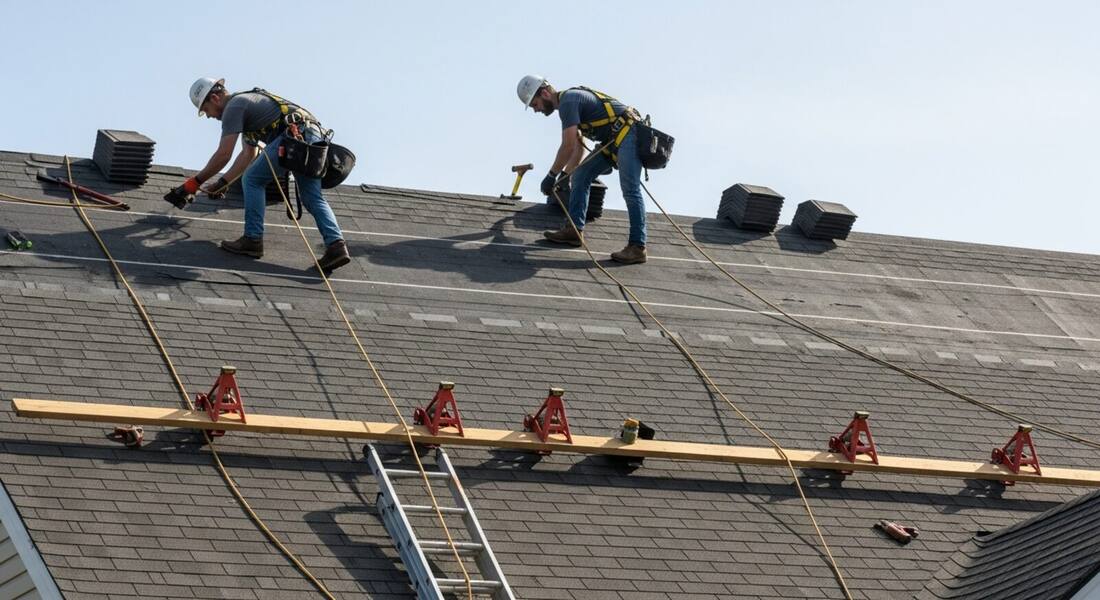
Roofing is one of the most dangerous trades, and nearly all of the danger comes down to falls — from edges, through openings, and off ladders. The most valuable inspection is the one that happens before anyone climbs, when protection can still be added. A roofing safety inspection checklist run from a photo makes that pre-work check quick enough to actually do on every job.
A crew lead can photograph the roof edge, the ladder setup, and the anchor points, and get an immediate read on whether the visible fall protection looks adequate. The scanner is tuned to leading edges without guardrails, unprotected openings and skylights, ladders that are not set up or secured correctly, and workers at height without a visible arrest system.
Wind, surface condition, and anchor strength still need a person to judge on site — the scan is the fast first pass, and the competent person makes the call.
Roofing is consistently one of the most hazardous construction trades. OSHA's fall protection standard for construction (29 CFR 1926.501) requires fall protection at six feet above a lower level on roofs, with specific provisions for low-slope roofs (under 4:12 pitch) that permit guardrail systems, safety net systems, personal fall arrest systems, or — under defined conditions — warning-line systems combined with safety-monitoring systems. Steep roofs (4:12 or greater) require guardrails or personal fall arrest. 29 CFR 1926.502 sets the criteria for each system: guardrails must withstand 200 pounds of force outward and downward, personal fall arrest systems must limit free-fall to six feet and bring the worker to a complete stop within deceleration-distance limits, and anchorages must support the required load per attached employee. Violations of these two standards account for a large share of all roofing-related OSHA citations each year.
OSHA's National Emphasis Program on Fall Hazards directs resources toward construction fall prevention, with roofing operations among the high-priority work types. Roofing fall-protection citations are among the most common and most severe in the construction sector, and OSHA compliance officers who observe unprotected workers during site visits will typically initiate an inspection. Employers who cannot demonstrate adequate fall protection systems for every worker above six feet face serious or willful citations depending on the facts; the penalty difference between a first-time serious and a willful citation is significant — consult OSHA's current penalty schedule for exact figures.
Unguarded skylights and roof openings are disproportionately represented in roofing fatality data — in many years they account for a third or more of fatal roofing falls — because they are easy to miss in a visual scan and because standard-issue fall protection systems (lanyards, harnesses) do not prevent a worker from stepping into an opening. OSHA requires that every roof hole or opening through which a person can fall must be guarded with a cover rated to hold twice the weight of the workers and equipment that could be placed on it, or with a standard guardrail on all exposed sides. Skylight covers must bear the same rating — a plastic bubble skylight cover is not a fall-protective cover.
Photographic inspection of roofing worksites is particularly valuable for opening hazards because a photo taken at ground level or from a drone can document the presence, condition, and location of covers and guardrails before workers are dispatched to the area. An inspection tool that flags unguarded openings and missing or inadequate covers at the pre-task stage prevents the failure mode where a subcontractor removes a cover for a day's work and never replaces it — one of the most common proximate causes of fatal skylight falls.
Run through these steps before crews start — each one covers a visible gap the AI can help you catch.
Walk the perimeter and every opening. Confirm guardrails are in place at all edges over 6 ft, and that every skylight or roof hole has a rated cover or guardrail — openings are the most common source of fatal falls.
Confirm every access ladder is secured at the top, set at a 4:1 angle, and extends at least 3 ft above the landing. Check that the ladder is not placed on unstable ground and is not being used as the work platform at the edge.
Check that every worker on the roof is wearing a properly fitted full-body harness, that the lanyard or self-retracting lifeline is clipped to a rated anchor, and that the free-fall distance does not exceed what the system is rated for.
Remove tools, offcuts, and scrap from slope areas — anything loose near an edge can be kicked off and strike workers below. Check that materials are stored back from the edge and that debris barricades are in place below.
Photograph the roof edge, ladder setup, and anchor points and upload to OSHA Scan. The AI flags visible fall exposures, references the OSHA standard each may relate to (1926.501, 1926.502), and suggests fixes — free, no account needed.
Everything on a fall-focused roofing checklist that a camera can see.
Leading edges without guardrails, and unprotected skylights or roof openings a worker could fall through.
Ladders that appear unsecured, at the wrong angle, or not extended past the landing for safe access.
Workers at height without a visible harness, lanyard, or anchorage, and gaps in the protection system.
Loose materials and tools near an edge that could be kicked off or create a trip hazard at height.
Scan a photo like the one above and this is the report you get — score, findings, OSHA references, and fixes. It is an illustrative example, clearly marked — not live scan data.
Compliance score
41
Lower means more potential hazards found
5 potential hazards found
1Unsecured hand tools resting on the slope above workers
HighPossibly related to falling object protection (29 CFR 1926.501(c))
Observed condition: A tool sliding off a pitched roof can strike a worker below the eave with serious force.
Corrective action: Stow loose tools in belts or secured containers and barricade the area below the eave.
High confidence
2Access ladder not extended above the landing
MediumPossibly related to ladder safety (29 CFR 1926.1053)
Observed condition: A ladder that does not extend past the landing makes getting on and off the roof unstable and unsafe.
Corrective action: Extend the ladder the required distance above the landing and secure it against movement.
Medium confidenceNot fully clear from the photo — verify on site.
Upload a photo like the one above and get a compliance score and hazard count in seconds. No account needed to scan — create a free account to unlock the full report.
Use the real site or facility name. If you save the scan after signup, it becomes the report name.
Three angles, one deeper scan
Only the wide shot is required — every extra angle gives the AI more places to look.
Required: Set the scene — one wide shot lets the AI sweep the whole area at once
Stand at the entry point and capture corner to corner: floors, ladders, scaffolds, and everyone at work
Drop a job-site photo or walkthrough video
Click to upload, drag & drop, or snap a photo on site. Photos scan free in about 15 seconds — no signup, no card. Video walkthroughs (up to 3 min) run on a free account.
Small habits, sharper scans
Set the scene
Start with context
Fill the frame
2–3 ft for close-ups; keep ladders, cords and workers fully in view.
Capture clearly
Make the frame usable
Light it right
Keep the sun or lights behind you — glare and shadows hide hazards.
Tap to focus
Tap the hazard on screen and hold still one second — blur can't be flagged.
Choose the useful view
Give the AI room to understand
Go landscape
Turn your phone sideways — a wider frame catches more of the scene.
Only upload photos you have permission to use, and avoid images showing personal, customer, or confidential information. Demo photos and results are held privately for up to 48 hours so you can save them to a free account; unclaimed photos are deleted automatically. Results are an AI-assisted preliminary review, not an official OSHA determination.
New: Video walkthrough scans
Record up to 3 minutes of your site — the AI extracts frames and flags every hazard with exact timestamps. Free account required.
Get the best results
Wide shot first
Stand at the entrance and photograph the entire work area so AI sees the full context
Hazard areas
Photograph elevated surfaces, equipment, electrical panels, and anywhere workers are active
Close-ups last
Move in close on anything damaged, missing, or that looks risky — the AI catches more detail
Run these points before the crew steps onto the roof. The first four are free — create a free account to unlock the full checklist and scan your own roof photos.
Free checklist — 12 points
Enter your email to unlock the full checklist
We'll also send you a printable PDF copy — no account required.
One email with the checklist, one follow-up. Unsubscribe anytime.
OSHA Scan reads a single photo. That makes it fast and easy for anyone on site — but it also means it has real limits. Here's an honest look at both.
A scan is a fast first look, not the final word. Before treating this kind of area as safe, a competent person should still confirm:
Fall protection. Nearly all serious roofing injuries are falls — from edges, through openings, or off ladders — so the checklist prioritizes protected edges and openings, correct ladder access, and fall-arrest systems in use. OSHA Scan flags the visible versions of these first.
It can flag visible ladder problems such as a ladder that is not extended above the landing or appears unsecured or at a poor angle. It cannot measure the exact angle or confirm the ladder is rated and undamaged, so treat ladder findings as prompts to verify on site.
No. A scan is an AI-assisted preliminary review and a compliance score is not an official OSHA determination. Anchor strength, system adequacy, training, and a competent person are still required — the scan helps you catch obvious exposures before work starts.
Reviewed by OSHA Scan Editorial
Last updated August 29, 2026
This content is produced by the OSHA Scan Editorial team and reviewed with AI assistance. It is general safety information, not legal or compliance advice. OSHA Scan is an independent tool and is not affiliated with, endorsed by, or certified by OSHA or the U.S. Department of Labor.
More ways to see what an AI OSHA scan can do for your site.
The overview hub — how the scanner works and every job, site, and hazard it covers.
The broader construction scanner covering all trades.
Confirm harnesses and head protection are in the frame.
Scaffold erection, planking, and fall protection for elevated work.
Ladder setup, angle, and securing requirements for roof access.
The step-by-step JHA behind these roofing checklist items.
See a complete labelled example of everything a scan returns.
Start with 5 included AI site scans plus a one-time 10-scan signup bonus — no credit card. Build JHA-ready reports and catch changing conditions sooner.
Start your free trial