
1
Set the scene
Start with context
Fill the frame
2–3 ft for close-ups; keep ladders, cords and workers fully in view.
Catch suspect asbestos materials before the wrecking starts
Demolition and renovation of older buildings routinely disturbs asbestos-containing materials, releasing microscopic fibers that lodge in the lungs and cause fatal mesothelioma and lung cancer decades later. Once fibers are airborne, there is no way to un-breathe them. OSHA Scan analyzes demolition-site photos to flag suspect asbestos-containing materials, missing containment and wetting, and inadequate respiratory protection before crews start tearing structures apart.
Free · No account needed to scan · Results in seconds
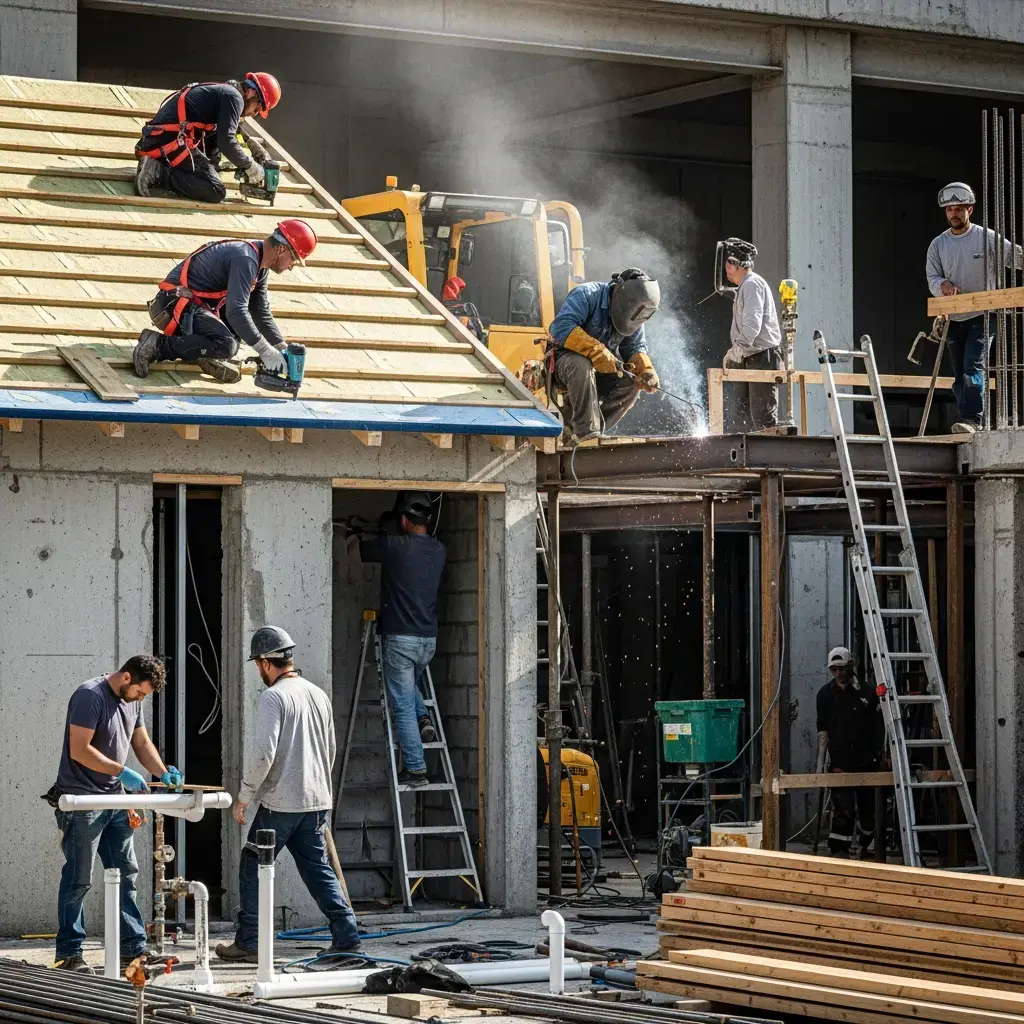
May relate to 29 CFR 1926.1101
US asbestos-related deaths estimated yearly
Latency before asbestos disease appears
OSHA permissible asbestos exposure limit
Typical time to get scan results
A demolition asbestos hazard is any demolition, renovation, or maintenance activity that disturbs asbestos-containing materials without proper survey, containment, wetting, and respiratory protection. It shows up as crews cutting into pipe insulation, floor tile, roofing felt, transite panels, sprayed-on fireproofing, or joint compound in structures built before asbestos was phased out.
In practice, the hazard forms when a building is demolished without a pre-demolition asbestos survey, when suspect materials are dry-cut or broken instead of wetted, or when a renovation crew removes old drywall, boiler insulation, or ceiling texture assuming it is 'just dust.' Uncontained work sends fibers throughout the site and onto workers' clothing, spreading the exposure far beyond the immediate task.
The danger is that asbestos fibers are odorless, tasteless, and far too small to see, and the disease they cause may not surface for twenty to fifty years. There is no cough, no irritation, and no immediate warning at the moment of exposure. That invisible, delayed harm is exactly why photo-based detection of suspect materials and controls matters.
Here is what an OSHA Scan report looks like for demolition asbestos detection. It is an illustrative example built from this scenario's hazards — clearly marked, not live scan data.
Compliance score
56
Lower means more potential hazards found
3 potential hazards found
Demolition Asbestos Detection
CriticalPossibly related to Asbestos (construction) (29 CFR 1926.1101)
Observed condition: A demolition asbestos hazard is any demolition, renovation, or maintenance activity that disturbs asbestos-containing materials without proper survey, containment, wetting, and re…
Corrective action: Establish regulated areas with negative-pressure enclosures for abatement
High confidence
Demolition Asbestos Detection: Asbestos (general industry)
HighPossibly related to Asbestos (general industry) (29 CFR 1910.1001)
Observed condition: Sets the permissible exposure limit for asbestos and requires monitoring, controls, medical surveillance, and respiratory protection for general-industry work such as maintenance…
Corrective action: Use HEPA-filtered negative-air machines and vacuums, never standard shop vacs
Medium confidenceNot fully clear from the photo — verify on site.
Demolition Asbestos Detection: Respirable crystalline silica
MediumPossibly related to Respirable crystalline silica (29 CFR 1926.1153)
Observed condition: Requires controls and respiratory protection for silica dust commonly generated alongside asbestos when cutting concrete, masonry, and tile during demolition.
Corrective action: Wet suspect materials before and during removal to suppress fiber release
High confidence
Every uncontrolled disturbance can release fibers that embed permanently in the lungs. Though disease is delayed, the exposure itself is instantaneous and irreversible, seeding fatal illnesses years before any symptom appears.
OSHA cites asbestos work under 29 CFR 1926.1101 with serious penalties over $16,000 and willful violations exceeding $160,000. Asbestos disease drives some of the largest and longest-running liability and litigation exposure in construction.
Discovering disturbed asbestos mid-demolition halts the project, triggers costly emergency abatement and decontamination, and brings OSHA and EPA scrutiny that can freeze the site and surrounding area for weeks.
Demolition, renovation, roofing, HVAC, and abatement crews working in pre-1980 buildings encounter asbestos in dozens of hidden materials, and multi-trade demo sites make containment and clearance especially difficult to enforce.
OSHA Scan uses an AI vision model to identify suspect asbestos-containing materials and control gaps. Upload a photo and it recognizes likely asbestos materials such as pipe lagging, transite, floor tile, and sprayed coatings, checks for containment, wetting, negative-air setups, and respiratory protection, flags disturbed or unprotected materials with a severity rating, and cites the OSHA standard it may relate to — in seconds, before demolition proceeds.
Analyze your first photo freeUpload a real job-site photo and OSHA Scan detects visible hazards in seconds — no account needed to run your first scan.
Use the real site or facility name. If you save the scan after signup, it becomes the report name.
Three angles, one deeper scan
Only the wide shot is required — every extra angle gives the AI more places to look.
Required: Set the scene — one wide shot lets the AI sweep the whole area at once
Stand at the entry point and capture corner to corner: floors, ladders, scaffolds, and everyone at work
Drop a job-site photo or walkthrough video
Click to upload, drag & drop, or snap a photo on site. Photos scan free in about 15 seconds — no signup, no card. Video walkthroughs (up to 3 min) run on a free account.
Small habits, sharper scans
Set the scene
Start with context
Fill the frame
2–3 ft for close-ups; keep ladders, cords and workers fully in view.
Capture clearly
Make the frame usable
Light it right
Keep the sun or lights behind you — glare and shadows hide hazards.
Tap to focus
Tap the hazard on screen and hold still one second — blur can't be flagged.
Choose the useful view
Give the AI room to understand
Go landscape
Turn your phone sideways — a wider frame catches more of the scene.
Only upload photos you have permission to use, and avoid images showing personal, customer, or confidential information. Demo photos and results are held privately for up to 48 hours so you can save them to a free account; unclaimed photos are deleted automatically. Results are an AI-assisted preliminary review, not an official OSHA determination.
New: Video walkthrough scans
Record up to 3 minutes of your site — the AI extracts frames and flags every hazard with exact timestamps. Free account required.
Get the best results
Wide shot first
Stand at the entrance and photograph the entire work area so AI sees the full context
Hazard areas
Photograph elevated surfaces, equipment, electrical panels, and anywhere workers are active
Close-ups last
Move in close on anything damaged, missing, or that looks risky — the AI catches more detail
A crew was gutting a mechanical room in a 1960s building to install new equipment. The scope did not mention asbestos, and no pre-demolition survey had been done, so workers began cutting and pulling off the old pipe insulation to reach the piping.
The insulation was asbestos pipe lagging. Dry-cutting it released fibers throughout the enclosed room, and workers wearing only nuisance dust masks tracked contaminated dust into adjacent areas. The exposure was not recognized until an inspector questioned the material, by which time everyone on site had been exposed.
A photo of the mechanical room run through OSHA Scan would have flagged the pipe lagging as suspect asbestos-containing material being disturbed without containment, wetting, or proper respirators, cited 29 CFR 1926.1101, and prompted the contractor to stop work, treat it as asbestos until tested, and bring in a licensed abatement crew before anyone continued.
In older buildings, unknown materials must be presumed asbestos until proven otherwise. A pre-demolition survey is mandatory, and any suspect material should trigger a stop-work and a quick photo scan before it is cut, broken, or removed.
Layered controls, from most to least effective.
Contain fibers and keep them out of the air so exposure is engineered down.
Build the survey and work-practice program that prevents unplanned disturbance.
The last line of defense for workers in and around regulated areas.
The federal standards this hazard may relate to.
Governs asbestos exposure in construction and demolition, requiring exposure assessment, regulated areas, engineering controls, respiratory protection, training, and clearance for work that disturbs asbestos-containing materials.
Up to $16,550 per serious violation; $165,514 for willful or repeat
Sets the permissible exposure limit for asbestos and requires monitoring, controls, medical surveillance, and respiratory protection for general-industry work such as maintenance and custodial tasks.
Up to $16,550 per serious violation
Requires controls and respiratory protection for silica dust commonly generated alongside asbestos when cutting concrete, masonry, and tile during demolition.
Up to $16,550 per serious violation
If an incident occurs, act fast and in order.
Workers will recognize suspect asbestos-containing materials, understand the fatal, delayed nature of exposure, and follow survey, containment, and respiratory-protection procedures before disturbing any older material.
Train before demolition or renovation of older structures begins, refresh annually, and reinforce with toolbox talks using real photos of suspect materials and controls.
Run these checks to stay ahead of citations.
10 more checklist points are waiting. Register with your email to reveal every item and download the complete OSHA compliance checklist as a printable PDF. Free, and it only takes a few seconds.
Already have an account? Sign in
In pre-1980 buildings, asbestos is often found in pipe and boiler insulation, sprayed-on fireproofing, floor tile and mastic, roofing felt, transite panels, joint compound, and textured ceilings. Any suspect material should be treated as asbestos until testing proves otherwise.
Yes. OSHA and EPA rules require that buildings be surveyed for asbestos before demolition or renovation. A licensed inspector must identify and sample suspect materials so hazards are known and abated before any structure is disturbed.
Asbestos fibers are microscopic and lodge permanently in lung tissue when inhaled. They cause mesothelioma, lung cancer, and asbestosis, but these diseases have a latency of 20 to 50 years, so a worker feels nothing at the time of the exposure that will later prove fatal.
A serious violation of 29 CFR 1926.1101 can exceed $16,000 per instance, and willful or repeat violations can top $165,000. Because exposures are irreversible, asbestos cases also generate some of the longest-running and most costly liability claims in construction.
No. Asbestos removal must be performed by licensed, trained abatement workers using regulated areas, containment, wetting, HEPA equipment, and respiratory protection. Untrained crews disturbing asbestos expose themselves and everyone on site.
Work is done inside a negative-pressure enclosure using wet methods to suppress fibers, HEPA-filtered air machines and vacuums, and leak-tight labeled waste bags. Workers use fit-tested respirators and disposable coveralls, then decontaminate before leaving the regulated area.
Stop work immediately, keep everyone out of the area, and do not cut, break, or move the material. Treat it as asbestos until a licensed inspector samples it, and bring in a qualified abatement contractor if it is confirmed or presumed positive.
OSHA Scan flags suspect asbestos-containing materials and control gaps. It recognizes likely asbestos materials, checks for containment and respiratory protection, and returns the location and OSHA citation. It supports, but does not replace, laboratory sampling.
Upload a photo of your demolition site and get instant, specific feedback on suspect asbestos materials and missing controls in your exact environment.
Get startedPut our expert asbestos-awareness demolition checklist to work on your next teardown to stay ahead of citations.
Get startedSee how OSHA Scan fits your demolition operation and get recommendations for your specific older-building risks.
Get startedSee how other demolition and abatement crews use OSHA Scan to catch asbestos hazards before fibers ever go airborne.
Get startedReview findings, organize chemical records, and open relevant official resources for your saved locations and work context.
You make the final call. Review, edit, or dismiss any AI-flagged hazard before finalizing your inspection report.
Scan chemical labels or upload legacy MSDS sheets to create structured drafts that support your team's search for and review of current official manufacturer Safety Data Sheets.
Open official OSHA and State Plan guidance, required posters, emergency contacts, and relevant publications for saved locations and work requirements.
OSHA Scan reads a single photo. That makes it fast and easy for anyone on site — but it also means it has real limits. Here's an honest look at both.
Reviewed by OSHA Scan Editorial
Last updated August 29, 2026
This content is produced by the OSHA Scan Editorial team and reviewed with AI assistance. It is general safety information, not legal or compliance advice. OSHA Scan is an independent tool and is not affiliated with, endorsed by, or certified by OSHA or the U.S. Department of Labor.
Start with 5 included AI site scans plus a one-time 10-scan signup bonus — no credit card. Build JHA-ready reports and catch changing conditions sooner.
Start your free trial