
1
Set the scene
Start with context
Fill the frame
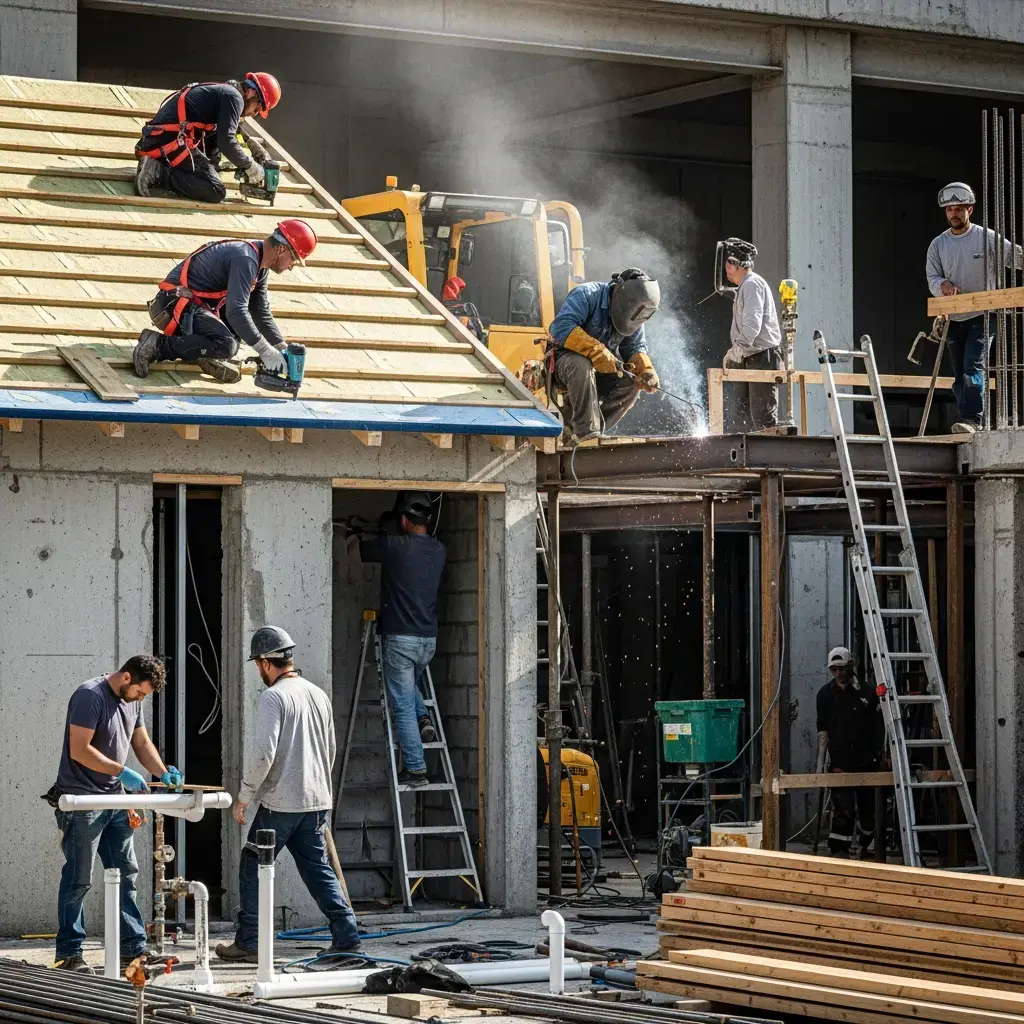
2–3 ft for close-ups; keep ladders, cords and workers fully in view.
The blast is over before a tech can react
When an electrical technician works on or near energized equipment, an arc flash can erupt in a fraction of a second, reaching temperatures hotter than the surface of the sun and hurling a pressure wave of molten metal. Survivors face life-altering burns. OSHA Scan reviews electrical work photos to flag energized work without lockout, missing arc-rated PPE, absent boundaries, and equipment gaps before your tech opens the panel.
Free · No account needed to scan · Results in seconds
May relate to 29 CFR 1910.333
Peak arc flash temperature
Arc flash incidents in US workplaces
Per serious electrical violation
Typical time to get scan results
An arc flash is an explosive release of energy caused by a fault between energized conductors or to ground. For an electrical technician it happens when working on or near live equipment — opening an energized panel, racking a breaker, or testing a live circuit — and a tool, dropped part, or insulation failure bridges the gap. The result is intense heat, blinding light, a pressure blast, and shrapnel of molten metal.
In the field the hazard shows up as work performed on equipment that was never de-energized and locked out, a technician standing inside the arc flash boundary without arc-rated clothing, missing or illegible arc flash labels on gear, and covers removed to expose live parts. It also appears when a tech treats a 'quick check' as an exception to lockout/tagout, assuming brief exposure is safe.
The danger is speed. An arc flash is over in milliseconds — far faster than any human reaction — so protection has to be in place before the panel is opened, not after something goes wrong. Because the conditions that lead to it are visible beforehand (live work, wrong PPE, no boundary), a photo review before work begins is a powerful safeguard.
Here is what an OSHA Scan report looks like for electrical technician arc flash. It is an illustrative example built from this scenario's hazards — clearly marked, not live scan data.
Compliance score
49
Lower means more potential hazards found
3 potential hazards found
Electrical Technician Arc Flash
CriticalPossibly related to Selection and use of work practices (29 CFR 1910.333)
Observed condition: An arc flash is an explosive release of energy caused by a fault between energized conductors or to ground.
Corrective action: De-energize and apply lockout/tagout, then verify zero energy with a tester
High confidence
Electrical Technician Arc Flash: Safeguards for personnel protection
HighPossibly related to Safeguards for personnel protection (29 CFR 1910.335)
Observed condition: Requires appropriate electrical protective equipment and PPE, including arc-rated protection, for employees working in areas with potential electrical hazards.
Corrective action: Perform an arc flash study and label equipment with incident energy and boundaries
Medium confidenceNot fully clear from the photo — verify on site.
Electrical Technician Arc Flash: The control of hazardous energy (lockout/tagout)
MediumPossibly related to The control of hazardous energy (lockout/tagout) (29 CFR 1910.147)
Observed condition: Requires procedures to isolate and lock out energy sources so equipment cannot be energized during servicing and maintenance.
Corrective action: Install remote racking and remote operation devices where feasible
High confidence
An arc flash inflicts severe third-degree burns, hearing and vision loss from the blast, and injuries from flying molten metal — often before the worker can even flinch.
Energized electrical work draws serious OSHA citations exceeding $16,000, and willful violations after a burn injury can surpass $165,000, with burn-care costs and litigation adding far more.
An arc flash incident shuts down the facility circuit, triggers an OSHA investigation, and typically reveals missing lockout/tagout and arc flash studies that implicate other equipment.
Maintenance and service electricians face constant pressure to troubleshoot live to avoid downtime, and older facilities often lack arc flash labels and updated incident-energy studies.
OSHA Scan uses an AI vision model to review your photos. It flags exposed energized parts, work without evident lockout/tagout, missing or incorrect arc-rated PPE, and absent arc flash boundaries or labels, then cites 29 CFR 1910.333 — prompting your team to de-energize, verify zero energy, and gear up correctly before opening the equipment.
Analyze your first photo freeUpload a real job-site photo and OSHA Scan detects visible hazards in seconds — no account needed to run your first scan.
Use the real site or facility name. If you save the scan after signup, it becomes the report name.
Three angles, one deeper scan
Only the wide shot is required — every extra angle gives the AI more places to look.
Required: Set the scene — one wide shot lets the AI sweep the whole area at once
Stand at the entry point and capture corner to corner: floors, ladders, scaffolds, and everyone at work
Drop a job-site photo or walkthrough video
Click to upload, drag & drop, or snap a photo on site. Photos scan free in about 15 seconds — no signup, no card. Video walkthroughs (up to 3 min) run on a free account.
Small habits, sharper scans
Set the scene
Start with context
Fill the frame
2–3 ft for close-ups; keep ladders, cords and workers fully in view.
Capture clearly
Make the frame usable
Light it right
Keep the sun or lights behind you — glare and shadows hide hazards.
Tap to focus
Tap the hazard on screen and hold still one second — blur can't be flagged.
Choose the useful view
Give the AI room to understand
Go landscape
Turn your phone sideways — a wider frame catches more of the scene.
Only upload photos you have permission to use, and avoid images showing personal, customer, or confidential information. Demo photos and results are held privately for up to 48 hours so you can save them to a free account; unclaimed photos are deleted automatically. Results are an AI-assisted preliminary review, not an official OSHA determination.
New: Video walkthrough scans
Record up to 3 minutes of your site — the AI extracts frames and flags every hazard with exact timestamps. Free account required.
Get the best results
Wide shot first
Stand at the entrance and photograph the entire work area so AI sees the full context
Hazard areas
Photograph elevated surfaces, equipment, electrical panels, and anywhere workers are active
Close-ups last
Move in close on anything damaged, missing, or that looks risky — the AI catches more detail
A maintenance electrician was troubleshooting an intermittent fault on a 480-volt motor control center. To avoid shutting down the line, the tech opened the panel energized to take a quick voltage reading, wearing only everyday work clothes.
A slip of the probe bridged two phases, initiating an arc flash. The blast burned the technician's hands, arms, and face and blew him back off the ladder. No lockout was performed, no arc-rated PPE was worn, and no arc flash boundary was established.
A photo of the setup run through OSHA Scan would have flagged energized work with no lockout and no arc-rated PPE as a critical hazard, cited 29 CFR 1910.333, and prompted the tech to de-energize and lock out the panel, verify zero energy, and don appropriate arc-rated protection before testing.
There is no such thing as a safe 'quick' live check on high-energy equipment. De-energizing and verifying zero energy is the rule, and a fast photo review catches live-work and PPE gaps before the panel is ever opened.
Layered controls, from most to least effective.
Remove the energy and reduce the incident energy before work begins.
Govern when and how energized work can ever be justified.
Match arc-rated protection to the incident energy at the task.
The federal standards this hazard may relate to.
Requires de-energizing and lockout/tagout before work on electric circuits unless energized work is infeasible, and mandates safe work practices and boundaries when live work is justified.
Up to $16,550 per serious violation; $165,514 for willful or repeat
Requires appropriate electrical protective equipment and PPE, including arc-rated protection, for employees working in areas with potential electrical hazards.
Up to $16,550 per serious violation
Requires procedures to isolate and lock out energy sources so equipment cannot be energized during servicing and maintenance.
Up to $16,550 per serious violation
If an incident occurs, act fast and in order.
Electricians will understand arc flash hazards, know when energized work is prohibited, and correctly apply lockout/tagout, boundaries, and arc-rated PPE for each task.
Train before energized-capable work and annually, and reinforce with a pre-task hazard briefing and photo review at each panel.
Run these checks to stay ahead of citations.
10 more checklist points are waiting. Register with your email to reveal every item and download the complete OSHA compliance checklist as a printable PDF. Free, and it only takes a few seconds.
Already have an account? Sign in
An arc flash is an explosive electrical fault that releases intense heat, light, and pressure. The arc can reach roughly 35,000°F — hotter than the surface of the sun — vaporizing metal and causing severe burns in a fraction of a second.
OSHA (29 CFR 1910.333) requires de-energizing and lockout/tagout before working on or near exposed energized parts, unless de-energizing is infeasible or creates a greater hazard. Avoiding downtime is not an acceptable reason to work live.
Arc-rated clothing, face shields or hoods, and gloves rated at or above the calculated incident energy for the task, plus voltage-rated insulating gloves for shock protection. The correct rating comes from an arc flash study reflected on the equipment label.
The arc flash boundary is the distance from an arc source at which the incident energy could cause a second-degree burn. Anyone crossing it during energized work must wear arc-rated PPE appropriate to the incident energy at that point.
It is a documented authorization required before performing justified live work. It describes the task, the hazards, the boundaries, the PPE, and the approvals, and forces a deliberate decision that energized work is truly necessary and controlled.
Serious violations of the electrical safe work practice standards can exceed $16,000 per instance, and willful violations, especially after a burn injury, can surpass $165,000, on top of significant medical and litigation costs.
Arc flash labels show the incident energy, arc flash boundary, and required PPE for a piece of equipment, based on an engineering study. They let a technician select correct protection and boundaries at a glance before opening the gear.
OSHA Scan flags energized work, missing lockout, exposed live parts, and incorrect arc-rated PPE. It cites 29 CFR 1910.333 so electrical hazards are caught in a photo review before the equipment is opened.
Upload a photo of your electrical work area and get instant feedback on live-work, lockout, and PPE gaps in your exact environment.
Get startedPut our expert arc flash and lockout checklist to work so every panel is de-energized and protected before work begins.
Get startedSee how OSHA Scan fits your electrical maintenance program and get recommendations for your specific work.
Get startedSee how other electrical professionals use OSHA Scan to prevent arc flash injuries before they happen.
Get startedReview findings, organize chemical records, and open relevant official resources for your saved locations and work context.
You make the final call. Review, edit, or dismiss any AI-flagged hazard before finalizing your inspection report.
Scan chemical labels or upload legacy MSDS sheets to create structured drafts that support your team's search for and review of current official manufacturer Safety Data Sheets.
Open official OSHA and State Plan guidance, required posters, emergency contacts, and relevant publications for saved locations and work requirements.
OSHA Scan reads a single photo. That makes it fast and easy for anyone on site — but it also means it has real limits. Here's an honest look at both.
Reviewed by OSHA Scan Editorial
Last updated August 29, 2026
This content is produced by the OSHA Scan Editorial team and reviewed with AI assistance. It is general safety information, not legal or compliance advice. OSHA Scan is an independent tool and is not affiliated with, endorsed by, or certified by OSHA or the U.S. Department of Labor.
Start with 5 included AI site scans plus a one-time 10-scan signup bonus — no credit card. Build JHA-ready reports and catch changing conditions sooner.
Start your free trial