
1
Set the scene
Start with context
Fill the frame
2–3 ft for close-ups; keep ladders, cords and workers fully in view.
Finish strong without cutting the corners that hurt people
The push to finish before quitting time is one of the most predictable injury windows on any job. As the clock runs down, crews skip the step-back, bypass the guard, and take the shortcut to beat the deadline — accepting risk they would refuse at 9 a.m. OSHA Scan lets a supervisor scan the work area before the final push, keeping the last hour as controlled as the first.
Free · No account needed to scan · Results in seconds
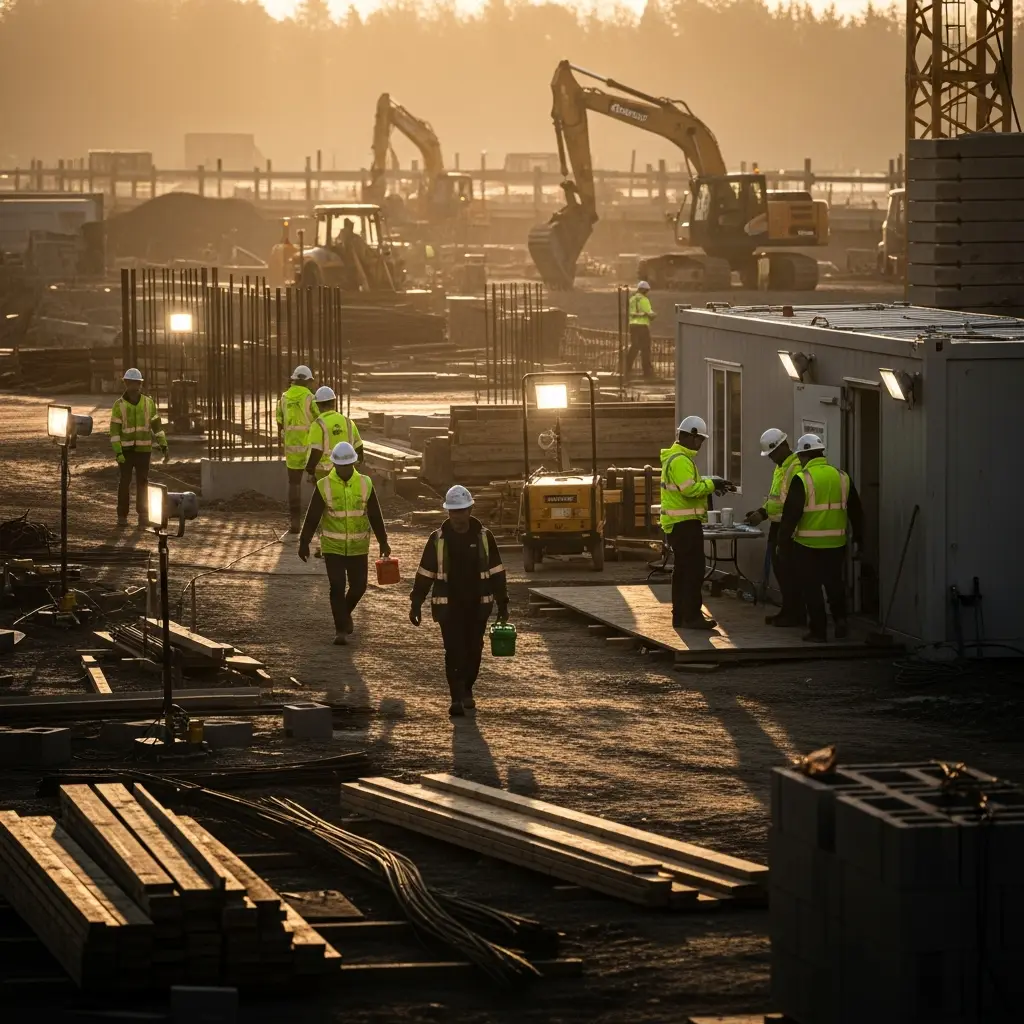
May relate to 29 CFR 1926.20
Concentrates a disproportionate share of injuries
Per serious OSHA general-duty violation
More shortcut behavior under deadline pressure
Typical time to get scan results
An evening rush-to-complete hazard is any unsafe act or condition created by the pressure to finish a task before the end of the shift or a deadline. It is a behavioral hazard: the work itself may be routine, but time pressure pushes workers to skip protective steps they would normally take.
In practice it looks like a crew leaving fall protection in the truck to make one last trip up, bypassing a lockout to shave a few minutes, stacking a load higher than rated to avoid a second lift, or racing to break down a scaffold as the light fades. Cleanup, teardown, and 'just one more' tasks are where the rush concentrates.
The danger is that the rush is self-justifying — the finish line is in sight, so accepting a little risk feels reasonable. But fatigue is highest at end of day, light is fading, and the safety net of a careful check is the first thing dropped. That combination makes the closing hour uniquely dangerous and worth a deliberate, objective pause.
Here is what an OSHA Scan report looks like for evening rush-to-complete. It is an illustrative example built from this scenario's hazards — clearly marked, not live scan data.
Compliance score
49
Lower means more potential hazards found
3 potential hazards found
Evening Rush-To-Complete
CriticalPossibly related to General safety and health provisions (29 CFR 1926.20)
Observed condition: An evening rush-to-complete hazard is any unsafe act or condition created by the pressure to finish a task before the end of the shift or a deadline.
Corrective action: Use guards and interlocks that cannot be quickly bypassed during teardown
High confidence
Evening Rush-To-Complete: Scaffolds — general requirements
HighPossibly related to Scaffolds — general requirements (29 CFR 1926.451)
Observed condition: Governs safe scaffold erection, use, and dismantling, a common failure point during rushed end-of-day teardowns.
Corrective action: Provide adequate task lighting for end-of-day and dusk work
Medium confidenceNot fully clear from the photo — verify on site.
Evening Rush-To-Complete: Duty to have fall protection
MediumPossibly related to Duty to have fall protection (29 CFR 1926.501)
Observed condition: Requires fall protection at 6 feet or more, which deadline-driven crews frequently skip during final-hour work at height.
Corrective action: Stage rated lifting equipment so overstacking is never the fast option
High confidence
Shortcuts remove the controls that stop routine tasks from becoming injuries. A skipped tie-off, a bypassed lockout, or an overstacked load turns the last task of the day into a fall, a crush, or a struck-by event.
OSHA obligations do not relax at quitting time. Deadline-driven violations of fall protection, lockout, or inspection duties draw serious citations over $16,000, and willful shortcuts pushed by management exceed $165,000.
An end-of-day injury erases any schedule gain the rush was meant to capture, triggering investigations, next-day stoppages, and rework that pushes the deadline further out than a controlled finish ever would.
Deadline-driven trades — construction close-outs, warehousing shipping cutoffs, and manufacturing production quotas — face intense end-of-shift pressure that normalizes shortcuts across the crew.
OSHA Scan puts an objective check between deadline pressure and the final push: a supervisor photographs the work area before the closing tasks, and the AI vision model flags missing fall protection, bypassed controls, overstacked loads, and teardown hazards, each with a severity rating and the OSHA citation it may relate to. The scan takes seconds, so it does not become the delay the crew is trying to avoid.
Analyze your first photo freeUpload a real job-site photo and OSHA Scan detects visible hazards in seconds — no account needed to run your first scan.
Use the real site or facility name. If you save the scan after signup, it becomes the report name.
Three angles, one deeper scan
Only the wide shot is required — every extra angle gives the AI more places to look.
Required: Set the scene — one wide shot lets the AI sweep the whole area at once
Stand at the entry point and capture corner to corner: floors, ladders, scaffolds, and everyone at work
Drop a job-site photo or walkthrough video
Click to upload, drag & drop, or snap a photo on site. Photos scan free in about 15 seconds — no signup, no card. Video walkthroughs (up to 3 min) run on a free account.
Small habits, sharper scans
Set the scene
Start with context
Fill the frame
2–3 ft for close-ups; keep ladders, cords and workers fully in view.
Capture clearly
Make the frame usable
Light it right
Keep the sun or lights behind you — glare and shadows hide hazards.
Tap to focus
Tap the hazard on screen and hold still one second — blur can't be flagged.
Choose the useful view
Give the AI room to understand
Go landscape
Turn your phone sideways — a wider frame catches more of the scene.
Only upload photos you have permission to use, and avoid images showing personal, customer, or confidential information. Demo photos and results are held privately for up to 48 hours so you can save them to a free account; unclaimed photos are deleted automatically. Results are an AI-assisted preliminary review, not an official OSHA determination.
New: Video walkthrough scans
Record up to 3 minutes of your site — the AI extracts frames and flags every hazard with exact timestamps. Free account required.
Get the best results
Wide shot first
Stand at the entrance and photograph the entire work area so AI sees the full context
Hazard areas
Photograph elevated surfaces, equipment, electrical panels, and anywhere workers are active
Close-ups last
Move in close on anything damaged, missing, or that looks risky — the AI catches more detail
A crew was breaking down a two-story scaffold with fifteen minutes left in the shift and rain forecast overnight. Determined to finish so the platform would not sit exposed, they skipped the planned sequence and removed lower braces before the upper deck was cleared.
With the bracing compromised and light fading, a section of the scaffold shifted and partially collapsed. A worker on the upper level fell nine feet with the platform, fracturing his wrist and ribs. In the rush, no one had re-checked the teardown sequence or the fall protection.
A quick photo scan before teardown would have flagged the missing fall protection and the out-of-sequence dismantling as critical hazards, cited 29 CFR 1926.451, and prompted the foreman to slow the crew, restore protection, and follow the safe sequence — finishing the next morning if needed.
No deadline is worth an end-of-day injury. The last hour needs a deliberate check precisely because that is when crews are most tempted to trade the safe sequence for speed.
Layered controls, from most to least effective.
Design the closing tasks so shortcuts are hard to take.
Remove the pressure that makes shortcuts feel necessary.
Keep protective gear on through the last task, not just the first.
The federal standards this hazard may relate to.
Requires ongoing inspections and accident-prevention programs throughout the workday, including the high-pressure closing hour when shortcuts spike.
Up to $16,550 per serious violation; $165,514 for willful or repeat
Governs safe scaffold erection, use, and dismantling, a common failure point during rushed end-of-day teardowns.
Up to $16,550 per serious violation
Requires fall protection at 6 feet or more, which deadline-driven crews frequently skip during final-hour work at height.
Up to $16,550 per serious violation
If an incident occurs, act fast and in order.
Workers and supervisors will understand why the closing hour drives shortcut injuries, recognize deadline-pressure behavior, and know how to run a pre-finish check and stop work safely when time runs short.
Train the crew at onboarding, refresh annually, and reinforce daily with a documented scan and safety check before the final push each shift.
Run these checks to stay ahead of citations.
10 more checklist points are waiting. Register with your email to reveal every item and download the complete OSHA compliance checklist as a printable PDF. Free, and it only takes a few seconds.
Already have an account? Sign in
Three factors converge: fatigue is highest, light is fading, and deadline pressure pushes workers to skip protective steps. The rush to finish makes normally safe crews accept shortcuts they would refuse earlier in the day.
OSHA holds employers responsible for maintaining safe conditions and procedures at all times. Deadline pressure is not a defense — if management drives shortcuts to meet a schedule, violations can be classified as willful.
Teardown and cleanup, work at height, lockout-dependent tasks, and material handling. These are the 'just one more' tasks crews try to squeeze in, often after protective controls have already been staged for removal.
Set realistic stopping points, ban new high-risk tasks in the final hour, and empower crews to finish safely the next day. A controlled finish avoids the injuries, rework, and stoppages that erase any rushed gain.
High-risk tasks should not be started in the closing hour. Fatigue and time pressure are highest then, and an interrupted or rushed task is more likely to end in an incident. Reserve the final hour for safe wrap-up.
Yes. Scaffold dismantling, guard removal, and equipment teardown carry the same or greater risk as installation and must follow a planned sequence with full fall protection — even when the crew is trying to beat the clock.
A serious violation can exceed $16,000, and when shortcuts are driven or tolerated by management to meet a deadline, OSHA can classify them as willful with penalties above $165,000 per instance.
OSHA Scan detects closing-hour hazards. It flags missing fall protection, bypassed controls, and unsafe teardown with a severity rating and the specific OSHA citation.
Photograph your work area before the final push and get instant feedback on the shortcuts a rushed crew would take.
Get startedPut our closing-hour safety checklist to work so deadline pressure never overrides a safe finish.
Get startedSee how OSHA Scan fits your deadline-driven operation and get recommendations for managing the closing hour.
Get startedSee how other crews use OSHA Scan to keep the last hour as controlled as the first.
Get startedReview findings, organize chemical records, and open relevant official resources for your saved locations and work context.
You make the final call. Review, edit, or dismiss any AI-flagged hazard before finalizing your inspection report.
Scan chemical labels or upload legacy MSDS sheets to create structured drafts that support your team's search for and review of current official manufacturer Safety Data Sheets.
Open official OSHA and State Plan guidance, required posters, emergency contacts, and relevant publications for saved locations and work requirements.
OSHA Scan reads a single photo. That makes it fast and easy for anyone on site — but it also means it has real limits. Here's an honest look at both.
Reviewed by OSHA Scan Editorial
Last updated August 29, 2026
This content is produced by the OSHA Scan Editorial team and reviewed with AI assistance. It is general safety information, not legal or compliance advice. OSHA Scan is an independent tool and is not affiliated with, endorsed by, or certified by OSHA or the U.S. Department of Labor.
Start with 5 included AI site scans plus a one-time 10-scan signup bonus — no credit card. Build JHA-ready reports and catch changing conditions sooner.
Start your free trial