
1
Set the scene
Start with context
Fill the frame
2–3 ft for close-ups; keep ladders, cords and workers fully in view.
Clear the fall zone before the load moves
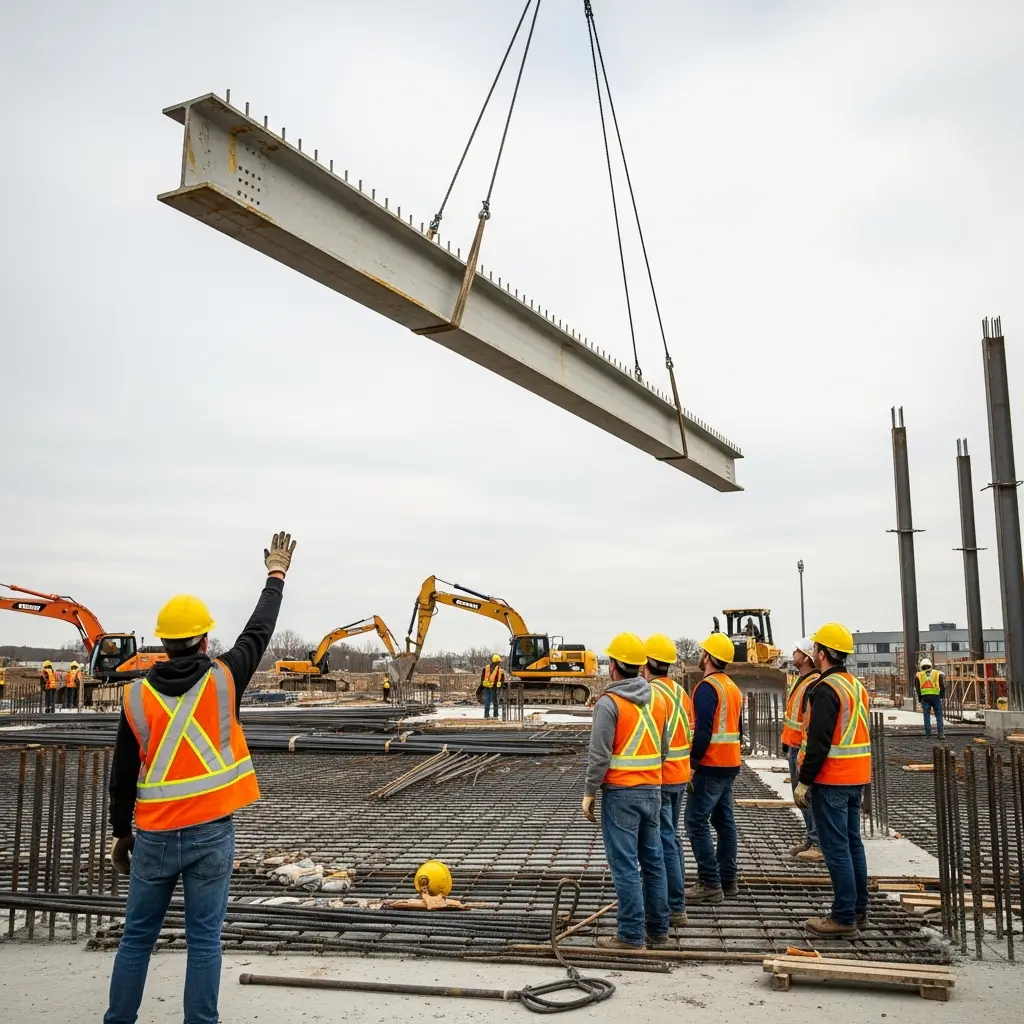
Crane loads that swing, slip, or drop are among the deadliest struck-by hazards on any site. A load moving on a boom carries tons of momentum, and a worker caught in the swing radius has no time to react. OSHA Scan analyzes lift-area photos to flag workers inside the fall zone, missing taglines, unsecured rigging, and loads staged over active work before the operator ever picks up.
Free · No account needed to scan · Results in seconds
May relate to 29 CFR 1926.1425
Of crane deaths involve struck-by a load
Typical load mass that leaves no reaction time
Feet of clearance most workers misjudge in a swing
Typical time to get scan results
A swinging-load hazard exists whenever a suspended load can move laterally, slip in its rigging, or drop into an area where people work. It shows up as a load being walked across a site with workers in the swing path, a tandem lift with mismatched rigging, or a load booming over an active crew because the lift plan never established a clear travel corridor.
In practice these hazards form under schedule pressure. Riggers skip the tagline to save a minute, a load is picked without confirming the center of gravity, or spotters lose sight of the load behind a structure. Wind, sudden stops, and shifting loads add uncontrolled swing, and workers walking a familiar site rarely realize they have stepped into the fall zone.
The danger is the sheer energy involved. A multi-ton load moving even slowly cannot be stopped by a person, and a dropped or contacted load crushes anything beneath it. There is no alarm and often no barrier — just a suspended mass and a crew that assumes it will pass safely overhead. That assumption is exactly what photo-based fall-zone scanning removes.
Here is what an OSHA Scan report looks like for swinging crane load. It is an illustrative example built from this scenario's hazards — clearly marked, not live scan data.
Compliance score
56
Lower means more potential hazards found
3 potential hazards found
Swinging Crane Load
CriticalPossibly related to Keeping clear of the load (29 CFR 1926.1425)
Observed condition: A swinging-load hazard exists whenever a suspended load can move laterally, slip in its rigging, or drop into an area where people work.
Corrective action: Attach taglines to control load rotation and swing on every applicable lift
High confidence
Swinging Crane Load: Operation of cranes and derricks
HighPossibly related to Operation of cranes and derricks (29 CFR 1926.1417)
Observed condition: Sets operating requirements for cranes, including signal procedures, load charts, and rules against moving loads over workers without engineered protection.
Corrective action: Barricade and post the fall zone beneath and around the load path
Medium confidenceNot fully clear from the photo — verify on site.
Swinging Crane Load: Assembly/disassembly and rigging
MediumPossibly related to Assembly/disassembly and rigging (29 CFR 1926.1404)
Observed condition: Requires rigging to be performed by a qualified rigger and loads to be properly rigged and balanced to prevent slipping, shifting, or unintended swing.
Corrective action: Use rated, inspected rigging matched to the load weight and center of gravity
High confidence
Being struck or crushed by a swinging or dropped load causes fatal crushing injuries, amputations, and severe trauma. The mass and momentum leave no margin — contact is frequently fatal on the spot.
Crane and rigging violations under OSHA's cranes standard carry serious penalties up to $16,550 each and far more for willful or repeat findings, while a fatality can trigger criminal referral and multimillion-dollar settlements.
A load incident stops all lifting site-wide, triggers an OSHA and crane-inspection review, and can idle a project for weeks while insurance costs and your experience modification rate climb.
Construction, steel erection, precast, and heavy-industrial crews run frequent lifts near active work, often in tight footprints where clear travel corridors are hard to maintain.
OSHA Scan uses an AI vision model to identify swinging-load risks that spotters can miss. Upload a photo of the lift area and it locates workers standing in the swing radius or fall zone, checks for taglines and proper rigging, flags loads staged or traveling over active crews, and cites the OSHA standard it may relate to with a severity rating — in seconds, before the pick.
Analyze your first photo freeUpload a real job-site photo and OSHA Scan detects visible hazards in seconds — no account needed to run your first scan.
Use the real site or facility name. If you save the scan after signup, it becomes the report name.
Three angles, one deeper scan
Only the wide shot is required — every extra angle gives the AI more places to look.
Required: Set the scene — one wide shot lets the AI sweep the whole area at once
Stand at the entry point and capture corner to corner: floors, ladders, scaffolds, and everyone at work
Drop a job-site photo or walkthrough video
Click to upload, drag & drop, or snap a photo on site. Photos scan free in about 15 seconds — no signup, no card. Video walkthroughs (up to 3 min) run on a free account.
Small habits, sharper scans
Set the scene
Start with context
Fill the frame
2–3 ft for close-ups; keep ladders, cords and workers fully in view.
Capture clearly
Make the frame usable
Light it right
Keep the sun or lights behind you — glare and shadows hide hazards.
Tap to focus
Tap the hazard on screen and hold still one second — blur can't be flagged.
Choose the useful view
Give the AI room to understand
Go landscape
Turn your phone sideways — a wider frame catches more of the scene.
Only upload photos you have permission to use, and avoid images showing personal, customer, or confidential information. Demo photos and results are held privately for up to 48 hours so you can save them to a free account; unclaimed photos are deleted automatically. Results are an AI-assisted preliminary review, not an official OSHA determination.
New: Video walkthrough scans
Record up to 3 minutes of your site — the AI extracts frames and flags every hazard with exact timestamps. Free account required.
Get the best results
Wide shot first
Stand at the entrance and photograph the entire work area so AI sees the full context
Hazard areas
Photograph elevated surfaces, equipment, electrical panels, and anywhere workers are active
Close-ups last
Move in close on anything damaged, missing, or that looks risky — the AI catches more detail
A mobile crane was moving a two-ton steel beam from a delivery truck to a staging area on a congested commercial site. The lift plan noted a travel path, but a second crew had begun working directly along that corridor after the morning briefing.
With no tagline and a partly obscured spotter, the beam began to swing as the operator swung the boom. It struck a worker who had stepped into the corridor to grab a tool, causing fatal crushing injuries before anyone could shout a warning.
A photo of the lift corridor run through OSHA Scan before the pick would have flagged workers inside the fall zone and the missing tagline, cited 29 CFR 1926.1425, and prompted the crew to barricade the corridor and attach taglines before the load left the truck.
Fall zones must be cleared and barricaded for every lift, taglines are not optional on loads that can swing, and a quick photo scan of the corridor confirms no one has drifted into the path before the operator picks up.
Layered controls, from most to least effective.
Control the load and the space so a swing cannot reach workers.
Plan and communicate every lift so no one enters the danger zone.
The last line of defense for the rigging and ground crew.
The federal standards this hazard may relate to.
Requires employers to keep workers out of the fall zone during lifting operations and limits who may be near a suspended load, with taglines or restraint used to control swing.
Up to $16,550 per serious violation; $165,514 for willful or repeat
Sets operating requirements for cranes, including signal procedures, load charts, and rules against moving loads over workers without engineered protection.
Up to $16,550 per serious violation
Requires rigging to be performed by a qualified rigger and loads to be properly rigged and balanced to prevent slipping, shifting, or unintended swing.
Up to $16,550 per serious violation
If an incident occurs, act fast and in order.
Workers will understand how swinging and dropped loads cause struck-by fatalities, recognize the fall zone, and follow rigging, tagline, and signaling procedures that keep the crew clear.
Train before crane operations begin, refresh annually, and reinforce with a pre-lift meeting for every critical pick using real photos to illustrate fall-zone hazards.
Run these checks to stay ahead of citations.
10 more checklist points are waiting. Register with your email to reveal every item and download the complete OSHA compliance checklist as a printable PDF. Free, and it only takes a few seconds.
Already have an account? Sign in
The fall zone is the area within which a load could fall, swing, or roll if it were released or slipped. OSHA requires workers to be kept out of this zone during lifting operations, with only essential personnel briefly permitted while a load is rigged.
A tagline should be used whenever a load can rotate or swing and workers must guide it. Taglines let riggers control the load from outside the fall zone, keeping hands and bodies clear of a moving mass.
Loads should never travel over workers. If a lift path cannot avoid occupied areas, the space must be cleared and barricaded, or engineered protection provided, before the load is moved. Keeping clear of the load is a core OSHA requirement.
Rigging must be done by a qualified rigger — someone with the training and experience to select and inspect hardware and balance the load. A dedicated, qualified signal person must also direct the operator when sight lines are limited.
Sudden starts and stops, wind, an off-center pick, improper rigging, and boom rotation all induce swing. Controlling swing requires taglines, smooth operation, a verified center of gravity, and suspending lifts in high wind.
Serious violations of the cranes and derricks standards can exceed $16,000 each, and willful or repeat violations can top $165,000. A fatality from a struck-by load can also lead to criminal referral and major litigation.
Cover the load weight and rigging, the travel path and fall zone, wind limits, signal procedures and stop signals, and who is authorized in the area. Everyone must confirm the fall zone will stay clear before the pick.
OSHA Scan detects fall-zone and rigging hazards. It flags workers in the swing radius, missing taglines, and unsecured rigging, and returns the specific location and OSHA citation.
Upload a photo of your lift area and get instant, specific feedback on fall-zone and rigging hazards in your exact environment.
Get startedPut our expert crane and rigging prevention checklist to work on your next lift to stay ahead of citations.
Get startedSee how OSHA Scan fits your lifting operation and get recommendations for your specific picks.
Get startedSee how other crews use OSHA Scan to keep workers clear of swinging loads before every lift.
Get startedReview findings, organize chemical records, and open relevant official resources for your saved locations and work context.
You make the final call. Review, edit, or dismiss any AI-flagged hazard before finalizing your inspection report.
Scan chemical labels or upload legacy MSDS sheets to create structured drafts that support your team's search for and review of current official manufacturer Safety Data Sheets.
Open official OSHA and State Plan guidance, required posters, emergency contacts, and relevant publications for saved locations and work requirements.
OSHA Scan reads a single photo. That makes it fast and easy for anyone on site — but it also means it has real limits. Here's an honest look at both.
Reviewed by OSHA Scan Editorial
Last updated August 29, 2026
This content is produced by the OSHA Scan Editorial team and reviewed with AI assistance. It is general safety information, not legal or compliance advice. OSHA Scan is an independent tool and is not affiliated with, endorsed by, or certified by OSHA or the U.S. Department of Labor.
Start with 5 included AI site scans plus a one-time 10-scan signup bonus — no credit card. Build JHA-ready reports and catch changing conditions sooner.
Start your free trial