
1
Set the scene
Start with context
Fill the frame
2–3 ft for close-ups; keep ladders, cords and workers fully in view.
Catch unventilated welding before fumes reach the lungs
Welding fumes carry manganese, hexavalent chromium, nickel, and other metals linked to lung disease, neurological damage, and cancer. The plume rises straight into the welder's breathing zone, and in enclosed or poorly ventilated spaces it lingers for the whole crew. OSHA Scan analyzes job-site photos to flag welding without local exhaust, inadequate ventilation, and missing respirators before those fumes are breathed in.
Free · No account needed to scan · Results in seconds
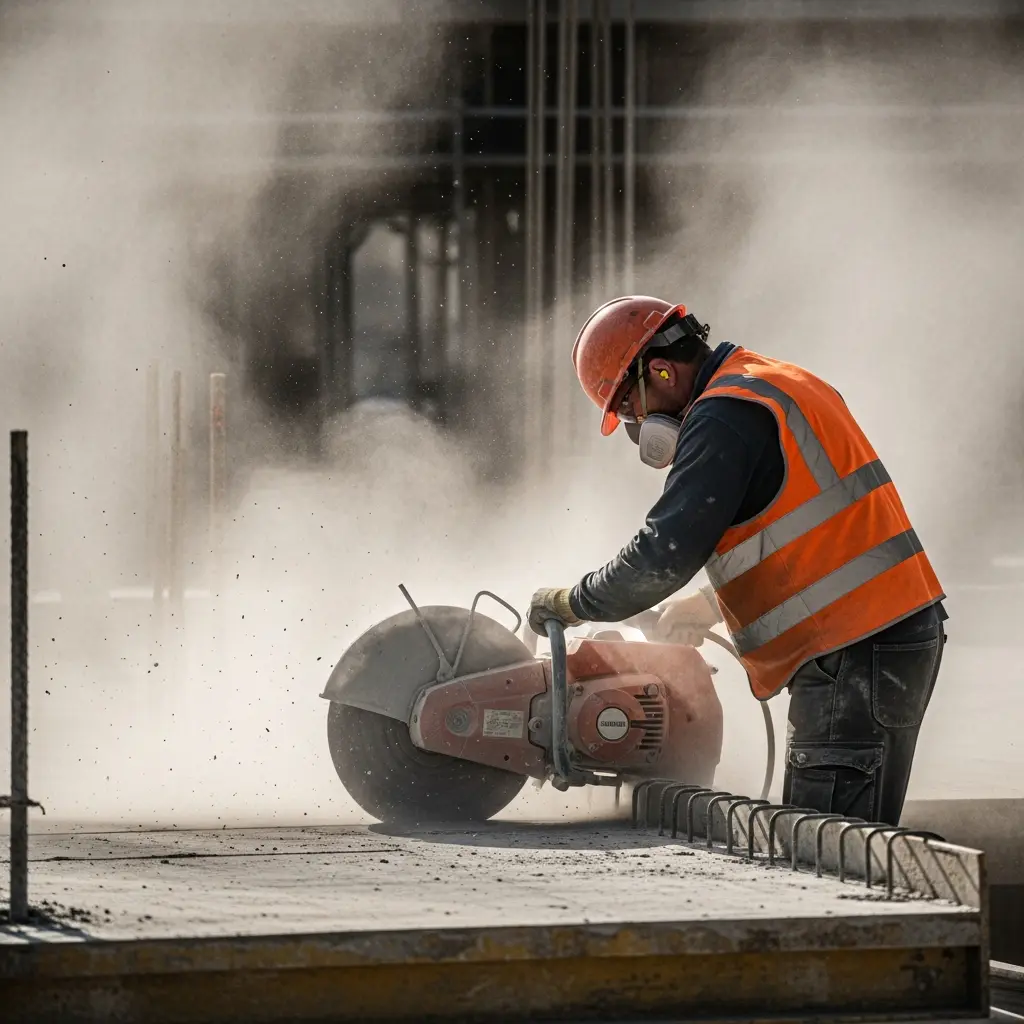
May relate to 29 CFR 1910.252
US welders exposed to fumes
Per serious OSHA air-contaminant violation
OSHA limit for hexavalent chromium (8-hr)
Higher lung-cancer risk for welders
A welding-fume hazard exists whenever arc or gas welding, cutting, brazing, or soldering produces a visible plume of metal oxides without controls to capture it. The specific toxins depend on the base metal, coating, and filler — mild steel gives off iron and manganese oxides, stainless steel releases hexavalent chromium and nickel, and galvanized or painted metal adds zinc and other coatings.
On job sites it shows up as a welder hunched over the work with the plume rising directly past the helmet, welding inside tanks, vessels, or small rooms with no mechanical ventilation, or a shop full of stations with no local exhaust arms. Coatings make it worse: welding on galvanized steel releases zinc oxide that causes metal-fume fever, and welding on painted or solvent-contaminated metal can generate additional toxic gases.
The danger is that welding fume feels tolerable in the moment — a metallic taste, maybe a mild cough — while manganese and hexavalent chromium accumulate toward chronic neurological and cancer risk. That slow, cumulative harm is exactly why capturing the plume and photo-based detection of missing controls matter.
Here is what an OSHA Scan report looks like for welding fume inhalation. It is an illustrative example built from this scenario's hazards — clearly marked, not live scan data.
Compliance score
50
Lower means more potential hazards found
3 potential hazards found
Welding Fume Inhalation
CriticalPossibly related to Welding, cutting, and brazing — general requirements (29 CFR 1910.252)
Observed condition: A welding-fume hazard exists whenever arc or gas welding, cutting, brazing, or soldering produces a visible plume of metal oxides without controls to capture it.
Corrective action: Use local exhaust ventilation or fume-extraction arms positioned near the arc
High confidence
Welding Fume Inhalation: Hexavalent chromium
HighPossibly related to Hexavalent chromium (29 CFR 1910.1026)
Observed condition: Sets a permissible exposure limit of 5 µg/m³ for hexavalent chromium and requires exposure assessment, controls, and medical surveillance — critical for stainless steel welding.
Corrective action: Fit fume-extraction guns for high-volume MIG welding
Medium confidenceNot fully clear from the photo — verify on site.
Welding Fume Inhalation: Respiratory protection
MediumPossibly related to Respiratory protection (29 CFR 1910.134)
Observed condition: Requires a respiratory protection program with proper respirator selection, medical evaluation, and fit testing wherever respirators control welding-fume exposure.
Corrective action: Provide mechanical ventilation for enclosed and confined-space welding
High confidence
High fume exposures cause metal-fume fever with flu-like symptoms, throat and lung irritation, and acute breathing difficulty in enclosed spaces where fumes displace oxygen.
OSHA enforces air-contaminant and hexavalent chromium limits closely. A serious violation exceeds $16,000, willful or repeat violations top $165,000, and long-latency disease claims drive high workers' compensation costs.
A fume citation forces exposure assessments, ventilation upgrades, and medical monitoring that interrupt fabrication. Retrofitting local exhaust into an active shop is far costlier than designing it in.
Structural steel, pipe welding, shipbuilding, and stainless fabrication carry the highest fume risk, especially confined-space welding and stainless work that releases hexavalent chromium.
OSHA Scan uses an AI vision model to spot uncontrolled fume exposure. Upload a photo of a welding operation and it identifies the plume rising into the breathing zone, checks for local exhaust ventilation, fume extractors, and respirators, flags confined-space and stainless welding with heightened risk, rates the severity, and cites 29 CFR 1910.252 — in seconds, before the next weld.
Analyze your first photo freeUpload a real job-site photo and OSHA Scan detects visible hazards in seconds — no account needed to run your first scan.
Use the real site or facility name. If you save the scan after signup, it becomes the report name.
Three angles, one deeper scan
Only the wide shot is required — every extra angle gives the AI more places to look.
Required: Set the scene — one wide shot lets the AI sweep the whole area at once
Stand at the entry point and capture corner to corner: floors, ladders, scaffolds, and everyone at work
Drop a job-site photo or walkthrough video
Click to upload, drag & drop, or snap a photo on site. Photos scan free in about 15 seconds — no signup, no card. Video walkthroughs (up to 3 min) run on a free account.
Small habits, sharper scans
Set the scene
Start with context
Fill the frame
2–3 ft for close-ups; keep ladders, cords and workers fully in view.
Capture clearly
Make the frame usable
Light it right
Keep the sun or lights behind you — glare and shadows hide hazards.
Tap to focus
Tap the hazard on screen and hold still one second — blur can't be flagged.
Choose the useful view
Give the AI room to understand
Go landscape
Turn your phone sideways — a wider frame catches more of the scene.
Only upload photos you have permission to use, and avoid images showing personal, customer, or confidential information. Demo photos and results are held privately for up to 48 hours so you can save them to a free account; unclaimed photos are deleted automatically. Results are an AI-assisted preliminary review, not an official OSHA determination.
New: Video walkthrough scans
Record up to 3 minutes of your site — the AI extracts frames and flags every hazard with exact timestamps. Free account required.
Get the best results
Wide shot first
Stand at the entrance and photograph the entire work area so AI sees the full context
Hazard areas
Photograph elevated surfaces, equipment, electrical panels, and anywhere workers are active
Close-ups last
Move in close on anything damaged, missing, or that looks risky — the AI catches more detail
A welder was making repair passes on stainless steel piping inside a partially enclosed process tank. The tank had a single small opening, no mechanical ventilation, and no fume extraction, and the job stretched across most of a shift.
Hexavalent chromium fumes from the stainless welding built up in the confined tank with nowhere to go. The welder wore only a standard welding helmet and no respirator. By afternoon he had a burning throat and difficulty breathing; air sampling later showed hexavalent chromium far above the permissible limit.
A single photo of the setup run through OSHA Scan before the job would have flagged stainless welding in a confined space with no ventilation or respiratory protection as a critical fume hazard, cited the hexavalent chromium and air-contaminant standards, and prompted the crew to add mechanical ventilation, a fume extractor, and a supplied-air respirator before striking an arc.
Stainless welding in confined spaces is one of the highest fume exposures in the trade. Local exhaust or supplied-air respiratory protection is mandatory, not a nicety, whenever the plume cannot escape.
Layered controls, from most to least effective.
Capture or dilute the fume before it reaches the welder's breathing zone.
Plan, monitor, and rotate to keep fume exposure under control.
Protect the airway when ventilation cannot fully clear the plume.
The federal standards this hazard may relate to.
Requires adequate ventilation or local exhaust for welding operations and additional protection for confined spaces and fluxes, coatings, and metals that produce toxic fumes.
Up to $16,550 per serious violation; $165,514 for willful or repeat
Sets a permissible exposure limit of 5 µg/m³ for hexavalent chromium and requires exposure assessment, controls, and medical surveillance — critical for stainless steel welding.
Up to $16,550 per serious violation
Requires a respiratory protection program with proper respirator selection, medical evaluation, and fit testing wherever respirators control welding-fume exposure.
Up to $16,550 per serious violation
If an incident occurs, act fast and in order.
Welders will understand how fumes harm the lungs and nervous system, recognize high-fume conditions, and correctly use local exhaust, ventilation, and respirators to stay below exposure limits.
Train before any welding assignment, refresh annually, and reinforce with a toolbox talk at each new setup using real photos of controlled and uncontrolled fume plumes.
Run these checks to stay ahead of citations.
10 more checklist points are waiting. Register with your email to reveal every item and download the complete OSHA compliance checklist as a printable PDF. Free, and it only takes a few seconds.
Already have an account? Sign in
Welding fumes contain metal oxides such as manganese, iron, zinc, and depending on the metal, hexavalent chromium, nickel, and lead. Manganese is linked to neurological effects, and hexavalent chromium (from stainless steel) is a known carcinogen. Coatings can add additional toxic gases.
You need adequate ventilation or local exhaust whenever fumes can reach the breathing zone. Open outdoor welding on mild steel may rely on general ventilation, but enclosed spaces, stainless steel, coated metals, and prolonged work require local exhaust or fume extraction, and often respirators.
Metal-fume fever is a short-term flu-like illness — fever, chills, muscle aches, and nausea — caused by inhaling freshly formed metal oxides, most often zinc oxide from welding galvanized steel. Symptoms usually pass within a day but signal significant overexposure that should be controlled.
Welding stainless steel releases hexavalent chromium, a carcinogen with a very low OSHA exposure limit of 5 µg/m³. Stainless welding, particularly in confined spaces, often exceeds that limit and requires strong local exhaust or supplied-air respiratory protection.
A standard welding helmet protects the eyes and face from radiation and spatter but does nothing to filter fumes. Fume protection requires ventilation, fume extraction, or a respirator such as a PAPR-integrated helmet or supplied-air system.
Powered air-purifying respirators integrated with the welding helmet are popular for particulate fume protection with good comfort. Confined-space and very high-fume work — especially stainless — often requires a supplied-air respirator. Selection must match the measured exposure level.
Workers exposed to hexavalent chromium above the action level, or wearing respirators for extended periods, require medical surveillance under the applicable OSHA standards. Monitoring helps catch early respiratory or neurological effects before they become disabling.
OSHA Scan detects uncontrolled welding-fume conditions — plumes in the breathing zone, missing local exhaust, and confined-space welding. It flags the hazard and cites 29 CFR 1910.252 so you can add extraction and respiratory protection.
Upload a photo of your welding setup and get instant feedback on fume controls in your exact environment.
Get startedPut our expert welding-fume checklist to work on your next job to stay ahead of citations and disease.
Get startedSee how OSHA Scan fits your fabrication or field-welding operation and get tailored recommendations.
Get startedSee how other shops use OSHA Scan to control welding fumes before they harm their welders.
Get startedReview findings, organize chemical records, and open relevant official resources for your saved locations and work context.
You make the final call. Review, edit, or dismiss any AI-flagged hazard before finalizing your inspection report.
Scan chemical labels or upload legacy MSDS sheets to create structured drafts that support your team's search for and review of current official manufacturer Safety Data Sheets.
Open official OSHA and State Plan guidance, required posters, emergency contacts, and relevant publications for saved locations and work requirements.
OSHA Scan reads a single photo. That makes it fast and easy for anyone on site — but it also means it has real limits. Here's an honest look at both.
Reviewed by OSHA Scan Editorial
Last updated August 29, 2026
This content is produced by the OSHA Scan Editorial team and reviewed with AI assistance. It is general safety information, not legal or compliance advice. OSHA Scan is an independent tool and is not affiliated with, endorsed by, or certified by OSHA or the U.S. Department of Labor.
Start with 5 included AI site scans plus a one-time 10-scan signup bonus — no credit card. Build JHA-ready reports and catch changing conditions sooner.
Start your free trial